In adulthood, a French poet said once, “children abdicate their ecstasy.” Perhaps this is nothing more, and nothing less than the fact that as we grow older we compromise with the many absurdities —obviously cultural, not natural— that constitute the world of social conventions, the errors taken for incontrovertible truths that shape the adult world.
As Marisol Martell has already pointed out, the universe of these Cuban artists is filled with child characters as well as with objects and features from the graphic arts that constantly allude to the world of childhood. In every case, what stands out is a surrealizing vein, not only in the constant use of free association as the axis of a logic of the image that sustains the entire identity of a given style, but also because of a certain dream-like, fantastic tone, connected to a curiously Frenchified kind of humor. Nothing alien to many Cuban artists, coming from a country where the Escuela de Bellas Artes was presided, at its foundation, by a direct disciple of Louis David.
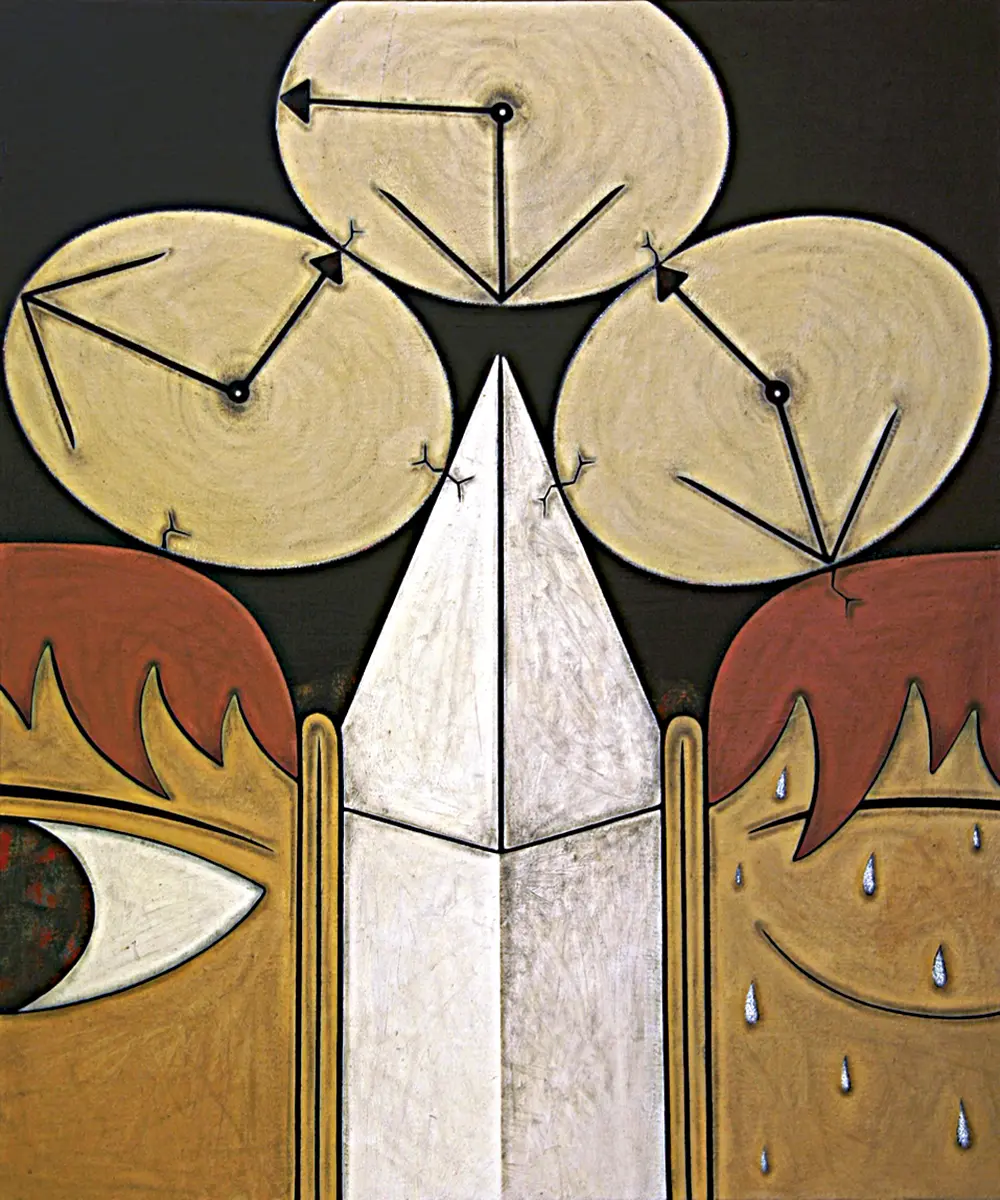
The most significant aspect of Mathew’s images is, however, the fact that the entire iconographic repertoire and even what we can think of as his personal iconology seems to allude, directly or indirectly, to the nature of time. Especially lived time, that psychological or existential time emphasized so intently in Henri Bergson’s philosophy, or, let’s say, Antonio Machado’s poetics. Not the quantifiable time of the clock, but the signifying time of the synchronicities that sustain an individual’s temporality, and also that of the myth. Empezando y terminando, Ciclos, or Tiempo Oportuno are only some of the titles are seen in this exhibition at Lyle O’Reitzel, where Mathew reminds us not only that the temporal flow depends, as Einstein new, on the concrete the position occupied by the viewer, but that it marks the “quality” of lived time and its immeasurable openness towards the a-temporal world of language, which fixes meanings and defines essences that transcend the river-like course of history.
In this way, a kind of childhood innocence on the part of the artist is what constitutes his lucidity, and the possibility of breaking the utilitarian logic of every day is also the decisive element for the rescue of imaginative freedom, equivalent to spiritual freedom.
The studied simplicity of Mathew’s drawing, his impeccable technique, his compositional schemes are taken from the 1920s or 1930s Surrealism or from early Cubism, in small-format works that infused with an irrefutable sense of humor remind us of the most characteristic features of the European avant-garde in the first half of the Twentieth Century, give Leonel Mathew’s painting a vaguely arcaicizing and, paradoxically, very contemporary tone, in that it reasserts the currency, today, of two-dimensional expressive languages.
LAURA GIL