
The experience of visiting Magdalena Fernández’s recent exhibition at the Museo de Arte Contemporáneo de Caracas was nothing short of captivating. Nature and technology converged in a darkened space, as flickering images from videos projected on the floors and walls, the only sources of light, coexisted with strange jungle sounds alternating between irregular croaks and strident squawks. At first disorienting, the exhibition enveloped the senses, engaging the body and the mind.
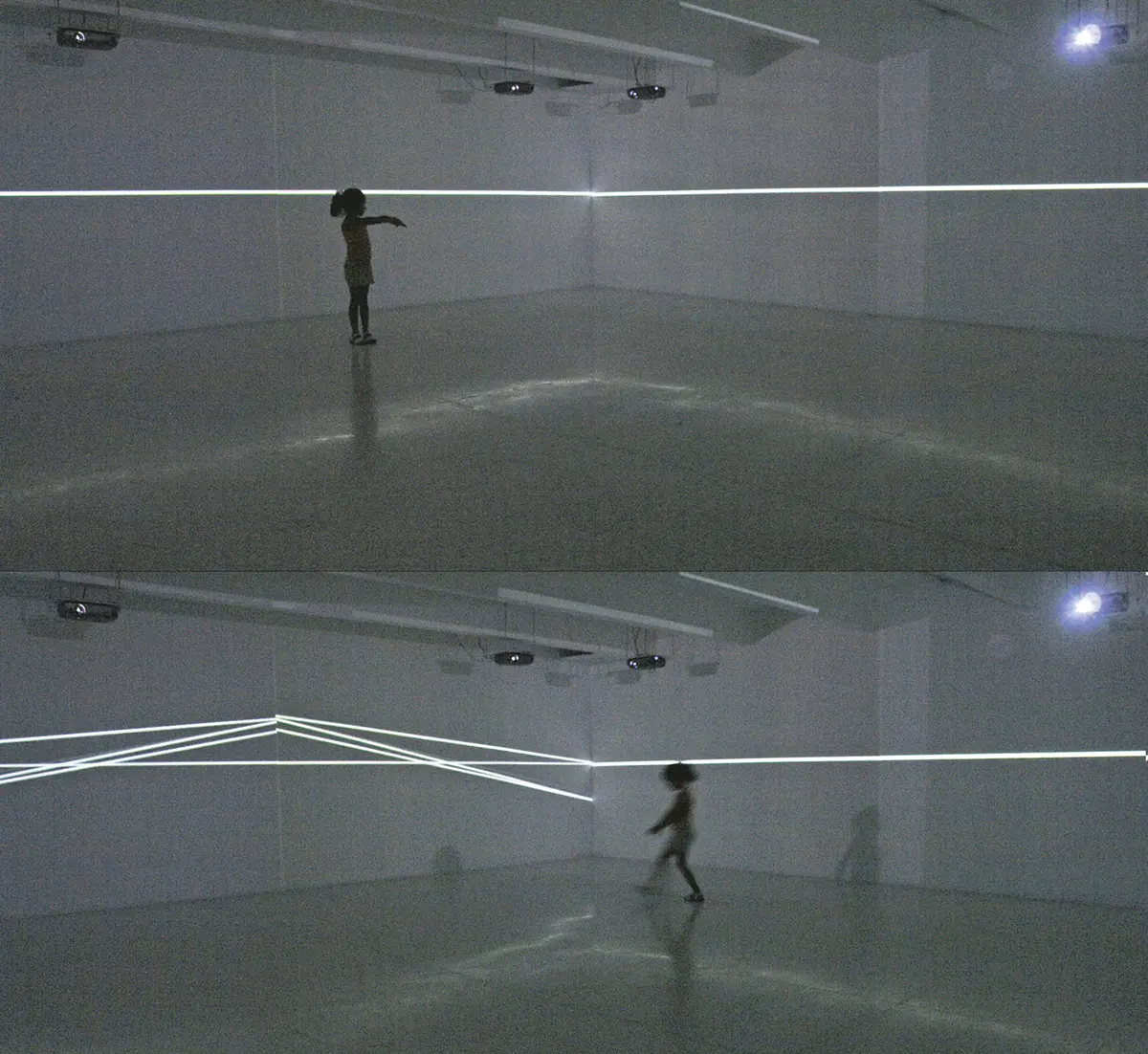
Fernández’s work builds on the legacy of geometric abstraction and kinetic art in new and unexpected ways. Her visual vocabulary consists of simple geometric forms, such as circles, squares, and grids, which come to life through organic movements, as in the video series Mobile Drawings and Mobile Paintings. In one instance, the viewer looked down at the floor to see a white square of light, whose sharp edges began to blur as a ripple effect overtook them. The experience was at once vertiginous, as though the ground had suddenly become water, and hypnotic. Another video, placed alongside it, was simply the white frame of the square, with darkness around it defining the inner and outer limits and whose undulations created a similar dichotomy between form and formlessness. The experience of these works was not only visual and corporeal but also auditory because it could not be dissociated from shrill sounds that emerged from an adjacent gallery. The movements of the squares seemed to follow the irregular patterning of the noise of the light installation Eleutherodactylus coqui (2006), whose title refers to a species of frog that has a particularly loud croak. The piece consisted of a large darkened room with a white line of light outlining the perimeter and an audio track of the frog’s call. The lines would angle themselves up or down at random intervals along the four walls, but their movements did not always appear to match the sounds. Viewers were forced into active participation as they attempted to track the motion of the lines and to connect the visual and auditory experiences. The unpredictable nature of the work, however, confounded expectations; try as one may, it was impossible to guess which of the lines would change from static to dynamic.
Another notable interactive work consisted of a video projection of an aqueous surface onto the floor. Its dimensions were large enough to prohibit passive contemplation; to experience the piece was to immerse one’s self within. Once inside, the gentle motions of the blue surface created a calming effect, much like floating. On a formal level, the work did not allude so much to geometric abstraction as to impressionism. Its all-encompassing nature recalled Monet’s Water Lilies, which shift the experience of painting from the retinal to the corporeal.
Also referencing the history of art was a series of monochromatic videos screened on a sequence of television monitors. They included basic shapes, among them a grid, horizontal lines, a black circle, a white circle, a black square, and a white square, which rippled and undulated like the surface of the water. Though similar in concept, the visual experience was altogether different for each piece due to the variations in form. Whereas the square maintained its integrity as a bounded figure, the horizontal lines dissolved like so many reflections on a current. Because of their placement on the wall, these videos demanded to be viewed as paintings, along a vertical axis. Indeed, this series offered a profound reflection on the legacy of geometric abstraction, recalling Malevich’s Black Square (1913) or White on White (1918), or Lygia Clark’s Egg (1958), a black circular painting with an interrupted white border. The grid itself brought to mind the work of Mondrian and, closer to Fernández’s frame of reference, Gego, as well as alluding to more traditional approaches to painting (the grid is the primary tool for perspectival mapping). Often appropriations are marked with irony, but that was not the case with this body of work, which meditates on the relationship between geometric abstraction and its spiritual (as in the work of Malevich and Mondrian) and phenomenological (as in the work of Clark and Gego) dimensions. By reconciling the geometric and the organic, Fernández’s videos further the long-standing search for divinity within the mathematical patterns of the natural world. They also argue for the fundamental connection between the eye and the body as integral to human experience, countering the conventional notion, expressed most famously by Clement Greenberg, that the art of painting only engages sight.
In addition to the videos, which made up the bulk of the exhibition, Fernández presented two kinetic environments constituted primarily of lights. One was astonishing for its utter simplicity: a penetrable formed by small light bulbs positioned on the ends of rubber cables. The feeling of walking within was magical, like being above the stars. The other consisted of a room with an angled ceiling from which little holes projected dancing reflective beams on the floor below. Simple and beautiful, it recalled the experience of being a child and realizing that you cannot capture light.
The work of Magdalena Fernández updates the legacy of geometric abstraction for the 21st century and convincingly argues for its continued relevance. Despite its reliance on a technological medium, it nevertheless approximates nature in a completely novel way. In an age characterized by the image saturation of mass media, the exhibition provided unanticipated sensory stimuli and also offered a respite from the over-politicized environment of Caracas.
TATIANA FLORES