
Territorios en trance is suggestive. Evocative, and equally poetic title of Brazilian photographer Mario Cravo Neto’s most recent exhibition, at the Madrid gallery Fernando Pradilla. This is the artist’s second personal show in this space, after the inauguration in 2004, on the occasion of PhotoEspaña, El ahora eterno. Both gave the Spanish cultural field an opportunity to engage in a dialogue with a proposal that, disregarding the thirst for excessive exoticism and the fashionable fetishization of subjectivity attempts a review of the anthropological legacy left by mestizaje and transculturation to the dazzling, many-layered space of contemporary Brazil.
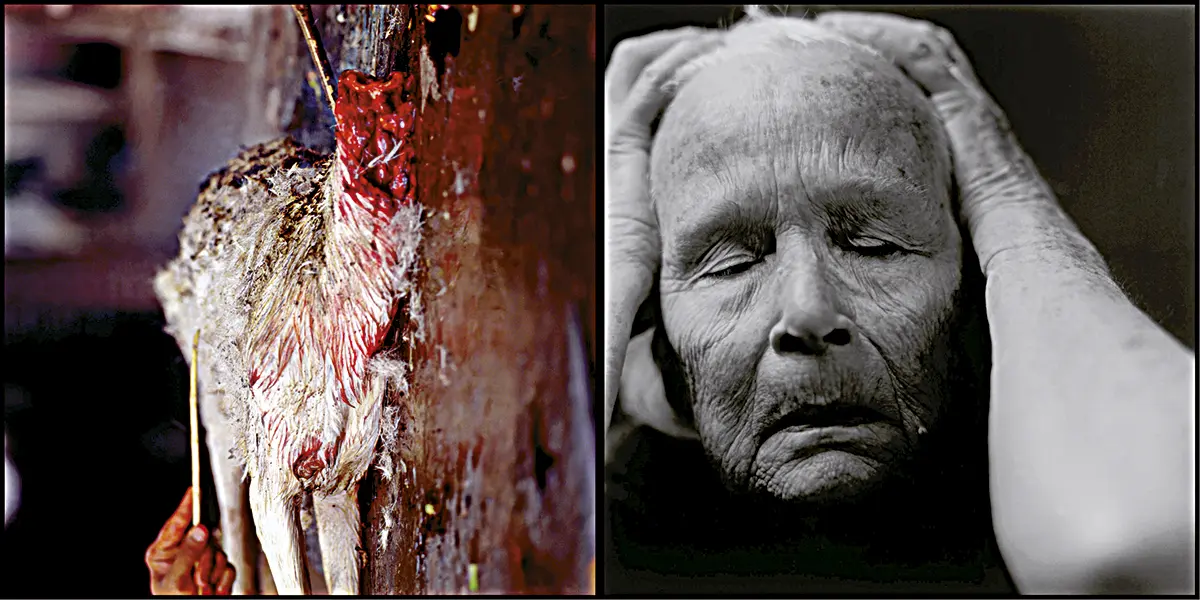
Comprised of seventeen color and black-and-white images, impressive in their execution and with highly seductive qualities, this show is exceedingly beautiful as it is unsettling. The title itself leads the viewer with a warning about the almost liturgical and sacred character of these photographs that are, at the end of the aesthetic journey, a major document of the anthropological. Poetic character of his work, as well as the understanding of the impassioned reconciliation determined by the cultural, ethnic, and racial confluence of the Brazilian Northeast, which is ultimately the referential text used by Cravo Neto for the articulation of his work: the mixture of the traditions of an indigenous population with Portuguese and African cultural legacies introduced during the colonial period. For the photographer who interprets them, these characters, objects and animals contemplate the scarring wounds of their mutual heritage. A brutal game is established here of commitment, belonging, critical gaze, and poetic stasis that gives a new dimension to the value and pertinence of his proposal.
Neto’s photographic narrative possesses several virtues, some already noted by the critics and they have in this exhibition their most eloquent expression. One of them, perhaps a determinant one is above all the sculptural character of his images, their synthetic power, and their repellent sobriety. In his entire oeuvre, including the series now exhibited at Pradilla, the artist is able to trace elaborate palimpsests and transvestite surfaces (which are, at the same time, synthetic, even if that seems like a paradox) where African and Brazilian ritual iconography, but also the Far East and classical mythology, “appear here infused with a negritude that restitutes ancestors of the human genre, ancestors who Cravo Neto brings closer to preexisting matter and to the animal world in a white magic and unconscious memory journey.” This being the case, the photographic proposal is in itself a powerful, vigorous exercise in aesthetic reductionism, entirely unconnected to the reductionism of the opportunistic (and also touristic) view of these syncretic, exuberantly mythologizing universes, where unfavorable prejudice establishes a vertical perspective in which the other is always seen as the barbarous, the exotic, the strange, the seductive... In opposition to this kind of discourse of those who practice a gratuitous anthropology and fossilize a reality they barely know, Cravo Neto’s work appears as a serious, bold, and aesthetic exploration, marked with the signs of the peripheral, into a cultural practice in which he himself takes part and of which he is, in a certain way, a potential carrier.
Their stage-directed, almost performative character, very much in tune with the scenification of ritual and mythical practice is another highly symptomatic visual evidence in the works exhibited. The poetics of the gesture and the emphasis on the transcendent pose in these images are languages in themselves, and the objects included serve as elements of a vocabulary that articulate that language and provide many meanings, some times inapprehensible, to the scene in question. In this way, the staging finds a central point in the artist’s photographic discoursing, which has driven some to even talk of a certain histrionism of the photographic act that “brings to mind filmmakers like Glauber Rocha. In his film Antonio das Mortes (1969), Rocha’s aesthetics of artificiality is not opposed to the veracity of the documentary.” Instead, is an alternative way of articulating social, historical, and cultural facts. It is also a way of dissipating the misleading verisimilitude of First-World cinema. For Cravo Neto, his study is the place in which revelation occurs, the place of interpretation and memory. It is also a place where the artist’s inclinations converge and mix: sculpture turns to live, photography acquires texture and depth, actors direct and incarnate. Supports become elements in an installation, objects metamorphose into talismans, optical effects synthesize acoustic features. Cravo Neto’s use of photography as a medium (a transfiguring potion) transports the mind, transforms reality, and translates symbols from text to image, from a datum in the subconscious to a representation of the expressive mind. His work investigates the richness of myths that live in him and perhaps in us.
ANDRÉS ISAAC SANTANA