
Upon entering Throckmorton Fine Art on East 57th Street, one is surrounded by ancient artifacts. A figure of Buddha accepts offerings at the elevator, and inside the gallery, a Chinese scholar’s rock sits next to a Mayan ballgame yoke. With one more step, one is in the landscape of pre-Columbian Peru.
Apart from the rediscovery and championing of his work by Edward Ranney in the mid-1970s, there has been in the last twenty years a substantial amount of international attention paid both editorially and in exhibitions to the work and career of Martín Chambi. Scholars and curators have focused on Chambi as a shining star among the photographers working in Peru during the first half of the twentieth century. Much of the work that has been seen and that has come to be identified with the artist has been his documentary photographs. There are many reasons for this, but the recent show at Throckmorton Fine Art focused on a lesser-known group of images.
Chambi was a remarkable character. His life began in a tiny village on the Puno plateau in the south of Peru. As a young boy, he followed his father to work in the gold mines in the region of Carabaya. There, he first saw a camera in the hands of the mine’s photographer and it was love at first sight. His early technical and professional training took place in Arequipa, in the studio of Max T. Vargas, where the upper-class citizens sat for formal portraits. With this foundation of experience, and acutely artistic eye, and an unwavering dedication to the indigenous population of Peru, Chambi established in 1920 a studio in Cuzco, where he spent the rest of his life.
In the foreword to Martín Chambi: Photographs 1920–1950, published in 1993 by the Smithsonian Institution, Mario Vargas Llosa notes that the status of photography in Peru in the nineteenth and early twentieth centuries had been primarily that of a technical occupation. He asserts that Chambi expanded and pushed that status to the level of an art form. Further, Chambi used his art to methodically record the varied inhabitants of Peru. He was as comfortable with the upper class of Cuzco as with the indigenous population—its intellectuals as well as its farmers—of the country that he deeply loved.
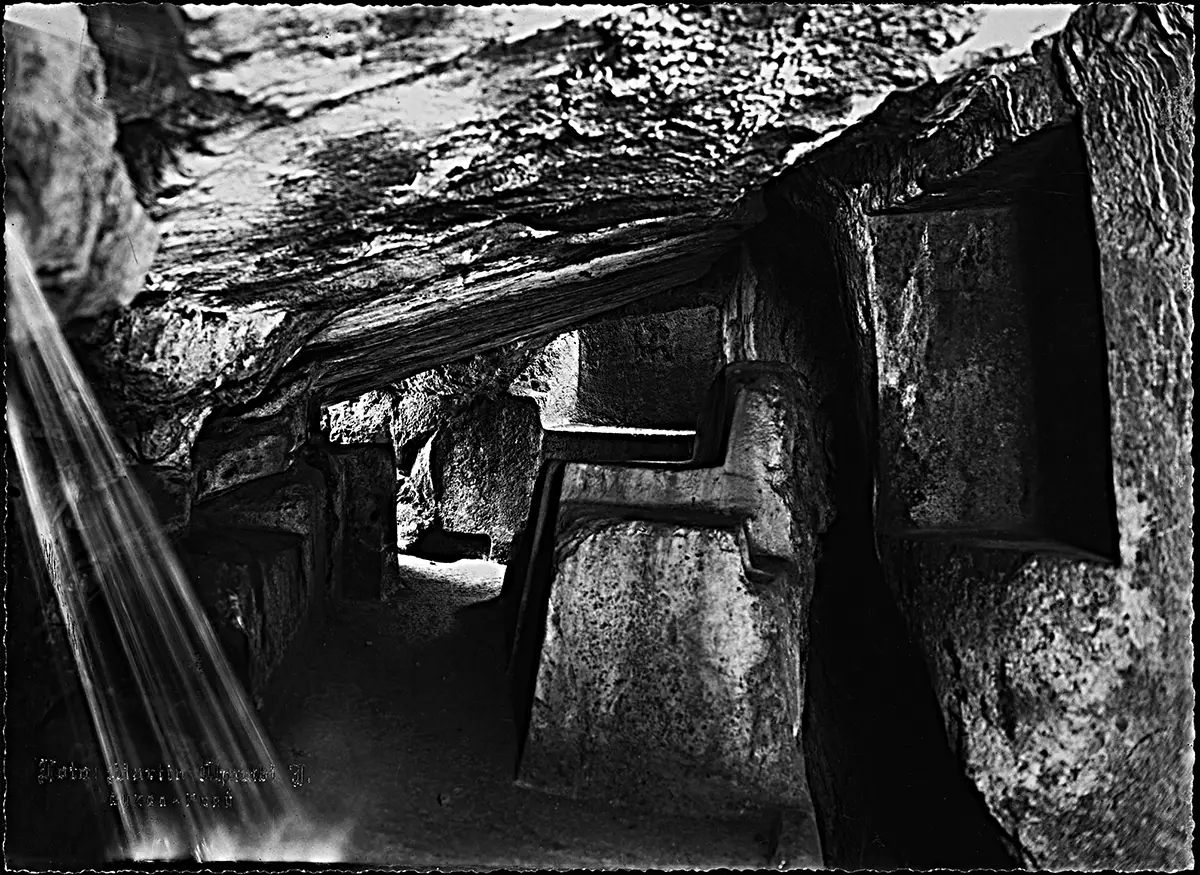
While an artist’s wit and the irony is present in much of Chambi’s better-known work, the recent exhibition concentrated not on the more ubiquitous postcards, the group and formal portraits of his studio, but on his work done in the countryside of Peru. It is in these pictures that the artist’s hand is most evident, perhaps because his hand was very much a part of Peru, of the place itself. For many years, he traveled extensively throughout the country photographing pre-Columbian sites, landscapes, and indigenous communities. In this small exhibition of forty photographs, it was easy to see that Vargas Llosa’s assertion has a great deal of merit. Chambi’s pictures of ruins are almost sculptural. They were shot and framed in a way that produced images that are as concerned with abstraction as being the recorded images of archaeological sites.
Two views of the Ollantaytambo Altar, both from the 1940s, beg to be seen as sculptures. When looking at these pictures, it is hard not to think that they foreshadow Richard Serra’s massive steel installations. In Kenko, Inside Altar from the 1940s, Chambi produced an image that is at once a crystal-clear interior view of a ruin and a work of abstract sculpture. This photograph presents a tour de force of his technical skills, the mastery he commanded of his tools, and his perception of photographs as works of art. These same qualities can be seen in Twelve Point Stone from the 1930s, which reduces an ancient wall to a subtle work of geometric abstraction.
No exhibition of this size could be said to be groundbreaking, but it could be considered seminal insofar as it encourages future, more extensive shows of related works. It was a great complement to the endlessly fascinating and insightful documentary images that Chambi accomplished among the rich and poor of Peru and to his rich, dense landscapes.
CLAYTON KIRKING