
Caos is the title of the recent individual exhibition of works by artist Oscar Oiwa (São Paulo, 1962,) held from October 4th through November 4th at the Thomas Cohn gallery.
The current production of this New York-based Brazilian artist of Japanese ancestry consists of an inch-by-inch struggle with the de-centering, expansion, and mobility of the iconic registers he explores, tom make evident that the exhibition of that same close-quarters fight with painting can become an impassible state.
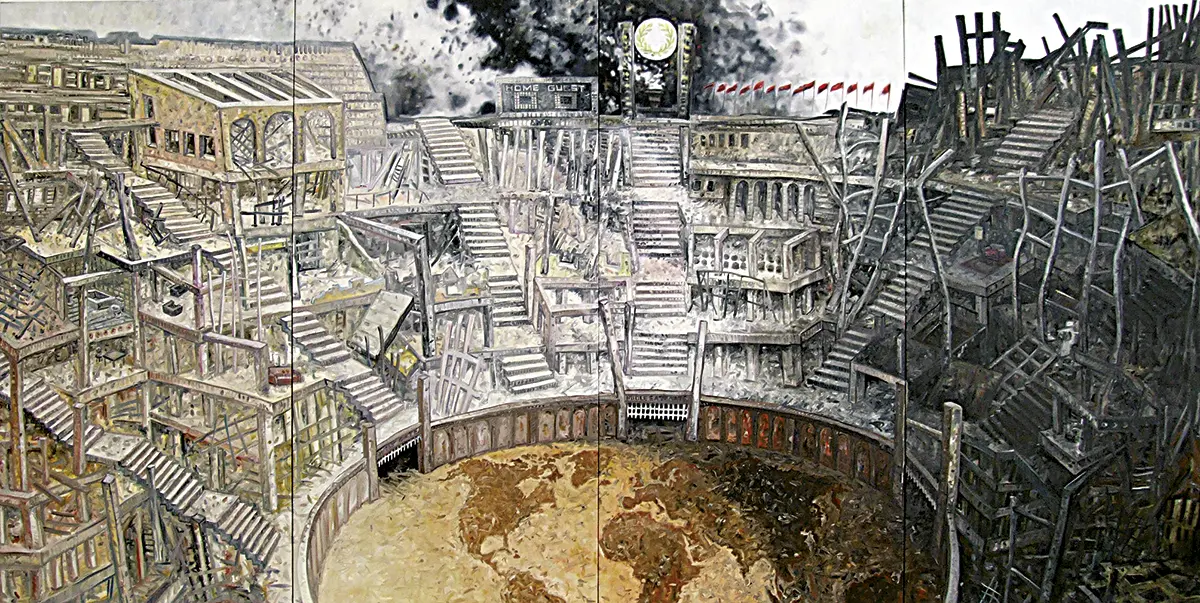
Locating himself, then, in that impassable threshold, Oiwa faces squarely the task of concretizing post-apocalyptic images, this is to say, vedutas or somber panoramas of an “after the aftermath,” which emphasize the concepts of rupture and discontinuity not only historical but also spatial, temporal, and existential, in order to play at “closing” fort himself all the doors of traditional iconic representation. In this way he lets us see the spectacle of painting as artifice, simulacrum, and metafiction, always based however in some kind of documentary referent or historical anchoring, most often taken from photographs of large catastrophes, which paraphrase the history of the Twentieth and Twenty-First centuries, making an inventory of all the discourses of modernity and late-modernity it congregates, ironically declaiming their rhetorics in order to pulverize them afterward and reducing them no nothing. With his great technical mastery, the different possibilities of painting gather together in giant polyptychs placing them within reach of our gaze, in a sum of small deaths and resurrections. His current works bring to the fore the manipulation of opposite tactics, of cris-crossing languages, superimposing the representational function and the character of painting that represents and the painting that subjects itself to judgment constantly. Works like Apartamento, Casa de la Cascada. Corporación, Coliseum, Casa Polar, and Escaleras seem under attack by an essential breakage, a radical fissure that is, without a doubt, an exploration of multi-dimensional space unseen since the pioneering works of Roberto Matta.
With a strong narrative accent, in a paradoxically bathetic and cooled-down climate, by virtue of the use of a “mental,” constrained palette of very low values and white illuminations in certain precise points, and sectorial touches of atmospheric color, Oiwa posits in Caos a kind of parodical and cynical retrospective, revealing the insufficiencies of our own culture in a growingly more globalized world.
This recent corpus can be interpreted as dual back-and-forth strategy, as a form of erudite skepticism, and also of the dismantling of all kinds of logocentrisms.
Based on his education as an architect, the artist breaks into pieces the pictorial convention, substituting the original image with accumulations of traces, technically manipulated through operations of framing, display, reduction, introduction of labyrinthine screens, flattenings, various infiltrations of the image’s photographic condition, hyperrealism, comic-book, with which these portentous paintings are traversed by an ironically and falsely mechanical unreality.
In this way, Oiwa transfers to oil paint, with obsessive meticulousness, photographic collages he builds using cut-outs from newspapers and magazines, as in the case of Apartamento, concerning an ominous first-person present. These are appropriated images that, in their origin, lacked all aesthetic pretension and were there to render an account of a tragic event, such as the 1996 Kobe, Japan, earthquake. We also find here a shaded emotional commitment and the identificatory catharsis with one of his preferred topics: the topic of death and resurrection in an equation that is the wholeness of meaning.
According to the artist, these works “are a portrait of the order that exists within the chaos and the way in which the absurd, transferred to a different context, becomes perfectly acceptable.” Oiwa continues with his reflection about these painting by declaring that “the landscape is a recreation of an old series titled Arquitectura Postmoderna, started right after the Kobe earthquake, where I reconstruct a high-patter dwelling, with Le Corbusier sofas, Italian marble checkerboard floors, plasma TV, and a Porsche in a garage with no exit.”
The descriptive and hermeneutic temptation plays sarcastically here with the traps of style, with the specific weight of the tradition of art, subverting the iconographic contents he chooses to represent. His gigantic oleographs are pieces of a non-present present, with a dream-like, at time neo-surreal aesthetic proposition where we read the remains of that which is separated by death, time, and the insistence on survival, beyond natural disasters. The forceful gradient of very low grays and blacks, typical of a “profound inside,’ is a form of pictorial nihilism. Gerald Richter said it at some point: “The color gray is better qualified than any other to represent nothing at all.”
Oiwa is undoubtedly interested in going beyond the mere visual stratum, the painting’s physicality, moving towards the encounter with gray matter. In some way, the artist exercises in that distance-taking, in that strategy of the Duchampian interval, sacrificing painting’s superfluous conventions in order to warn us of the impossibility of creating an image whose reading is to be unitary.
CLAUDIA LAUDANNO