
In recognition of his contributions to Mexican art throughout a long and prolific career, the exhibition Raúl Anguiano 1915–2006 was presented as a posthumous tribute to this artist. Held in seven galleries at the Antiguo Colegio de San Ildefonso, the exhibition comprised a total of 122 works, including drawings, prints, and paintings, by Anguiano, a founding member of the Taller de Gráfica Popular.
The main interest of this retrospective, which covered the period between 1919 to 2005, was that it offered a new and enriching panoramic view of Anguiano’s production, as it included not only representative works from his different periods but also a sizable number of works held in private national and international collections and previously unknown to the public. This offered viewers the opportunity to approach the Jalisco artist’s universe of form and content and revealed the way he explored paths away from the characteristic indigenous images that made him prominent among the last of the Mexican School painters.
Thus, this anthology, which was on view from May to August, was a revealing tour of Anguiano’s artistic production. Under Beatriz Vidal de Alva’s curatorship, it was organized chronologically and along with various themes. The first section included a series of childhood drawings, like Artista de cine (ca. 1919, pencil on paper), that revealed the artist’s precocious aptitude in this discipline, as well as several works resulting from his study of painting in his native Guadalajara, such as Joven desnudo (1931, oil on canvas) and Cabeza de muchacho (1931, oil on cardboard).
The exhibition continued with the works created after Anguiano’s relocation to Mexico City. The paintings from this period—such as Fundición (1934) and Fábrica (1935), two watercolors on paper—indicate his interest in the urban phenomenon of industrialization and its protagonists, the workers, recreated with monumental strokes.
Anguiano’s support for workers’ and peasants’ struggles, a basic principle of the Taller de Gráfica Popular, is expressed in paintings of explicit social commitment like Manifestación de mujeres indígenas (1937, oil on canvas) and in a group of lithographs that handily capture the people’s wit and cleverness. Two examples are No te arrugues cuero viejo, que te quiero pa’ tambor and Por eso los hacen pandos, porque los montan tiernitos, both from 1939.
Similarly, the everyday life of the working class in the country’s capital was the motivation for the draftsman Anguiano to construct images based on a figurative language of dynamic fluidity and expressionistic undertones. In this group, circus scenes, tents, and bordellos are featured in La madame (1936, gouache on paper) and La carpa (1937, oil on canvas).
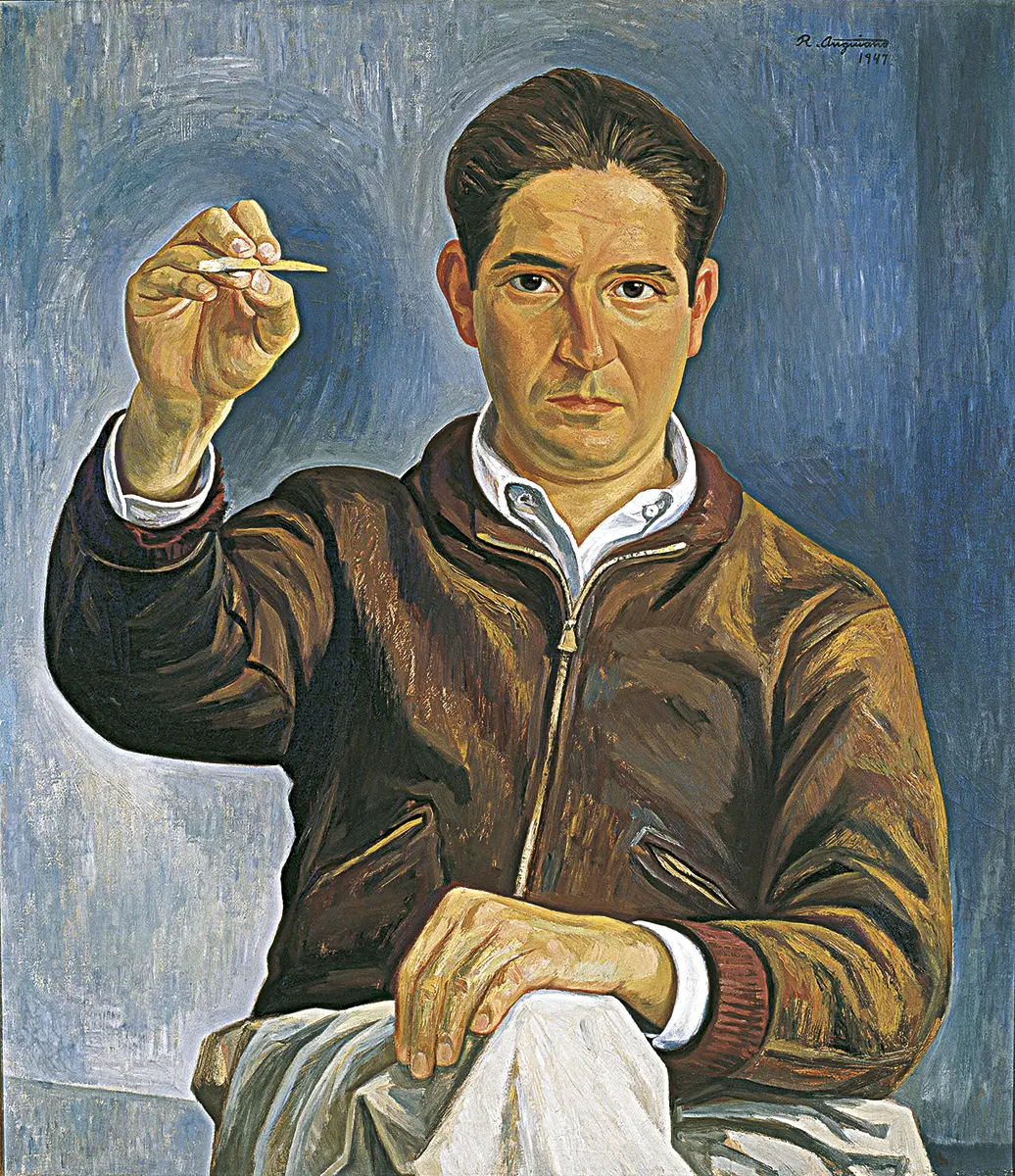
Special attention was given to the paintings gathered under the theme “Portrait: Metaphor of Form” for two reasons: the importance of Anguiano’s work in the context of modern Mexican portraiture and the consistency of his production in this genre. He created many excellent works of portraiture, capturing images of relatives in Flor de pato (1942) and of famous women from the period in Retrato de María Asúnsolo (1942) and Desnudo de Pita Amor (1948–50).
There were also canvases accounting for a different kind of portrait, one that dives deep into the soul of the people—seen in its tragic dimension in Campesino asesinado (1953), it's profound religiosity in Cristo milagroso (1959), or its celebrations in Carnaval de Veracruz (1957).
While these works reveal that Anguiano was not a stranger to the lessons of Expressionism, the exhibition also alluded to the influence of other avant-garde movements, in particular to that of Surrealism, as one could see in two oil paintings on canvas, La llamada del instinto (1942) and Caín (1943).
The exhibition’s two remaining themes dealt with the artist’s best-known work. The first was his incursion into muralism, which he practiced until his last days. In this area, the show included La batalla entre guerreros mayas (1964), a mural painting on wood restored for this occasion, and sketches on paper for murals like El hombre, la palabra y la técnica (1998) and La Creación (2001). The second theme, “Intermezzo with Lacandons,” brought together Anguiano’s emblematic works that refer to the jungle environment, the daily life, and the customs of the Lacandon ethnic group of Chiapas, Mexico. Works in this section included the oil paintings Lacandones asando monos sarahuatos (1950), El matapalo (1951), and La espina (1951), perhaps his best-known work.
From the wide perspective offered by this museographic discourse, the work of Raúl Anguiano emerges as a succession of realistic poetics always conveyed by an accomplished handling of line. While the movement-infused geometric configurations in his murals are continuous in form and content with the postulates of Rivera, Orozco, and Siqueiros, his easel painting reveals a more personal language, one that is liberated from the imperatives of socio-historical content and revels in portraiture with an eloquent classicist sobriety. Lastly, his persistent exploration of paradigms of identity translates into a vigorous aesthetic of the popular and of the indigenous, marked by plasticity at the service of a deep-rooted sense of wonder and celebration.
ARGELIA CASTILLO