
Raul Vasquez has had a long career in contemporary art in Panama, where he has performed a valuable role as a creator, a thinker, and a catalyzing force behind the development of a large group of painters from his region. He was born in 1954 in the legendary Villa de Los Santos, where he still lives today—a small city on the Azuero Peninsula on the Pacific side of the Republic of Panama, an area where the main activities are agriculture and livestock farming and which Vasquez has described as “beautiful, magical, and full of history.”
Vasquez held his first exhibitions in the late seventies and he has held more than a dozen solo shows in Panama and abroad throughout his successful career as a painter. He is an enigmatic and rebellious man whose artistic style stems from being mostly self-taught and from knowledge enriched through copious reading and experimentation with art. Nevertheless, it is worth noting that in high school, Vasquez was a friend and student of the Panamanian painter Juan Manuel Pérez, who had studied art in Mexico and was later a professor at the School of Fine Arts in Chitré, where he had an important influence on the artists of the Azuero region. Moreover, as a young man, Vasquez had the opportunity to spend several months as a scholarship student in Florence and later in Mexico City. Being a rebel, Vasquez found nothing of interest in the traditional art he saw in Italy, but in Mexico he felt that he “vibrated with the art and the roots of the people.” This connection can be seen in his pictorial language, which is linked with the art of the Amerindian tribes and also with the paintings of Mexican masters such as Francisco Toledo and Rufino Tamayo.
In his creative world, Vasquez feeds on Panamanian traditions, pre-Columbian art, prehistoric drawings, and Australian aboriginal art. His style of painting is also influenced by his practice of Shamanism and a profound interest in the ancestral and spiritual presence of every aspect of nature. He shows a preference for earthy and stone-like tones as well as bright colors, and most of his canvasses are covered with a rough and sandy texture into which he scratches deep lines and forms. In these texture-rich environments, Vasquez incorporates elements from the natural world, sometimes drawn in the most schematic manner, together with signs and symbols like spirals, crosses, arrows, and circles.
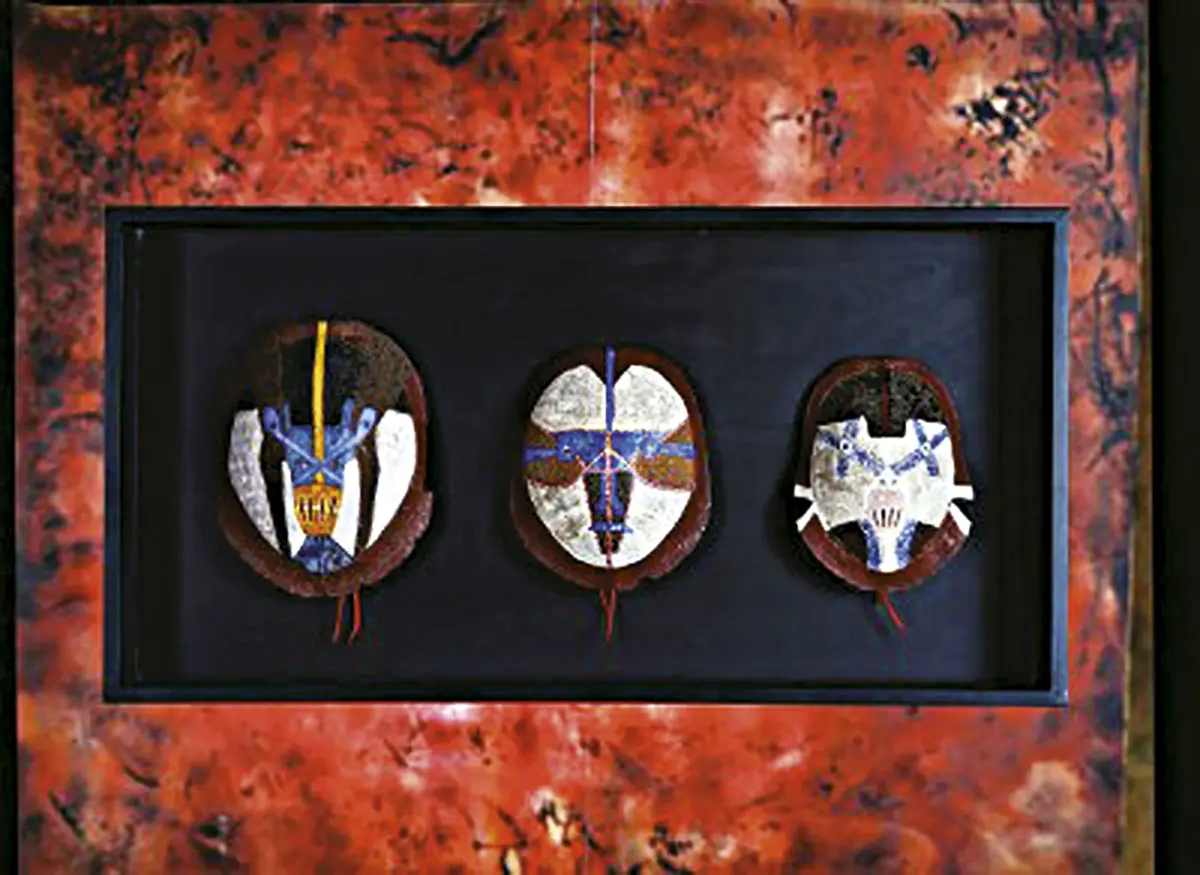
In his most recent works exhibited at Galeria Habitante, Vasquez granted himself the freedom to show unusual objects that resemble talismans, objects with magical meanings that the uninitiated can only begin to decipher. The show included painted coconuts; turtle shells with drawings; an alligator’s skin transformed by the artist; small sculptures of stone, sand, and brick; and woodcarvings with applied mixed media and paint. While it’s true that Vasquez’s work always had shamanistic undertones, every one of the pieces in this exhibition transmitted a strong sense of mystery and primitivism. The visitor witnessed a mature Vasquez who creates objects that seem to come from the soul and who has put aside the traditional canvas, a four-sided object that seems decorative by its very shape. The works in this show spoke of deep beliefs and an essential connection with nature and the cosmos.
With carvings and simple strokes, Vasquez depicted animals such as manta rays, fish, birds, goats, owls, grasshoppers, and ants—all figures with penetrating eyes, the repositories of a primeval force. There were strange characters such as the snake-deer, a green-eyed elf, and sorcerers whose outlines were scratched onto the surface of coconut or an old plank of wood. The objects looked like artifacts, encouraging an anthropological interpretation of the way in which they blended symbolic language and rough craftsmanship. Moreover, Vasquez demonstrated his knowledge of art history in several works, such as his Venus of La Espigadilla, a feminine figure carved on a worn-out piece of wood. La Espigadilla is a place near la Villa de Los Santos; referring to primitive fertility figures discovered in Europe, Vasquez’s sculpture suggested a prehistoric find in the Panamanian soil. The visual impression of Venus and several other works were intensified by the incorporation of iron nails along their perimeters. Even though they might seem superfluous, those rough-hewn nails could be understood as painful symbols of the invasion of the industrial world over the natural world.
Although the catalog includes the reproduction of a dedication signed by the great painter Francisco Toledo, this exhibition revealed work by Vasquez that is furthest from the influence of the Mexican School. In this fully mature stage of his artistic life, Vasquez has created a group of refreshing and genuine works that convey their message in an innocent and primitive language that inevitably touches the spiritual fiber of even the most skeptic viewer.
MÓNICA E. KUPFER