
Several decades ago, a favorite toy among boys and male adolescents was a kit of metal pieces, screws, pulleys, axles, and tools are known as Meccano. At a time when computers and digital games didn’t exist, youngsters spent hours building platforms, vehicles, and mechanical games using a limited number of prefabricated components in appealing colors. The game’s creativity fostered the imagination and the invention of structures that resembled industrial machinery and processes. Manual dexterity and the ability to imagine movements and assemblages joined to provide a degree of satisfaction in the face of challenging complexity.
The era of mechanical play with tangible materials has given way to another one in which textual, iconic, and virtual languages develop skills that are more communicational, less industrial, more interpretive than manual. This change both in our work disciplines and in playful activities reflects the age in which we live, connected by dozens of informational instruments that separate individuals from the experience of the third dimension, the matter and the processes of construction and assemblage characteristic of the Fordist capitalism that began at the turn of the twentieth century.
Ricardo Rendón’s artistic proposal is a return to those not-so-distant constructions of material reality, which, despite the Information Age, continue to be the primary substratum of cities, buildings, and physical spaces. The building trades, which have marked humanity’s development and the development of thought—Freemasonry was a philosophical movement that valued human constructive capacity and considered it a source of guild solidarity—are still forms of labor that, day after day, transform our world by erecting impressive monuments or solving the most basic needs of human beings.
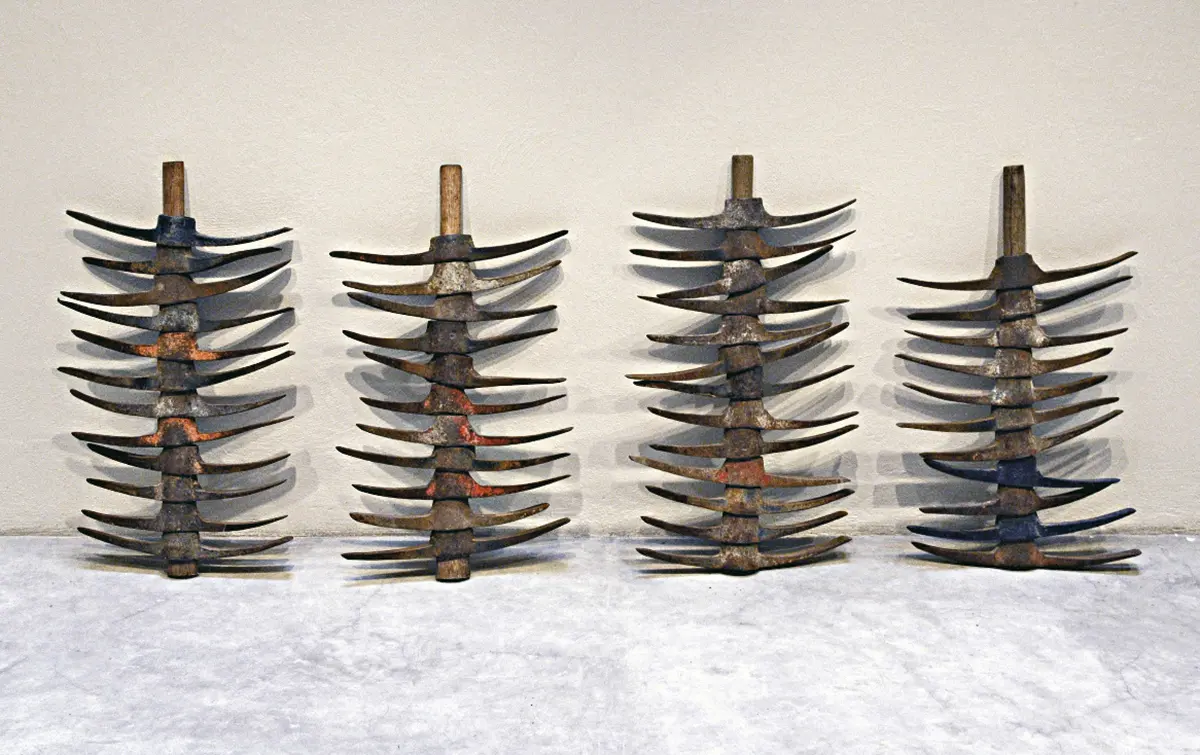
For that reason, and due to a logical progression of his work with objects, Ricardo Rendón has decided to focus his artistic production exclusively on traditional building techniques with the trade’s most characteristic tools—historically the same through the centuries—and the most basic skills. Rendón’s art began as a simple assemblage of debris and material residues in the works he made after finishing his studies at La Esmeralda a few years ago. It has developed to include two variants: assemblages that create a syntax of well-balanced forms, such as a metal pickaxe joined to a wooden handle that resembles a natural formation like the agave plant, or residual materials elegantly gathered into solid forms, such as three acrylic cubes containing wood shavings or fragments of various materials, like plaster and paint chips.
Rendón’s work is a meditation on the manual and the tradecraft, which are once again valued by art as a critical reaction to the excessively virtual, electronic forms of expression and as a re-thinking of craft, so dear to the creation of modern art. In his recent exhibition, the artist, who has devoted himself to learning the construction trade and is perfectly capable of dry-walling a house, transformed one of the gallery’s walls with a well-applied layer of gray cement. It was frankly very appealing as an example of craft and entirely inexpressive.
One can say that the work remains a demonstration of the potential of the material and its handling, a way of redefining art as pure technique. Rendón, like the Meccano player is an example of homo ludens, experimenting with matter and form to gather the knowledge involved in a given practice without symbolic features, which brings his work close to the minimalist aesthetics of Carl André’s or Richard Serra’s sculptures. The difference is that, in his work, the hand and the tool demonstrate the ingenuity and the aestheticism of manual labor.
JOSÉ MANUEL SPRINGER