
The Last Photograph is the first individual show of works by the renowned Brazilian artist Rosângela Rennó (Belo Horizonte, 1962) at Vermelho gallery. It recovers a constellation of photographic metaphors and thick references to the “object,” the “motif,” the “framing,” the “pose,” the “register,” i.e. indicators of the pure analogy of the “medium of the fleeting instant.” In that sense, for Rennó the photographic language is much more than the imperative desire to stop the fleetingness of the moment, ripping it away from the inescapable flow of duration, with the purpose of fixing it in a kind of provisional eternity. Her work incises on the territory defined by the use of a photography that is more mental than empirical, considering, first, it's own body and status, as though it were an ultra-sensible plaque of the highest complexity, destined to hold analog and/or intervened images in the laboratory of our involuntary memory. For this reason, in The Last Photograph, the former medium of the fleeting instant becomes a forceful catalyst and condenser of latent, subsumed content; it is never an end but a means, in which what matters most are the open processes that unfold, rather than the final results. In this way, the show proposes an ever-broader heterogeneity in the extension of the concept “contemporary photography,” placing the emphasis not merely on the mimetic activity but, above all, on resources such as transvestism, collage, the use of monochrome, camouflage, the mask, elements all that mark the already labile borders of the I and of Otherness, in terms of the problem of perspectival categorization. It is important to highlight in this proposal, then, the non-transparency of the image, its inventive complexity, increasingly more hybrid and dynamic.
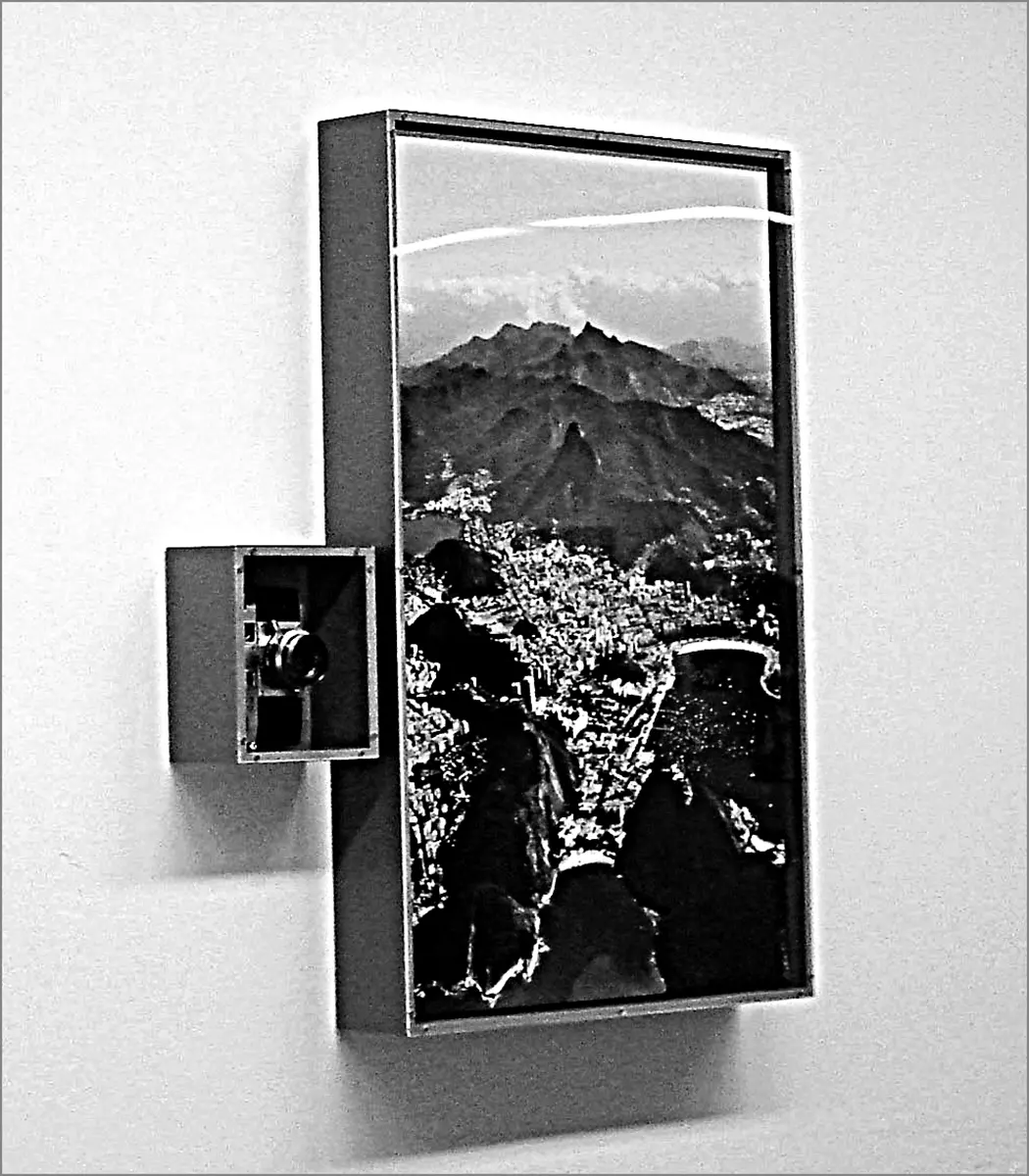
The fieldwork proposed by Rennó in The Last Photograph consists of an analysis of the progressive disappearance of positivist, analog, and documentary photography, and its substitution by “post-photography,” be it digitalized, intervened, or touched by the artifice of Photoshop, with its new supports, printing techniques, and montage. This implies ending the certainty of the visible, fully “readable” image and the myth of the “innocent eye.”
Thus, the first stage in this arduous process of research began with Rennó’s invitation to 42 photographers to participate in this collective exhibition. Then each one of them chose a photographic machine from the artist’s collection, acquired over time in flea markets or through donations and gifts. This implies that each “photographist” became a co-creator of the show. And in a third instance, already with their devices, the 42 photographers produced black and white or color images of two iconographic motifs that have become icons of Rio de Janeiro: the Sugarloaf Christ and the Corcovado hill. After her colleagues had produced their photographs, Rennó selected the first work. A posteriori, in an almost ritual act, she proceeded to seal with ink the lenses of the cameras used. Each sealed camera and its “last image” captured comprise, then, a group of 43 diptychs, including the one by Rennó herself.
The 43 cameras used were also exhibited in this sort of work-in-progress, as veritable ready-mades, given that Rennó disfunctionalized them from their original utility, or “trust,” by sealing the lenses.
Regarding the selection of the two iconographic themes, it is important to note that while the Corcovado is unproblematic in terms of its copyright, there is an issue with the Christ image, and a complex one, because it belongs to the Rio de Janeiro Archdiocese. This means that as an icon it can be represented, but not reproduced ad infinitum. This is because the authors of this giant statuary work, Heitor da Silva Costa, Paul Landowski and Carlos Oswald, indirectly ceded their rights to the Archdiocese.
In the roster of works on exhibit, some standouts are the works of Rafael Assef, Rochelle Costi, Eduardo Brandao, Paula Trope, Vicente de Mello, Matheus Rocha Pitta, Odires Mlaszho, and Edouard Fraipont.
In the majority of the photographs exhibited, the subject is the hidden face of perception. Indeed, perception is approached after the perceived object, so that its subjective and inter-subjective dimension appears often as an epiphenomenon. Thus, with this large-scale show, Rennó suggests that we are immersed in an absolute state of the simulation. Simulation, that gigantic and monumental device for the generation of meaning, quality, and discursive efficiency, encompasses all technical, operational, and communicational artifices, to play with the image’s documentary and fictional reality.
It is precise because of that that the photographic object is so enigmatic: it no longer offers itself in its total transparency, but, at any rate, in the horizon of its own vanishing. Tempus fugit.
In The Last Photograph, Rosângela Rennó also sheds light on the current state of the accomplished utopia, with a hefty group of images hyperrealized in that an undefined simulation that is, clearly and simply, post-utopian.
CLAUDIA LAUDANNO