
Alejandro Almanza Pereda (born in 1977, Mexico) is clear about the circumstances of his generation: the only certainty is uncertainty, the danger is increasingly greater, and their presentation can come in a variety of ways. It is through unusual, somewhat neo-70s constructions that the artist confronts the viewer with high-risk situations. His work contains an element of knowingness that danger is not only in what is visible but also, the viewer should be aware, in loosely connected points that one needs to perceive, put together, understand, or guess. What seems to be a threat—unplugged power cords, for example—is only a distraction; the problem is the two tidy rows of bags and boxes with material that, were they ever to come together, would contain the true danger.
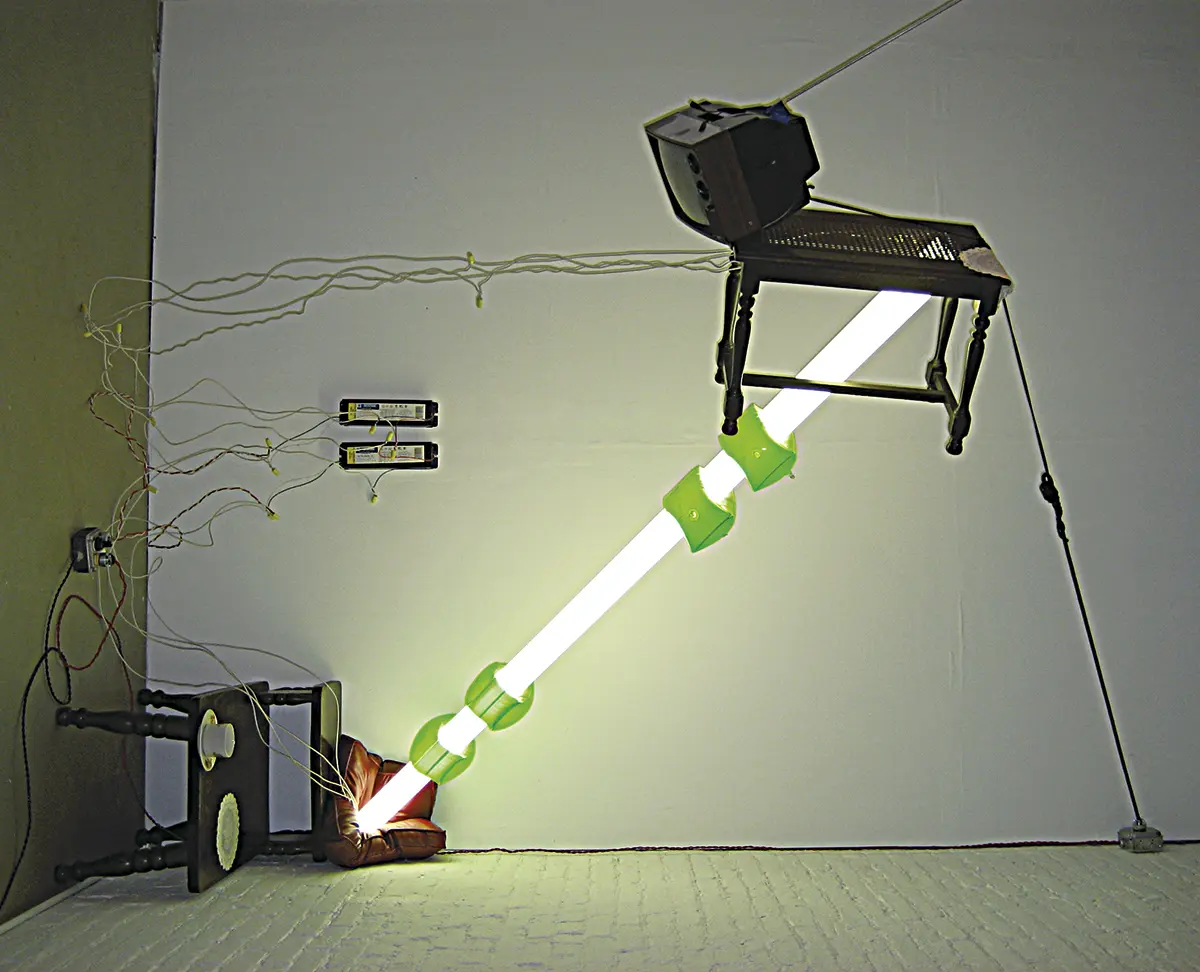
Stand Clear I also indisputably implies that one should remain alert. By “standing clear,” all we solve is the problem of immediate security, but by remaining alert, we pay attention to conditions of a longer duration. Almanza Pereda’s installations are like mementos of contemporary society. His armoires, corners, and ledges come across as warnings. An unstable balance and the evidence of complex risk in formulation and execution constitute the visual structure of the majority of his installations. Normally, people avoid placing any weight against a mirror that is set on glass light tubes. “Normally” is here synonymous with “before”—in another time, sometime before 9/11 and before the tsunami. Who would have used a large neon tube to support a television? In Sin titulo (Mesa), the position of the monitor can be understood as one that makes it possible for a viewer to watch TV while lying down, but there are already solutions for that situation, from the metallic arms found in some hospitals or hotels to a simple ledge on the wall. Evidently, we are not to think that Almanza Pereda’s intent is to watch TV lying down. The monitor is the least important thing; in fact, the monitor is dislocated from its axis and its little table of support by the potentially dangerous large tube. The key is in the balance of the fragile supporting the weighty—i.e., the fragile human beings must support the state of alertness and risk.
How long can these acutely unstable balances be supported, either those created by the artist or those created by humanity? In the case of Almanza Pereda’s works, the artist can allude to something semi-ephemeral and transform the installation into something more lasting. This situation makes more evident the fact that what matters in his work is an aesthetic of signs. The work can have its life guaranteed, with the proper construction and partial or complete replacements if necessary. Humans can create the proper construction or protection for themselves and can have partial replacements, but they don’t have the option of a complete replacement. Regarding the constant of the visible cables, the emphasis is on the temporary. Can we truly believe that watching the war live on TV leaves us untouched because we are far away? The realm of the airwaves does have an effect. Nothing is just virtual anymore; everything leaves its mark, even aggressive virtual games.
As more mementos, reinforcing the idea of what is there for a brief lapse, Almanza Pereda’s photographs are not the usual aesthetic objects. In their presentation and in the space they refer to, these photographs pay attention to the passage of a fleeting event, to something registered from certain anonymity.
The artist studied and now resides in the U.S., and this is his first individual show. Amidst car repair shops and bodegas in Chelsea, there are the most sophisticated commercial art spaces. Through one of the gallery’s two street-level windows, we see a thick cement block supported by large light tubes, with orange-colored filaments that are connected even during the day (the world is always in danger). The second window hides the rest of the installations behind its curtains. Once inside, the small, compartmentalized environment produces the same double-edged sensation that characterizes Almanza Pereda’s works: theatricality and warning. Here, the artist assumes the Baroque from the standpoint of the present, creating works of extreme tension that can seem to be merely theatrical but are altars to humanity made with materials from this earthly life.
GRACIELA KARTOFEL