
It is true that, as Fernando Ortiz would have it, “without blacks, Cuba would not be Cuba,” but at the same time, as the popular saying goes, “we Cubans either can’t reach or go past it,” with the result that the black component in Cuban culture has always been overestimated in the context of the cultural mix, with the consequence that a clichéd view of the island has become the norm. Contemporary representations of certain racial and cultural stereotypes are closely related to the kinds of images made popular since the era of slavery. Alexis Esquivel commented on this in Criollo Remix, his recent individual show at Galería Havana Club at the Museo del Ron. His proposal combined the “colonial” and the “postcolonial” in an intelligent discourse that incorporated Cuba’s characteristic sense of humor. He is concerned with the distorted way in which the market negotiates those stereotypes, starting from the fact that Cuba is a country with a precarious economy, where tourism has inevitably become the first export category.
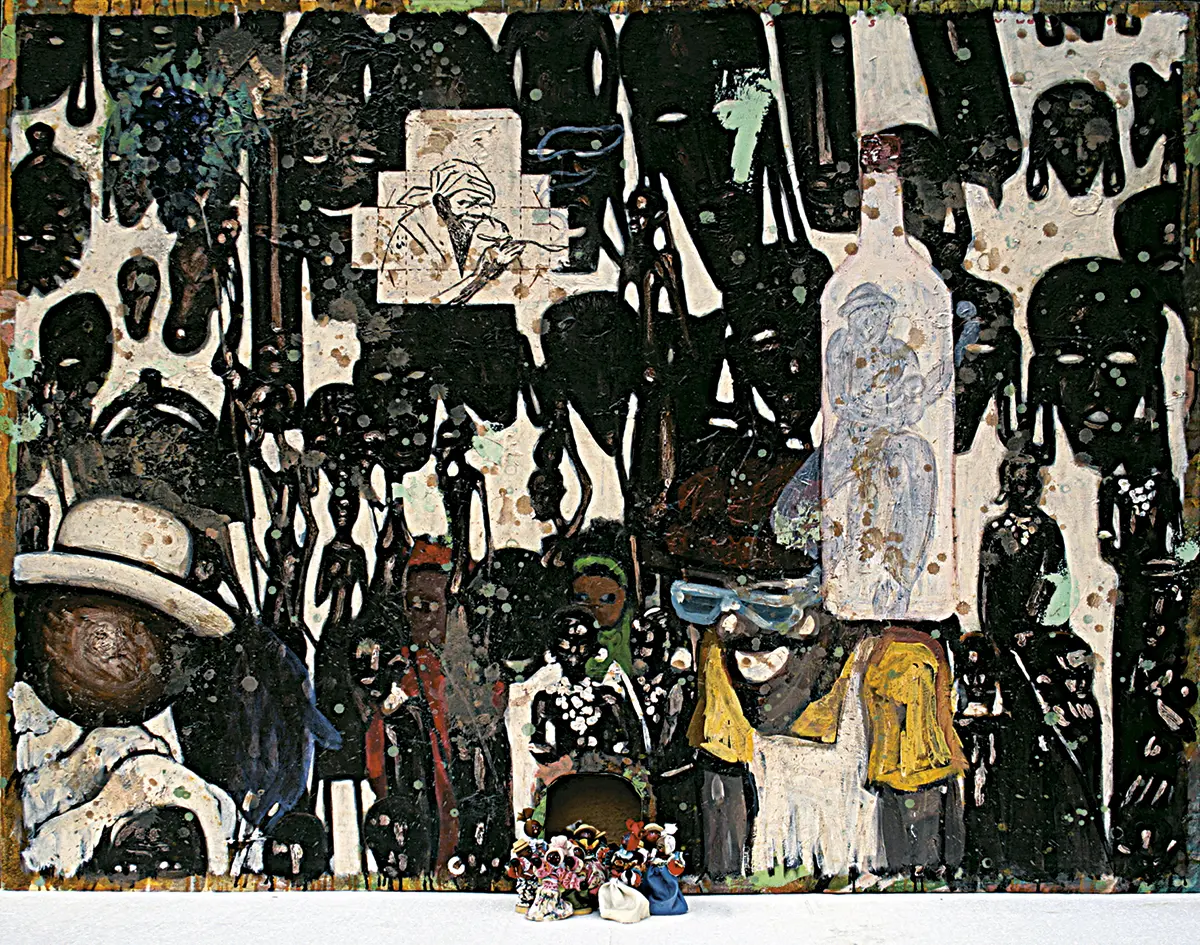
To put together these stories, Esquivel took advantage of the archetypical black figures in commercial handicrafts, so common in any popular market in Cuba, and made them the protagonists of his fifteen works. Two of them were drawings on construction paper and the rest were acrylic paintings on canvas, allowing for a constant ironic play with figures and backgrounds: at times Esquivel covered one layer of pigment with another, at times muddying or veiling the image, as in a perpetual reinvention of narratives. He confesses to enjoying this kind of palimpsest because for him “the real painting goes on top of what has been painted before.” This artist builds stories upon stories, in a commentary of the ways in which national imaginations can be reinvented beyond the ideological, political, and cultural Manichaeanisms used historically by the holders of power in their presentations of Otherness. At times, colonial speakers have needed to “cleanse” their sexuality through the black population and have used black bodes to project the narrative of a sexualized alien to the white race.
Besides being a witty title, Criollo Remix results from the artist’s reinterpretation of twentieth-century experimentalism in art. This was a period when the history of art was re-read and re-inscribed in critical terms that questioned it, from its functions of domination to its probably expressive emptiness, making way for an acceptance of the Other as part of a cultural re-ordering. In “bad painting,” Esquivel finds the most effective way to revise this discourse and reframe the rejection that such an excessive folklorization can provoke. His black male and female characters are executed in “bad form” with dirty colors and emphasize a life mediated by sex, music, and alcohol with a whining tone, given a condition of servitude. It must be pointed out that the way in which Cuban craftsmen interpret this racial group is derived from old slave traditions.
A highlight in Esquivel’s work is its sense of humor, which is often pushed to sarcasm. Works like La celosa de Rodas, ¿Nos gusta la pachanga?, Carnavales del 73, and La concepción del mundo are some examples in which this feature is salient. The first of these works opened the show and alludes to the widely known statue of Apollo, transformed into a female in heat, furiously defensive of her criollo male. For that purpose, she carries on her head a bilongo, a sort of talisman used in Afro-Cuban religious practices to retain a lover.
In recent years, tourism has grown exponentially in Cuba, which has established foreign tastes as criteria for the value that spills over to other realms of Cuban life. Whoever comes from abroad dictates what should be available. What comes from abroad imposes a measurement of quality. Since he must survive at any cost, the average Cuban operates with this mentality; since the tourist decides what is to be bought, the figure of the black is chosen as a fetish. There is an attempt to resolve the tourist’s unsatisfied desire to “traffic” in difference at the level of the visual.
Esquivel has been developing these works, which are as rich in textures as they are in interpretations, for some time. But it wasn’t until recently that he was able to completely mature a discourse that truly hits a nerve regarding the use and abuse of cultural and racial stereotypes, which are often manipulated to political ends. For now, he prefers to use humor, in order to reflect without anguish.
AMALINA BOMNÍN