
Although Alfredo Jaar is one of the most important and represented artists in the international contemporary art scene, his work is still considered controversial. For many years, from long before “political art” became a fashion or an aesthetic category, Jaar was already traveling widely and creating markedly conceptual works with photography, in which he denounced the situations of different peoples living in extreme economic, social, or political conditions. His works about Brazilian miners, Haitian boat people, and the Rwandan genocide is widely known. The controversy over his work has resided not in the issues and situations that he denounces but in the formal resolution of them. He has often been accused of rendering suffering as sterile, and while it is true that Jaar’s works occasionally display a virtuosity that contrasts with the precariousness of the landscapes and characters they record, it is equally true that he has created some of the most politically powerful images in contemporary art: black boxes filled with photographs are forever hidden, with only a written description of the contents; the gradually disappearing image of a black woman, a reminder of the invisibility to which the entire African continent is subjected; or the million slides on a light table multiplying the gaze of Gutete Emerita, the involuntary witness to the massacre of 400 people. These are some of Jaar’s contributions to the debate about the situation of the postcolonial world and its relationship to the developed world. Intriguingly, while impeccably finished and possessing a high aesthetic component, the works described lacked romanticism. The artist witnessed a situation and attempted through his work to give voice to the voiceless, thus creating the ambiguity of his own position regarding the situations he presented.
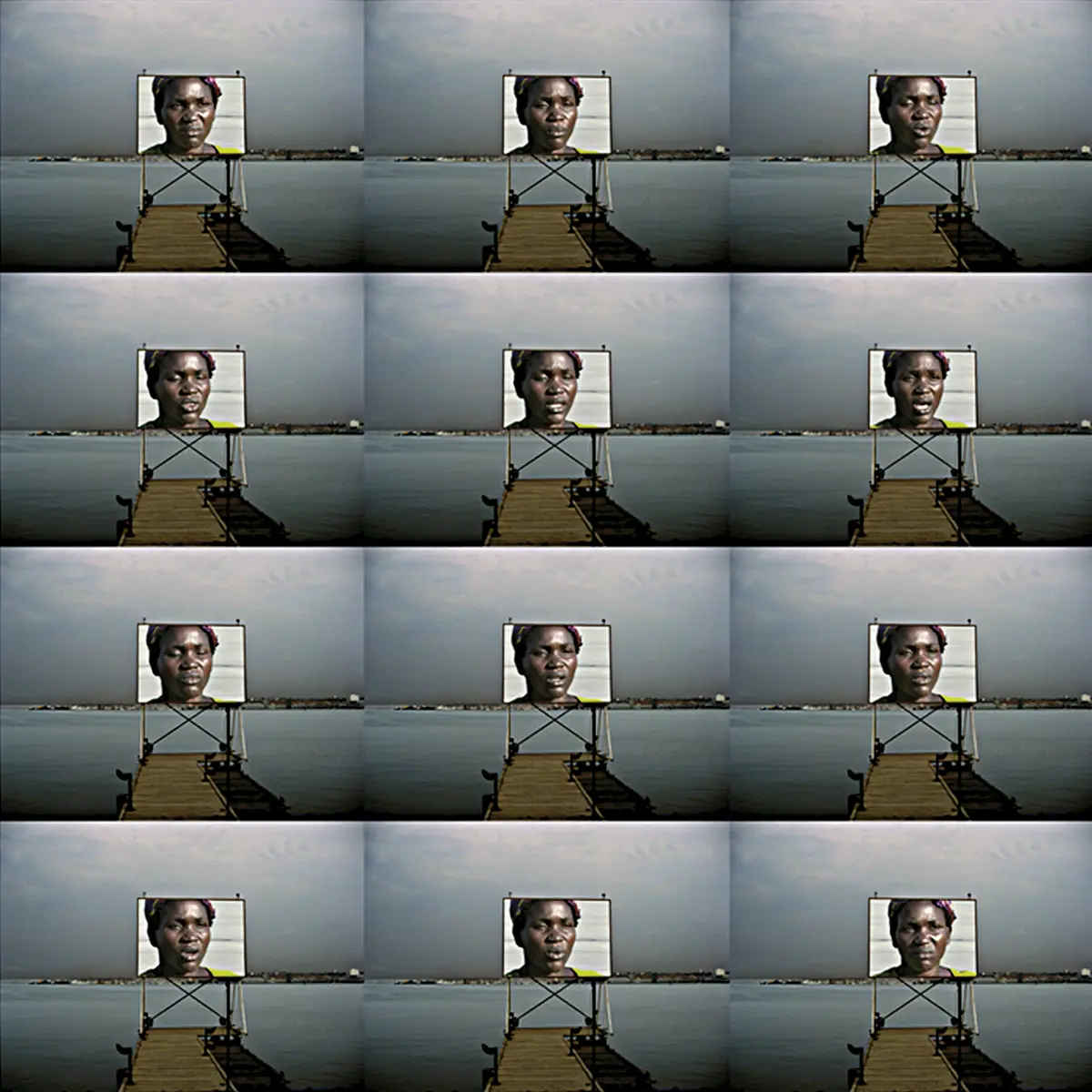
The case of Muxima is radically different. The starting point for this roughly-forty-minute film is Jaar’s personal collection of African music—a passion undoubtedly derived from his many travels—in which he finds various versions of an Angolan song and uses them to guide succession of vignettes that attempt to illuminate an aspect of the political and social context in which each recording was made. Jaar defines it is a visual poem, but his reference to the haiku form is perhaps excessive. The resulting series of vignettes is unevenly forceful but contains a number of memorable images, like the one of an empty open-air theater that serves as a metaphor for a recurring theme in Jaar’s work: the theme of invisibility, the absence of witnesses in some parts of the world. At its best, the film achieves very powerful images, and the role played by the music is indeed essential. In fact, the sheer sonic transformations undergone by the song, from which the title of the film is taken, create a wealth of evocations. A weakness is an ambiguity that Jaar sustains between the documentary gaze and the constructed gaze. The sensation of the found situations is often diluted by the evidence of staged ones. Although Jaar asserts that he didn’t use actors, special effects, or artificial lighting, one nonetheless perceives a certain amount of stage direction, especially in the shots that include characters.
In that sense, Jaar’s filmic construction of movement—unlike his photographs and lightboxes—revives the debate about the subjects and the gaze the artist directs at them. As a matter of fact, the more static, more simple, and thus more powerful its images are, the better the film works. To confirm this assessment, it is enough to contemplate the lightboxes and photographs also exhibited in the gallery; all of them demand attention and are excellent images focused on the drama, the beauty, and the current social and economic situation of Angola. The photographs carry forward the veneer of denunciation one expects from this artist, albeit with less grief and greater resignation—or, better yet, with the kind of hope that emphasizes a people’s character over their political and economic situations. In that sense, Muxima is a surprisingly romantic work that evokes above all the gaze of an artist who knows and loves his subject matter is convinced of the beauty and the appeal of what he shows, and is happy to be sharing it.
ISSA Mª BENÍTEZ DUEÑAS