
The title of the recent exhibition at the Kunsthaus Zurich, The Expanded Eye, was so similar to the 1965 MoMA show The Responsive Eye as to seem redundant.1 Furthermore, one wondered what else could be expected from a visual arts event than something for the eye. The Zurich exhibition, however, promptly established its legitimacy as an art historical response to questions raised by the 1965 MoMA show. The earlier exhibition defined the eye as a receptor of physiological stimuli. The Zurich show suggested that vision is much more than that. In fact, one could say that the newer show was the one that should have taken place back in 1965. Its premises were much more acute, interesting, and thorough.
The 1965 show was intent on isolating psycho-mechanical responses of the eye to external stimuli, seeking to elevate these forms into a coherent art movement. In his introduction to the catalog, the curator, William Seitz, did his best to prevent a reduction of “the eye” to an anatomical definition.2 Yet the show itself led viewers in another direction, and the exhibition was quickly dubbed “the Op-art show.” Inadvertently, the MoMA show had the dual effect of prematurely cutting short the development of Pop art, which seemed in that moment to have reached a peak in the art market, and of creating in its place one of the shortest-lived art movements in western art history.3 The artificiality of the project was reflected in the fact that many interesting and important artists were disrespectfully arranged together according to superficial appearances instead of shared philosophies or research problems. The thread linking the works exhibited in the MoMA show was perceptual dazzle. In an ironic twist, visual illusions and tricks from psychology books were made into art icons, using the same means that Pop art had applied to commercial imagery. Op art—ignoring and, in fact, contradicting what the artists were actually pursuing—became a temporary appendix of Pop art, both in the title and in methodology. Confirming this emphasis on the superficial, Bridget Riley’s visually irritating patterns were adopted as the emblem of the show, used for the cover of the catalog, and, more importantly, instantly co-opted for application in the fashion industry as commercial fabric designs.
The goal of instant consumption, reflected in the emphasis on immediate and fleeting sensorial impact, overrode any deeper engagement with creative problems in visual art. An otherwise richly diverse assemblage of artists was homogenized. Piero Dorazio’s hedonistic color plays, Julio Le Parc’s concern with interactivity, Josef Albers’s constructivist speculations, Victor Vasarely’s work on shifts from quantity to quality, Ellsworth Kelly’s search for improbable color balances, Mon Levinson’s experimentation with moiré patterns: all were trivialized by compression into an array of quick and thoughtless sensorial kicks.
The Zurich exhibition revisited the 1965 show in the form of a respectful critique. Some of the artists who participated in the MoMA show were included The Expanded Eye, such as Riley, Vasarely, Le Parc, and Albers. But they have placed in a context both broader and much more thought-provoking. The anchor of this exhibition was definitely its predecessor, The Responsive Eye, a point underscored by the inclusion of a wonderful 24-minute documentary that had been made on the opening night in 1965 by the as yet unknown filmmaker Brian De Palma. From the vantage point of 2006, the 1965 film becomes an anthropological study of the art scene of the time. De Palma built his film chiefly around interviews with William Seitz and the psychologist Rudolf Arnheim. But there are also opinions and comments by selected art-socialites. There are some mini-portraits in fatuousness: among them is Philip Johnson boasting that he bought a Bridget Riley piece before the show was organized and Huntington Hartford plugging a recent book of his. More revealing is Rudolf Arnheim’s description of Op artists as a combination of protest and masochism: “protest” because they seek to subvert conventions in art, and “masochism” because of the labor-intensiveness of the work.
The Expanded Eye was far more ambitious than its predecessor in that it demoted “the eye” and replaced it with “vision,” a much more complex issue. The strength and several virtues of this exhibition could be attributed to this expansion, but so could it's few weaknesses. In general, the show seemed strongest when it stayed closer to the actual eye. Here, the work ranged from interesting vintage Op and retro-Op pieces to expansions are much more concrete than the vague notion of “fusing art and life” of which Bice Curiger, curator of the exhibition, made a point in his introduction to the catalog.4
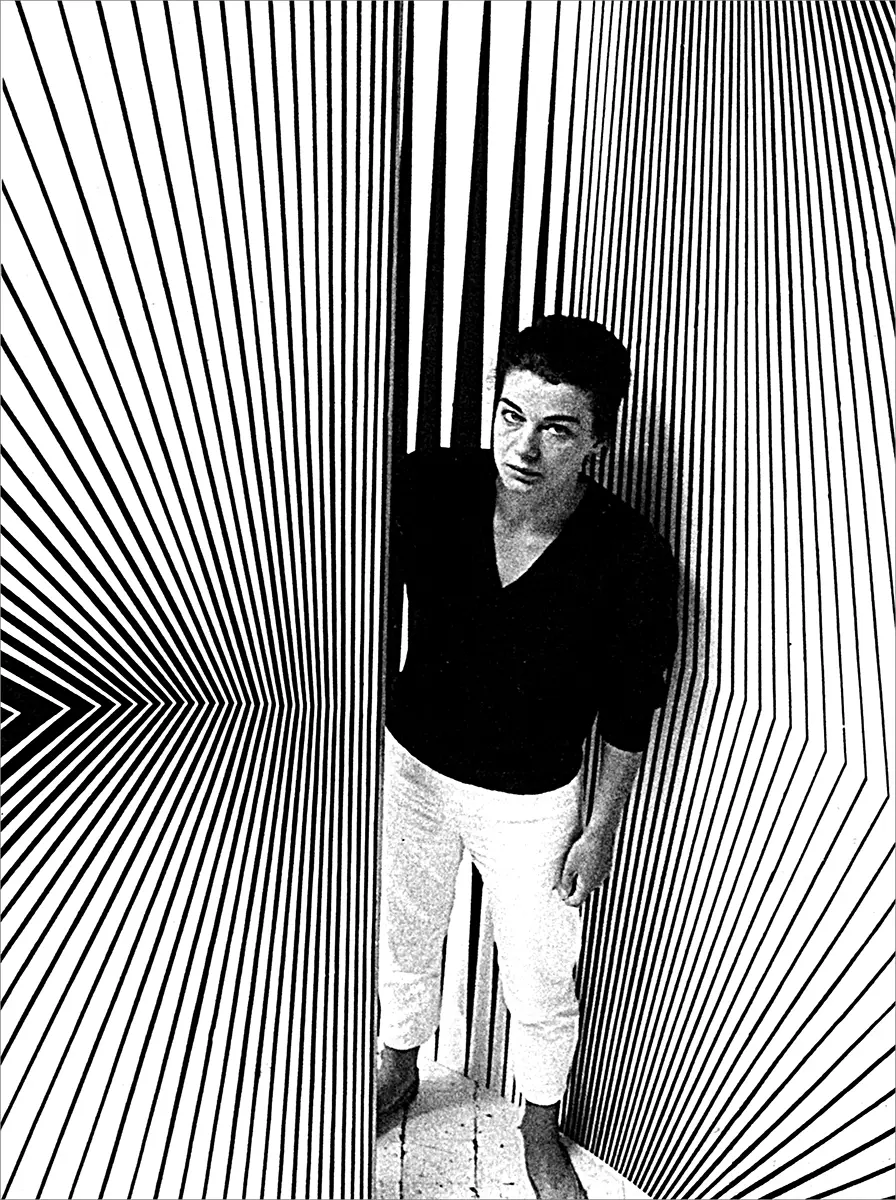
Among the revealing vintage Op-art pieces was Bridget Riley’s Continuum (1963), a spiral environment where the dimensions one walks are alternatively enhanced and contradicted by the patterns on the walls. The most stunning retro-Op piece was Pierre Schwerzmann’s Untitled (2006), a plain striped painting that could have been made forty years ago. The gradation is so incredibly subtle that it gives rise to a powerful sense of being blinded. The effect is so intense that all the Responsive artists whoever attempted this kind of effect would go pale with envy.
Among the “concrete” expansions were two obvious and important issues that were ignored by The Responsive Eye. One is the question of when plain vision crosses over into meditation. The other is the question of the relation of information to vision. Both meditation and information are inseparable from the physiological process and the objectivity of perception becomes debatable because of their integration. Both place perceptual processing in the brain rather than the eye. And both were probably too new, historically, to be picked up by MoMA in 1965. At the time, psychoactive drugs had only recently become the rave; the idea that the brain, rather than the physical mechanisms of the eye, is the actual processor of vision was only just beginning to be studied with the help of new computers. And, too, the field of informatics was still rather esoteric.5 In the Zurich exhibition, there was at least one piece that made interesting connections to both these issues: Brion Gysin’s Dream Machine (1959). Gysin’s piece produces a mild stroboscopic effect using a cardboard cylinder with illuminated cutouts that rotates on a record player.
The Responsive Eye had included one meditative piece, although it probably was chosen for its sensorial irritation. Wojcieck Fangor’s paintings had a strong hypnotic quality, achieved with blurred circles. They seemed out of focus but were placed at a distance where the eye, aided by the edges of the canvas, “knew” that they were in focus. The discrepancy created a sensation of losing oneself in infinity, and yet it was an infinity that advanced toward the viewer and surrounded him. Unfortunately, Fangor was absent from The Expanded Eye, but there were works clearly indebted to him. Anish Kapoor evoked a receding infinity in The Earth (1991), one of his most refreshingly sparse and direct pieces, which consists of a black circle made with his typically saturated pigment. The result is an endlessly deep tunnel that contradicts the knowledge of the actual flatness of the piece. James Turrell’s Acro Red (1968), in contrast, creates a virtual wall with a powerful red-light rectangle, apparently detached from any physical support and denying the corner of the blackened room. These examples of meditative work received interesting support from several “mescaline” drawings from the 1950s by Henri Michaux that seem to play with pseudo-writing in documenting his visions and reactions while on psychedelic trips.
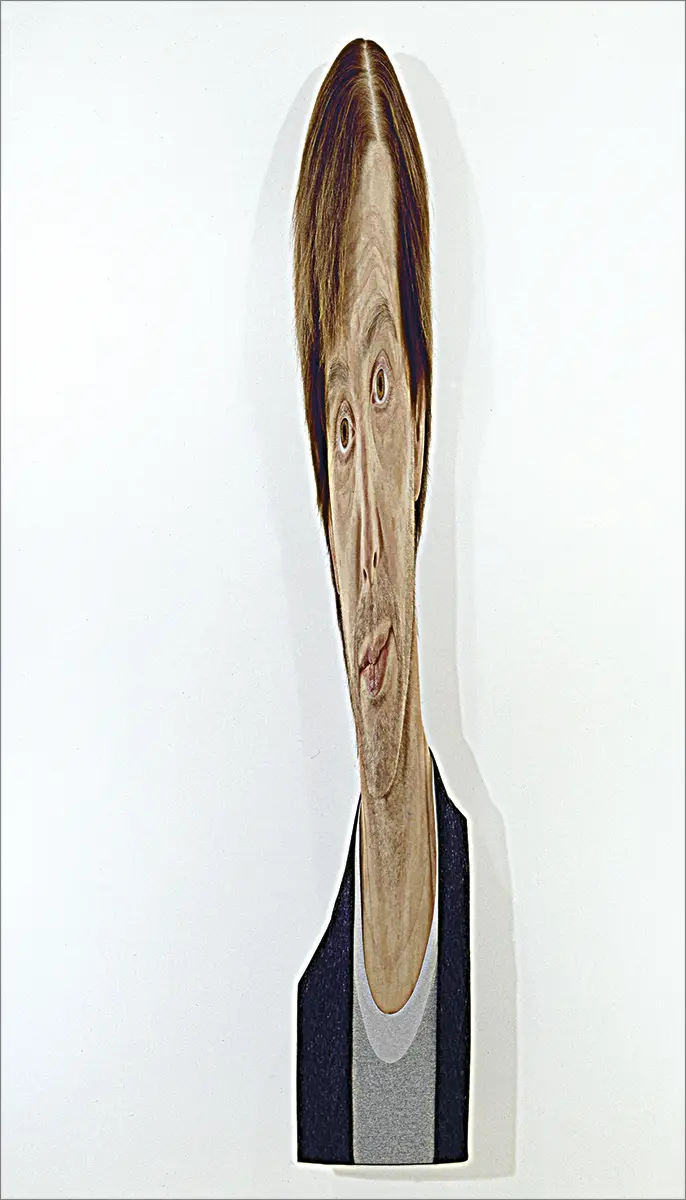
Of work connected to the issue of information, those most worth mentioning are Chuck Close’s Self-Portrait (1977) and Evan Penny’s Madrileño No.2 (2005). Close’s piece is one of his typical works, exploring variations of halftone techniques to create photo-related appearances. Continuous gray images are translated into a yes/no binary system indicated by the presence and absence of dots and their change of size. Halftone was developed to make possible the simulation of grays in a printing technique in which only black ink was used. Changing the size of black dots affects the amount of white space in between them, which convinces the eye viewing the effect from a distance that there are variations of gray, when in fact only black has been used. Close expands on this halftone system by exploring the shape and content of these dots (which often have continuous grays in themselves) in order to create his portraits. Evan Penny, in contrast, adopts a more holistic approach to information. His work, unlike that of Close, cannot be broken down into discrete parts. His hyper-realistic sculptural relief of a face is a compacted distortion that promises the viewer a resolution when he or she moves in front of it, as with anamorphic images. However, the silicon relief, with all its hairs and wrinkles, remains frustratingly distorted no matter where one stands to view it, which reminds one of Fangor’s conundrum, but now in the world of realism. In denying the viewer a point of view, it erases the concept of position.
The word “expanded” in the title of the exhibition was a play on Gene Youngblood’s 1970 book Expanded Cinema, which stood as an early analysis of the experimental cinema of the 1960s.6 In the context of the title, the word announced both technical and conceptual expansion. Curiger correctly interpreted the experimental film of the sixties as a form of expanded vision; he included several films in the show and provided a series of film screenings that allowed for a more inclusive review of the “new cinema” of the decade.
The “moving image” was an obvious and needed inclusion. Many of the original Op art pieces relied on the effect of after-images on the retina and their interplay with present images. Flicker and the dynamics introduced by moiré and lenses are evident as a link with filmmaking, and The Expanded Eye used this wisely by including Marcel Duchamp’s Rotoreliefs (1939) and Gysin’s Dream Machine.
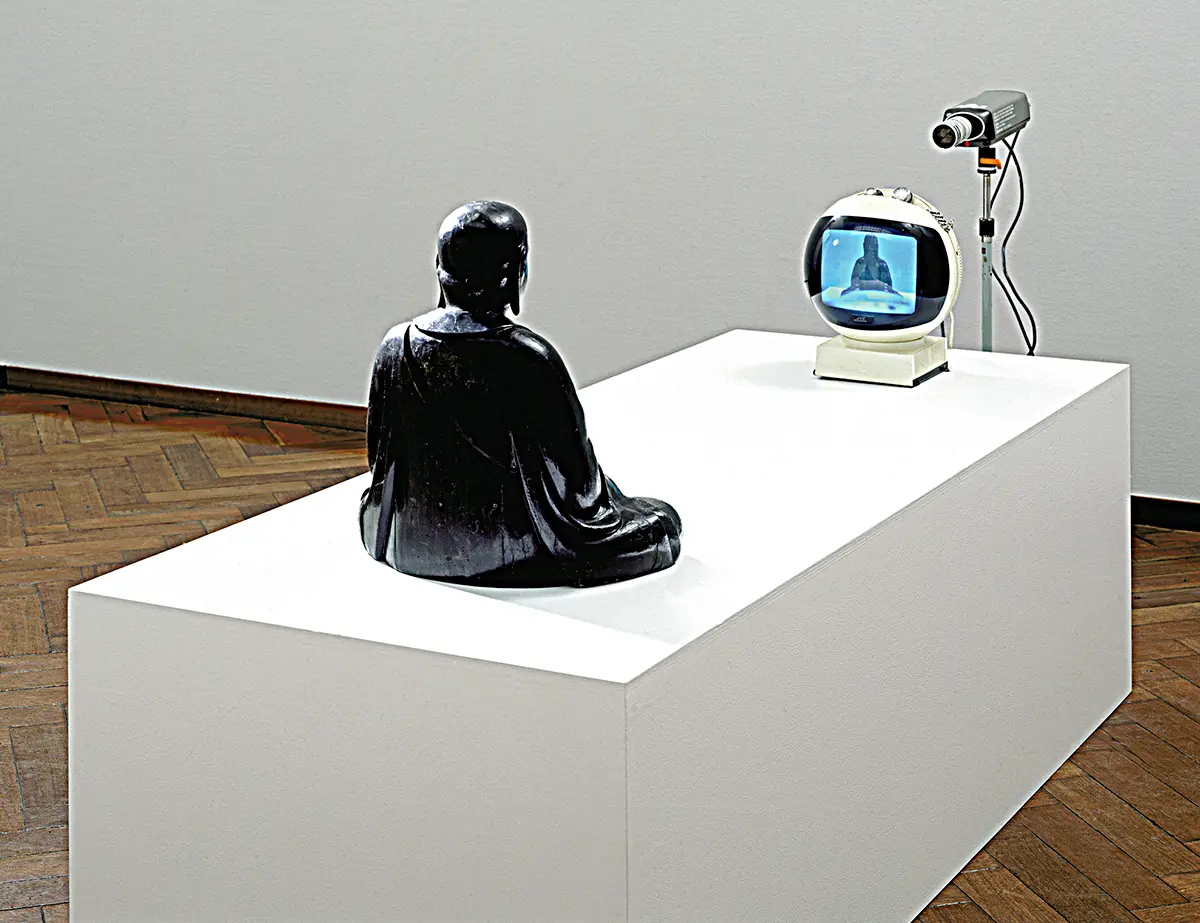
At the same time, the opening made by the link to moving images also had the effect of diluting the focus of the exhibition, by introducing pieces that seemed peripheral. Nam Jun Paik, for example, was appropriately represented by his TV-Buddha (1974)—a sculpture of the Buddha watching itself on a TV screen— and was also represented by his TV Bra for Living Sculpture (1975). But unlike TV Buddha, TV Bra has only a tangential connection to the issue of vision. It documents a performance piece Paik did with Charlotte Moorman in which she played the cello with television sets covering her breasts. TV Bra isn’t really about vision but rather functions as a comment on the scandal surrounding Moorman’s earlier “topless cellist” piece.
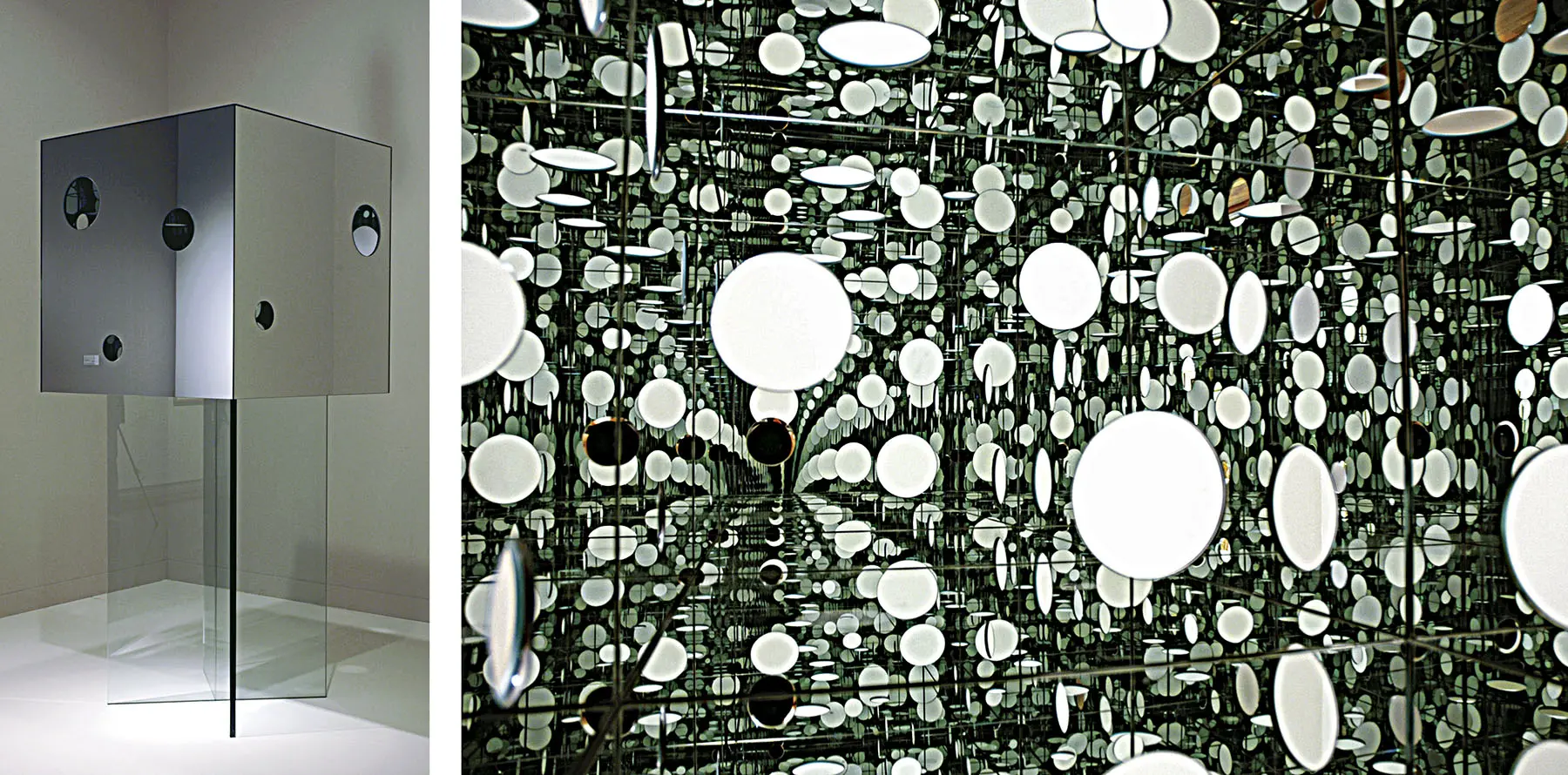
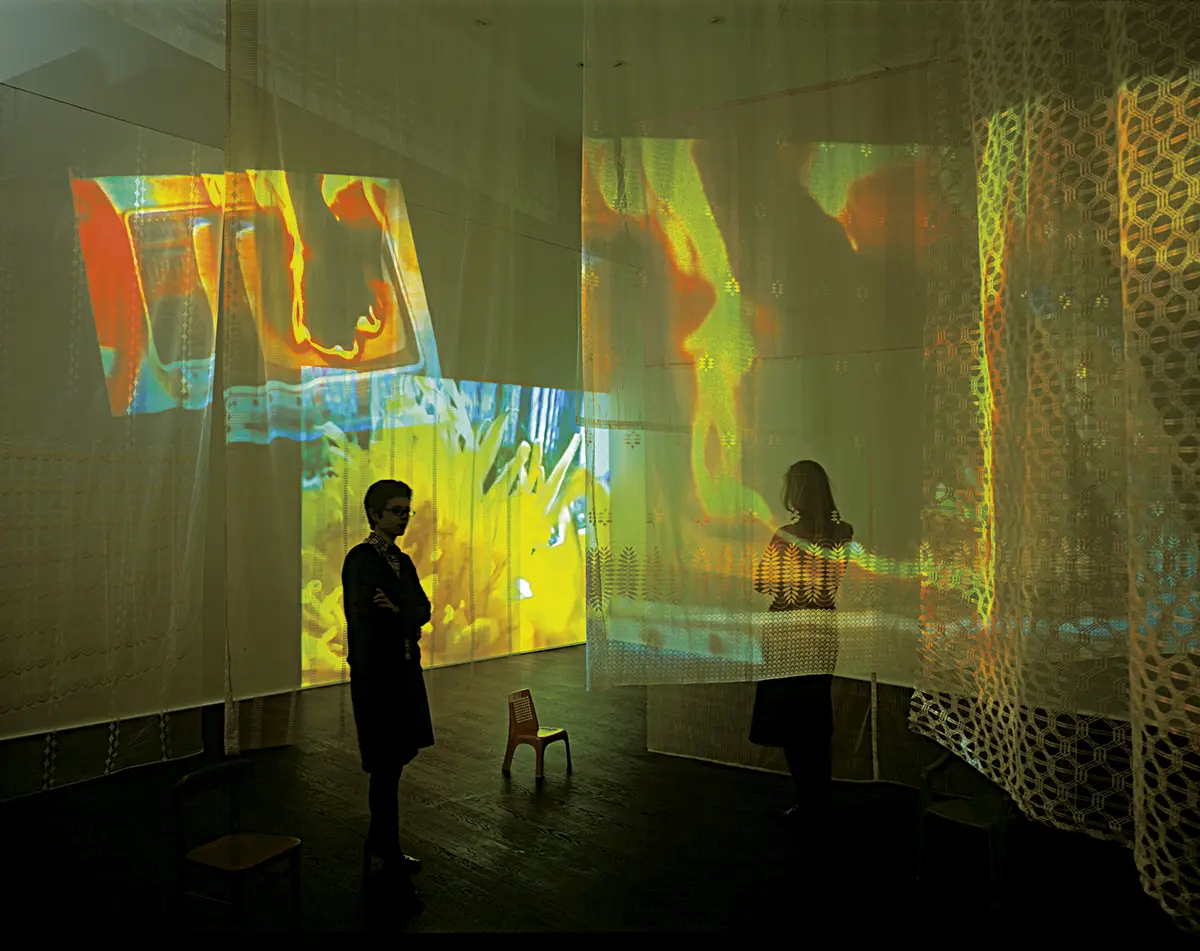
There are grounds for including peep shows in a show on vision, as is clear from Yayoi Kusama’s The Passing of Winter (2005), a mirrored box of infinite reflections and a variation of a room originally made during the 1960s. But the inclusion of TV Bra encouraged a segue culminating in a room installation by Pipilotti Rist, Related Legs (Yokohama Dandelions), in which there were wonderful video projections, but the power of the piece owed much more to the evocation of narrative elements than to the actual visual environment. The fact that the images were projected onto lace curtains actually weakened rather than enhanced the visual effect.
The weaknesses in The Expanded Eye may simply be explained by space constraints. These probably prevented a complete investigation of all the topics the show raised. In some cases, the work was of only anecdotal interest, such as two early pieces by Robert Smithson, dating from the time he sought to be included in The Responsive Eye but was rejected. Other work by Smithson, such as Mirror Displacements (1969) might have fit more seamlessly and effectively into the exhibition. Hans Haacke’s piece, Blaue Seide in einem Luftstrahl flatternd / Blue Silk Fluttering in a Stream of Air (1964), is extremely beautiful and makes a good spectacle, but has only the thinnest of connections to the intent of the exhibition. It is possible that “the idea of fusing art and life” made the show somewhat vulnerable to dilution.
Besides the overarching visual fun of the show, this exhibit also offered the pleasure of discovering arcane pieces. Of special interest were Structure cinétique penetrable (1966) by Jean-Pierre Yvaral, completed a year before Jesús Soto embarked on his series, and La vitesse totale (1958), a collaboration piece between Jean Tinguely and Yves Klein.7 La vitesse totale consists of a rotating steel disk painted in Yves Klein’s trademark blue and brought into movement by Tinguely.
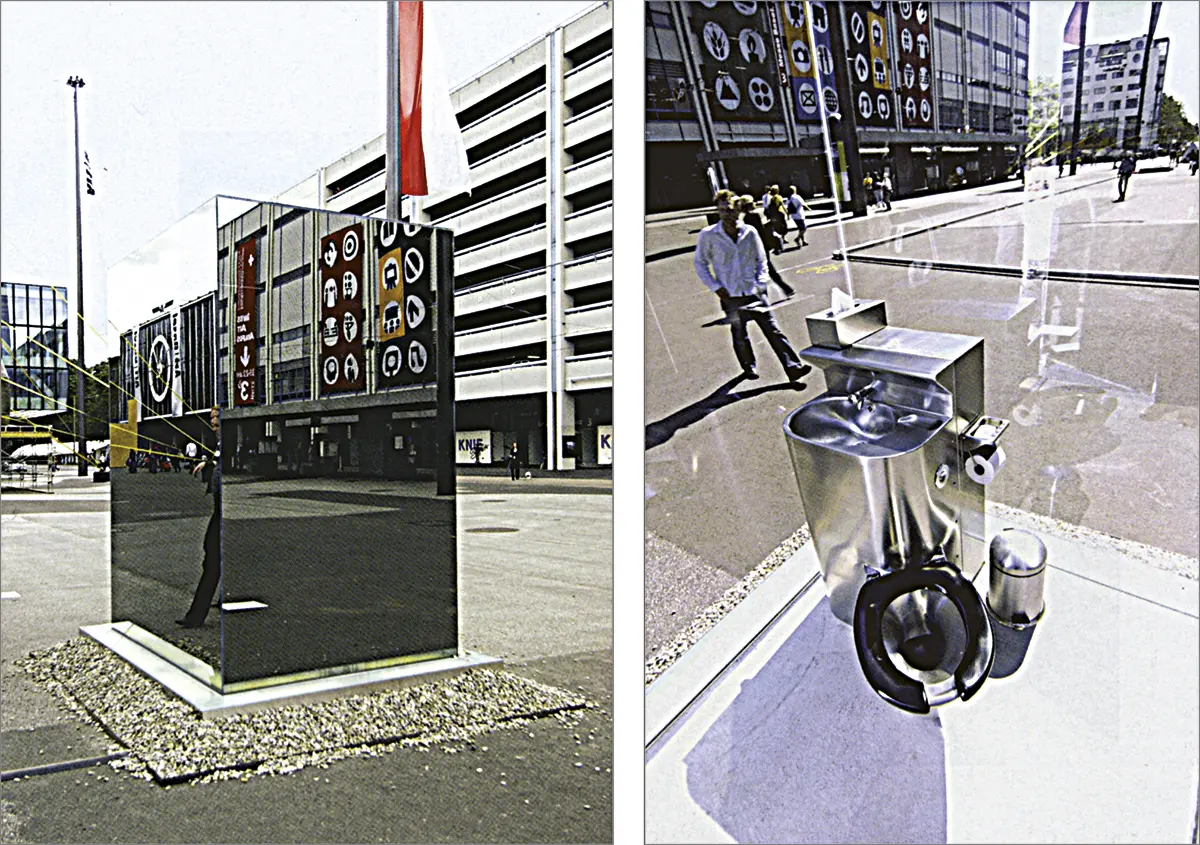
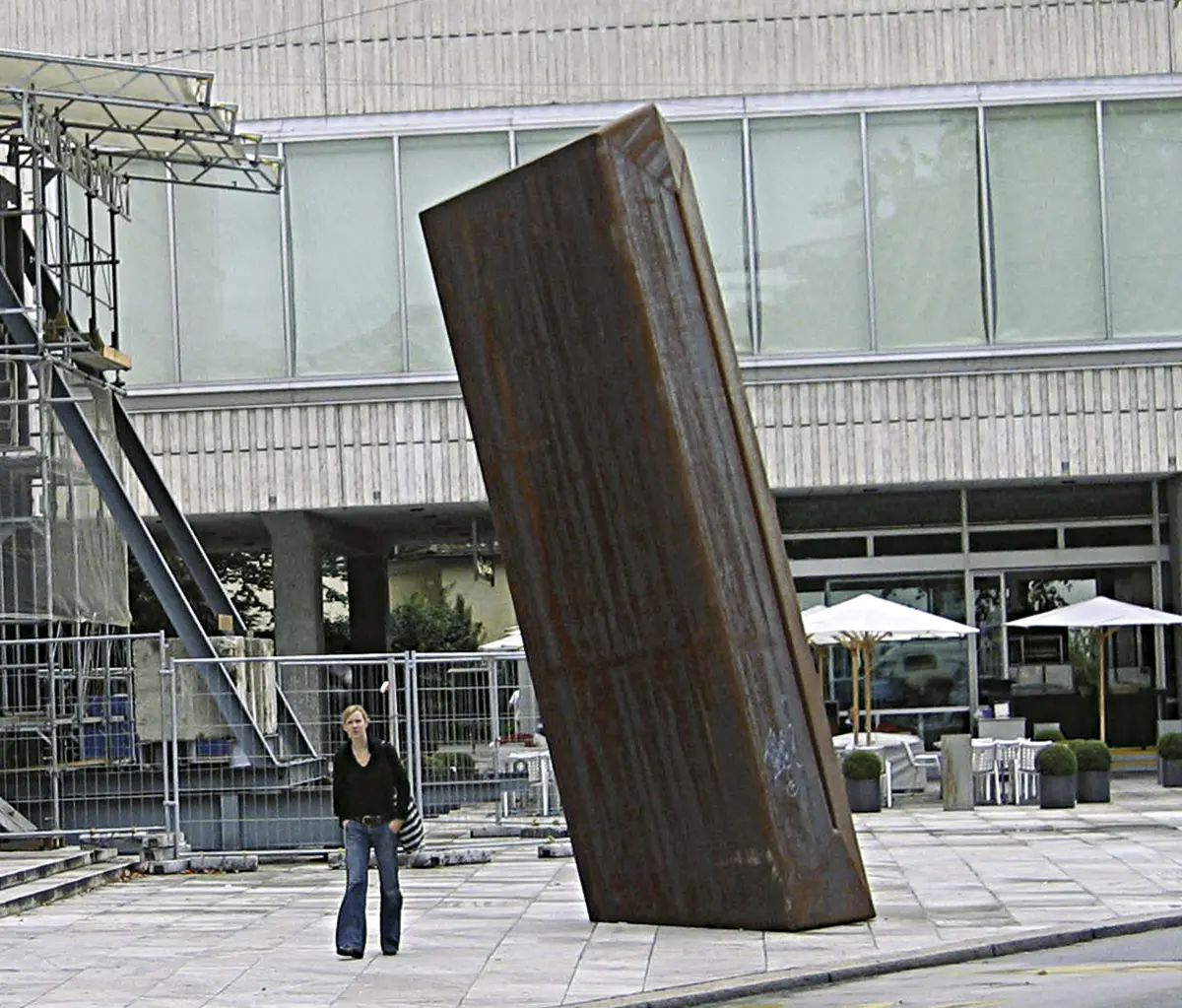
Curiger’s idea of fusing art and life was effectively represented in a piece by Monica Bonvicini, whose toilette was made of walls with one-way mirrors was installed on the sidewalk outside the Kunsthaus. Passersby saw only their own reflection, while anyone using the toilet saw everything outside and had the sensation of being totally exposed while engaged in the most private of acts. It’s an inspired piece, and, in an unexpected turn of events, it experienced a further expansion of the connection between art and life. On the night of July 28th, the respected sculptor Jorg Altherr—who was born 1944 in Zurich, studied with Marino Marini, and has work in the collection of the Kunsthaus—arrived in a truck. He unloaded a five-ton iron sculpture on the same sidewalk, closer to the entrance of the museum than Bonvicini’s piece, and then left the scene. As public art, Altherr’s sort-of-minimalist piece doesn’t look bad, but it created a problem for the museum: in trying to get it removed, the museum discovered it lacked jurisdiction over the sidewalk, had failed to get a permit for Bonvinci’s piece, and was therefore subject to a fine for having installed an art piece without permission of the city. The museum had to pay 500 dollars, as did Altherr. But in his case, the sculpture was removed. Fortunately, with a permit in hand, the museum was permitted to retain Bonvincini’s piece in its place for the duration of the show. It’s a fine piece that is in some respects a counterpoint to Penny’s face—having two points of view, each one excluding the other. There is also, implicitly, the third point of view—that of the artist as a manipulator, creating a situation at once fraught and funny. This is appropriate for an exhibition that took art historical dialogue seriously, but with a slight smile.
NOTES
1. The Expanded Eye, Stalking the Unseen at Kunsthaus Zurich, June 16–September 3, 2006. The original title of the exhibition was in English.
2. Seitz quotes Harry Asher saying in 1961, while referring to the phenomenon of simultaneous contrast of colors: “To this day it is not known for certain whether the process underlying the effect takes place in the eye or the brain.” From The Responsive Eye (New York: Museum of Modern Art, 1965) 5.
3. When word got out that The Responsive Eye exhibit was being organized, the gallerist who was representing me in New York at the time asked me if I would want to switch from my expressionist work to something more in line with optical effects.
4. Bice Curiger, “The Expanded Eye: Stalking the Unseen,” The Expanded Eye (Ostfildern, Germany: Hatje Kantz Verlag, 2006) 19. The catalog is an excellent resource, not only for the work of the exhibition but for related documents and writings both in art and science.
5. Bela Julesz, a psychologist working in Bell Labs, was only then proving that stereoscopic vision occurred in the brain. He used randomly generated black and white pixels “disturbed” by a simple shape that was unperceivable for a single eye. Julesz was one of the first to combine computer-generated information with visual perception. To his surprise, his patterns were alluring enough to be declared art and to be exhibited in 1964 at the Howard Wise Gallery in New York. During that time, Julesz also became an advisor for Salvador Dali’s experiments in three-dimensional vision.
6. Gene Youngblood, Expanded Cinema (New York: E. P. Dutton, 1970).
7. Interestingly, Soto, though mentioned in the catalog of The Responsive Eye as an example of moiré work, was not included in the exhibit. He was, however, included in The Expanded Eye with Tés noirs et rouges (1972).
Edited by Selby Hickey.
LUIS CAMNITZER
Emeritus Professor at the SUNY College, Old Westbury.