
Ceramics has deep roots in Peruvian culture. The ability of this artistic discipline to make relative or even suppress the distinction between objects of contemplation and utility contains tremendous potential for the consolidation of a long-unattained national identity. The professional path of Carlos Runcie Tanaka belongs to this line of exploration. Tanaka, who was born in 1958 in Lima recently presented the anthology exhibition Sumballein at the newly restored complex of San Marcos University in Lima’s historic center.
This exhibition, curated by Gustavo Buntinx, sought to account for the extent and depth of Runcie Tanaka’s engagement with the challenges and expressive potential of his trade. In the words of the curator, this was a “broken anthology.” Indeed, all the works displayed mortar sutures because they fragmented or exploded in the kiln—“Fire does not make concessions,” the artist says in the catalog—or they broke by accident. This salvaging of discarded fragments and repairs without veiling their “wounded” condition revealed an underlying discourse about the inexhaustible sequence of trials and errors that constitute the process from which the work emerges.
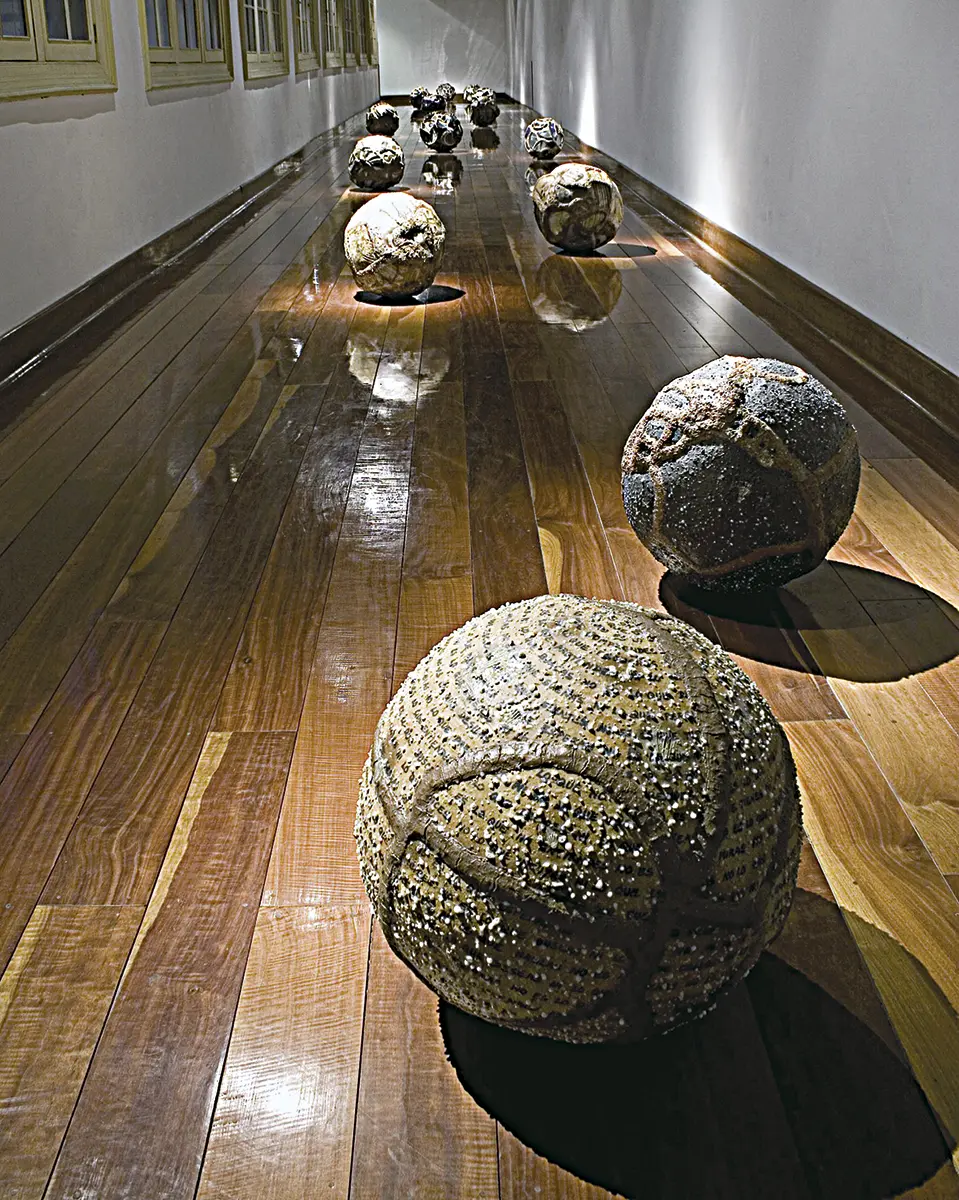
The show’s title alluded to the Greek root of the word “symbol,” meaning “bringing together” or “gathering.” The artist’s intention, in alliance with the curator, thus admitted many readings. In an objective sense, the viewer was confronted with visually sutured works that set aside the expectation of pulchritude in terms of finish and presentation. Metaphorically, interpretations multiplied and overlapped. Runcie Tanaka—whose British and Japanese surnames suggest dual heritage and mixed identity—reconciles the disciplines of ceramics and sculpture, refuting the common pigeonholing of the former into merely utilitarian ends, which follows prejudices about the supposed fragility of clay or the loss of the condition of uniqueness from serial production. The work with the three-pronged title Huayco/Kawa/Río alluded to an intercultural heritage. On an installation of fourteen large spheres, the artist embedded fragments of broken dinnerware. The work was made disturbing by the ambiguity of these masses, weighty like those carried by the huayco or Andean flood, yet appearing light, like parts of a model of a planetary system. To these forms, Runcie Tanaka incorporated salvaged ceramic fragments that his ancestors would have thrown to the kawa, the Japanese brook where failed attempts from the kiln usually ended up.
Other artistic disciplines beyond ceramics and sculpture were brought together in the exhibition. The show included videos and photographs of the artist’s interventions on the coastal desert: performances like the construction of piles of rocks that mark a pilgrimage (apachetas). As in any anthology, the exhibition gathered works covering Runcie Tanaka’s wide thematic range, from his connection to the coastal landscape with evocations of his forebears’ migratory adventure, to his emblematic crabs presented in ceramic and origami that signified individuals “stranded” on the shore, to his presence at the capture of the Japanese ambassador’s residence in Lima by a commando team of the Tupac Amaru Revolutionary Movement in early 1997. After five days in captivity, along with almost five hundred hostages, Runcie Tanaka’s experience of violence and confinement in those close quarters drove him to re-signify the characters he was working with at the time. Thus, in October of 1997, at the First Lima Biennial of Ibero-American Art, the artist presented Tiempo detenido (no olvidar). This installation, recreated for Sumballein, showed a multitude of anonymous characters placed atop pedestals made bright by a reddish light. Seemingly convoked by the figure of a fallen colleague—a “sacrificial figure,” in the words of Gustavo Buntinx—kept inside a glass urn and prostrated on a bed of beads, this multitude transformed the Centro Cultural of the Escuela Nacional de Bellas Artes into a funerary chamber, one dense with metaphors of the Peruvian tragedy.
This symbolic integration of the aesthetic and the utilitarian, of what is demanded by personal or political articulation and what is motivated by sheer aesthetic impulse, as well as the intersection of diverse rhetorics in the language of ceramics is what made “Sumballein” a mandatory opportunity to approach the work of one of the most important artists in the contemporary Peruvian scene.
LUIS AGUSTI