
Daniel Joglar was born in Mar del Plata, Argentina, in 1966. he lives and works in Buenos Aires, and since 1997 has developed a career in the visual arts, supported by experiences such as the work, directed by Kuitca, in the fellowships with young artists, his first prize at the National Art Biennial in Bahía Blanca, the National Arts Foundation fellowship, and the subsidy to artistic creation from the Antorchas foundation, among other distinctions.
On this occasion, the artist presents an installation in one of the exhibition galleries of Bogotá’s Centro Colombo Americano, comprised of a large number of objects hanging from the ceiling by nylon threads. Mid-distance from the floor, wooden bars with spherical ends, fine metal tubes, pressed-good pieces in geometric shapes, rings, and other objects form a kind of mobile that the viewer can see from the sides of the gallery. The impenetrable composition is set at different heights and with different degrees of tilt, in order to be seen as a three-dimensional drawing in which the objects can be read as tracings, lines, and focal points suspended in space.
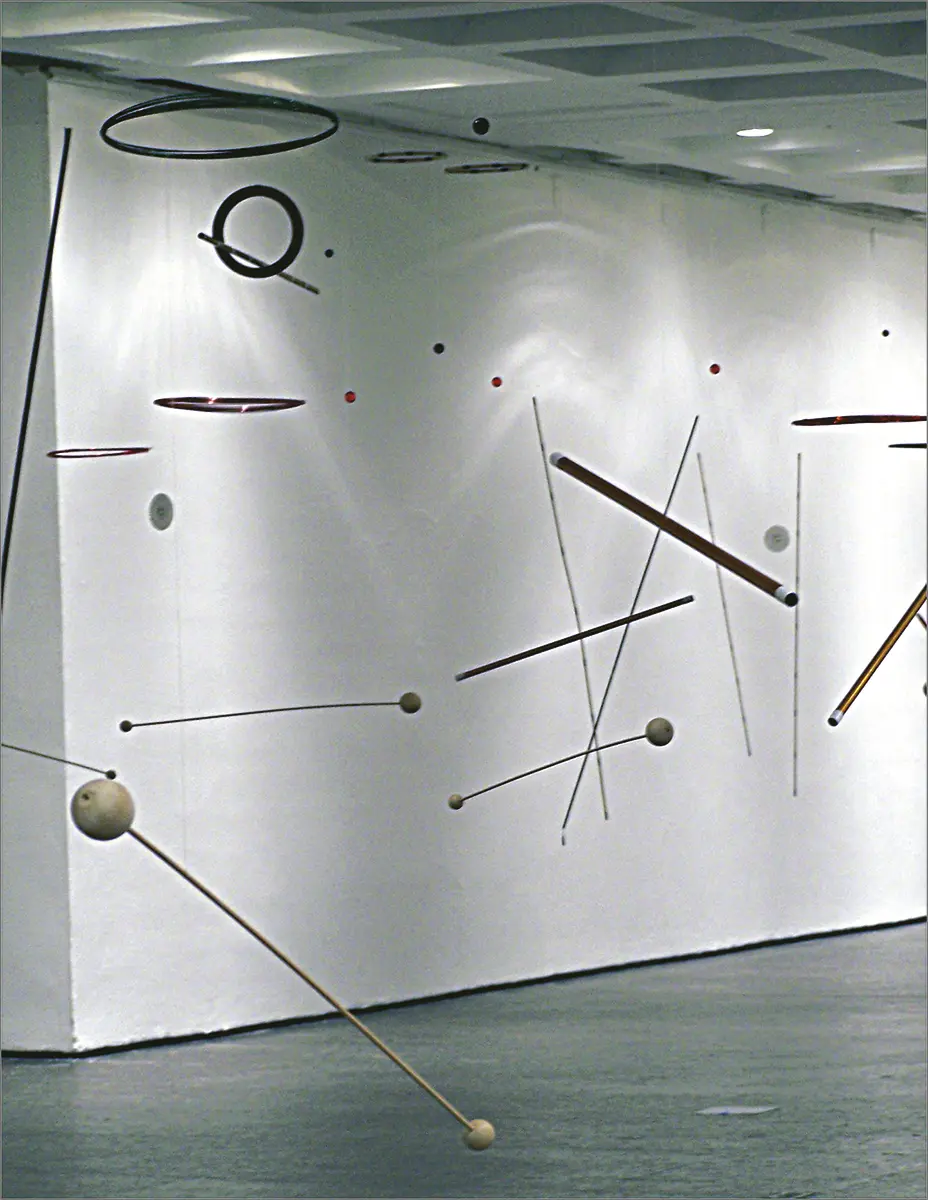
Joglar often creates installations on the basis of found objects according to the site in which his work is scheduled for exhibition. In this way his production acquires a site-specific character that could seem of an overriding simplicity, but it gains complexity as it builds formal volume connections, symmetry, and logical order. In the apparent chaos of the elements involved, the artist orchestrates a well-though, direct and clear dialectic, which denotes a programmed intention with a schematic background. A certain mathematical rigidity plays with the endless possibilities offered by the weavings of hanging objects according to the angle from which they are visualized.
From the conceptual point of view, we note notions like “equilibrium,” “balance,” “gravity,” “light,” “time,” “space,” velocity,” which are important when it comes to arrange each element taking into account its role as an integral part of the work. It is not by chance that the objects in this installation are light and the artist’s justification for this feature lies in the need to not have some “weight” more than others either in literality or in corporeality.
Repeatedly, Joglar’s work involves the magical. In fact, the very title of the show ...Nothing in My Hands, Nothing Up My Sleeves... evokes a phrase commonly used by magicians who execute optical illusions through manual dexterity, recontextualizing the elements that are the objects of his act. Similarly, this work is magical inasmuch as it re-signifies those objects although in a more explicit way that that or mere illusionism. What is ingenious, shocking, and fun is more the result of the mental process of that re-signification. The many things that can be said of the compositional effect of a series of rods, invented shapes and everyday objects turn the elemental into the complexity of formal relationships the wonder of which is precisely how it fills the insignificant with meaning.
What interest the artist most is not the symbolism of objects but their shape, their function, and the character of the materials of which they are made. The artist divides the elements he uses to form his representations into three basic groups: The first group comprises new things that can be purchased anywhere; the second group comprises things that belong to collections (nostalgia triggers); the third group comprises unique things. Daniel Joglar says: “I attempt to exercise a dispositive action over these things in order to end their identity or functionality, in order for them to be seen differently. I am interested in arranging things so that the object is focused on itself, as if it closed upon itself to the point of only being what it is inasmuch as it is seen in a different way.”
MARÍA JOSÉ RAMÍREZ