Urban art —that controversial, indefinable phenomenon— has gained increasing acceptance in spaces reserved for those artists who have passed certain tests and have demonstrated not only their excellence and originality but also the consequence and enduring relevance of their work. This has been s, in part, because many “street” artists have come to realize the need to play a game that is different from the games they played when money and fame were not important (examples: solving the problem of the ephemeral nature of their works, using different supports, using better materials.)
A product of this aesthetic (an art produced by “the marginal,” self-taught rebels who want to express themselves/accuse/protest/propose utopias, and be heard and taken seriously not only by those closest to them but also by those who control the art world and a highly conservative, rigid pyramidal society,) a follower of his generation’s music (and experienced DJ), is Carlos Colon (self-taught, born in Chicago to Puerto Rican parents, who started as a graffiti artist at the age of 13 under the influence of the New York graffiti movement, and who in a brief time has achieved a measure of international recognition,) known as DZINE.
This young artist tries to —and often does— translate the energies of urban art and music that surround/affect/influence him in Chicago and later in other cities (those colors, those rhythms, those singular expressions of indignation and hope) into original and harmonious “cantos” that can elevate us in the creation of agreeable spaces/experiences.
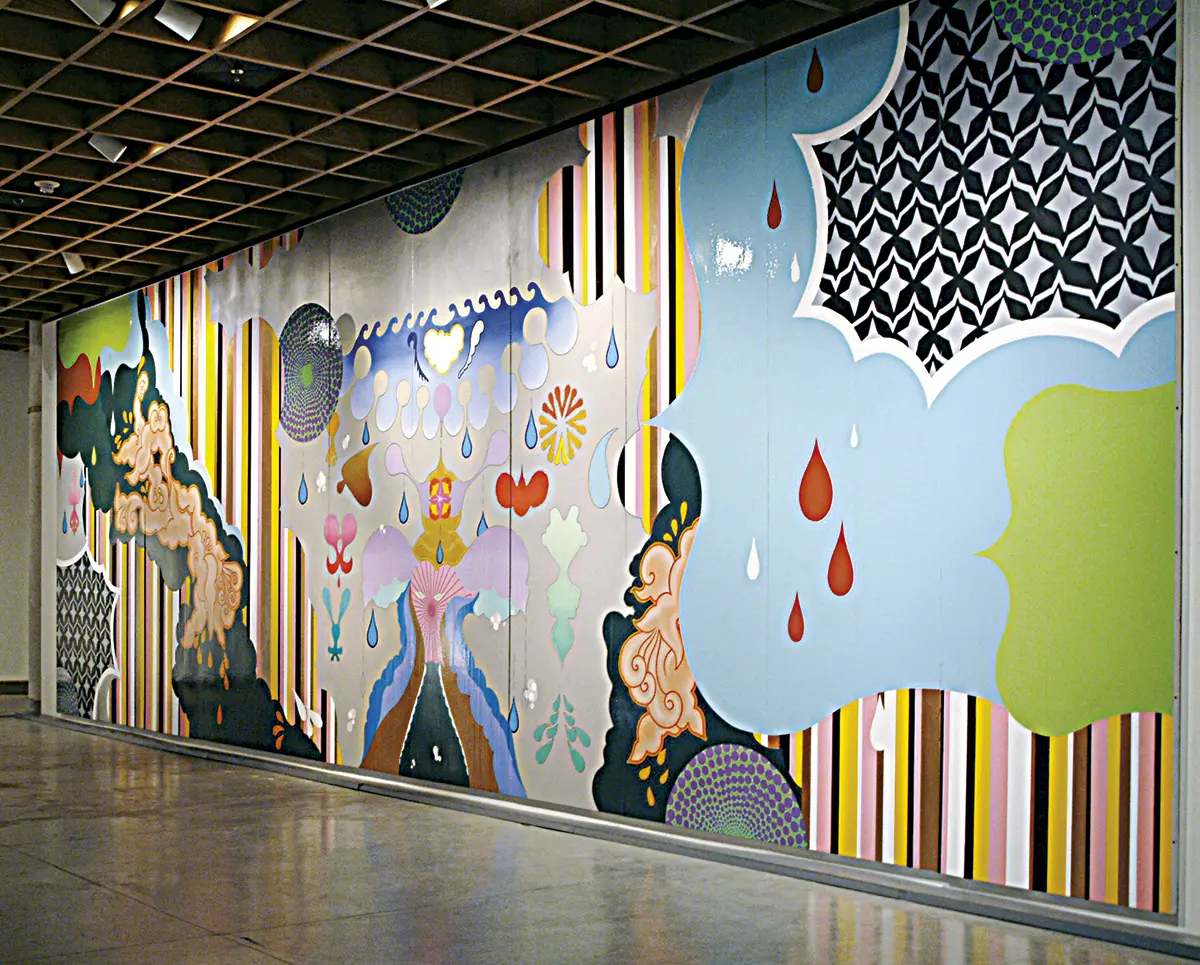
In Beautiful Otherness, an exhibition presented at the Museo de Arte de Puerto Rico from August through September, 2006 (an exhibition we believe to have been premature for one of the main galleries in the “national museum” that is trying to establish its position in the art world,) we see how the artist, under the aesthetics he knows calls “punk/funk/psychedelic,” creates designs and textures that are appealing/joyful/fun (in all kinds of formats) using acrylics and glass beads (Beadazzled) (Graffiti art for museums and collectors?)
In his large paintings and panels, DZINE tries to carry/translate “into visual representation the sound effects of music” (his music, the music of his generation) and creates abstract and semi-abstract designs (where we can see clouds, rain, flowers, industrial designs, etc.) that combine, intelligently and effectively, the psychedelia and Pop Art of the 1960s and 1970s, with organic postmodern elements. In monumental panels like Beautiful Otherness from 2004 (acrylic and glass beads on canvas) and Punk Funk from 2005 (acrylic, envirotex, and varnish on wood,) where he no longer uses the glass beads that defined his work and helped drive his popularity, the artist builds colorful “landscapes” where we see the passage/shift from a raw/rough urban art to a much more formalized kind of work. DZINE, newly aware of the durability of his work, will redefine the rules of his game. The main problem is that these works, although forceful at first sight, can become calculated exercises and, in a not-too-distant future, end up boring us, easy to mix up with the decoration of a Las Vegas hotel. In the smaller works we encounter a more intimate, more lyrical, more honest DZINE. The show’s most interesting work is Hero/Heroine: East, of 2006, a set of 1970s turntable and speakers wrapped in glass beads and affixed to the lower part of one of the walls (work in collaboration with Codi Hudson.)
Although, to a degree, I find what DZINE is doing with street art similar to what Federico García Lorca did with Andalusian/Gypsy popular poetry in his Romancero gitano, “elevating” the popular and the ephemeral and giving it a space in the canon, there are many who see the work of this young visual poet as a highly decorative, superficial art, combining used and re-used organic elements, late-coming minimalism, elements of psychedelia and Pop from the 1960s, in the construction of agreeable, harmless designs devoid of any consequence. Time will be the only judge.
MANUEL ÁLVAREZ LEZAMA