
Under the title of Guajira interior, the Artepuy gallery presented, between May and June, recent works by Edison Parra. This exhibition gathered 26 works —paintings, tapestries, and sculptures— in large and medium formats. The work of this Zulia artist is the result of an inexhaustible quest in which the components of his artistic language see their symbolic resonance intensify, something that has been expressed in a coherent and interconnected manner throughout Parra’s career. From an absolute and rational geometry, the product of his explorations in the 1960s, when he shared Constructivist interests, we moved to less rigid constructions where the rhythmic and the serialized sketch a kind of primordial alphabet. In that proposal, the artist seems to hark back to that instant when drawing and writing were at the genesis of graphic communication. Later, these elements started to show an ever freer and more spontaneous drive; what was symmetrical becomes asymmetrical and what was well-ordered becomes aleatory, and in this way, Parra’s propositions began to reflect a more fluid expression. During the 1980s and the 1990s, Parra’s exploration of the material took him to the creation of hand-made supports; paper and weaving give him versatility in the execution of his works, as well as greater visual and conceptual density. Attracted to the tapestries produced in the La Guajira peninsula, Parra has researched for years this discipline, which has endured through the centuries among the region’s indigenous communities. From this experience, he has extracted new knowledge to enrich his work and widen his repertoire with varied and complex procedures.
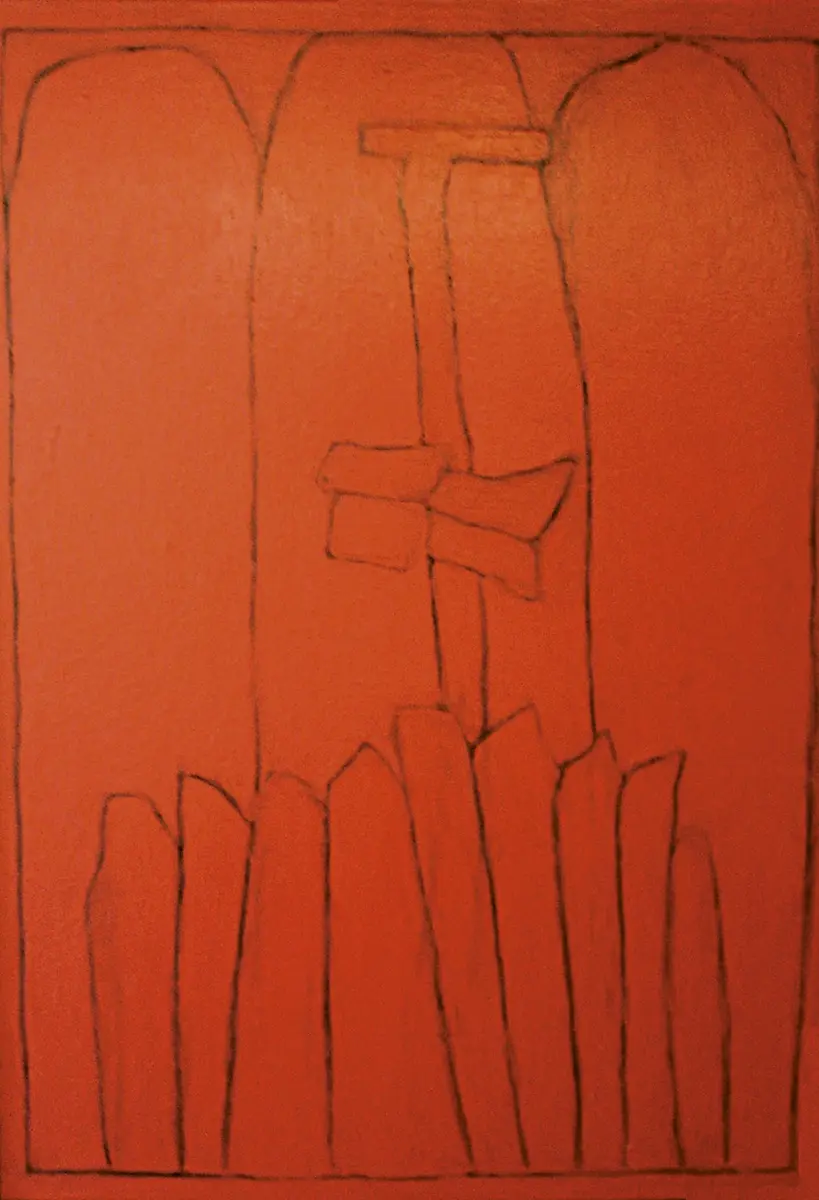
On this occasion, we observe in Parra’s paintings a process of decantation that de-materializes shapes as it gives a protagonic role to the monochrome colors that now take over the entire canvas. Sepias, grays, and reds are the hues of these works that denote telluric nuances, as can be seen in Postes Signos No. 3 and Postes Signos No. 4, both mixed techniques on canvas. In them, the schematization of the lines derives into skeletal outlines that dissolve into the plane and make possible a calmer kind of reading, because the confrontation between figure and background is reduced to a secret dialogue between the parts. These minimalist works bring to mind those incisions in stone or the marks left by the original peoples on the sides of walls and mountains. More than assembled shapes, these images seem to mutate into segments that intertwine, fragment, or agglomerate in dynamic groups that modulate the surrounding space. Parra builds a universe of enigmatic signs with atavistic roots that connect with the mythical and the imaginary, with traces that endure the passage of time. From the pictorial synthesis described in his paintings, the artist turns to the tracing of lines, to the plot and structure of yarn and the bulkier dimension formed by his tapestries/sculptures; art, craft, and technique come together to generate a new sense of the artistic event. These works are warm, not only because of the sense of closeness suggested by their manual manufacture, the solid curvature, or the tactile surface, but because they transmit a sensation of shelter, protection, and comfort derived from weaving as an everyday object. With this, the artist proposes an ambivalent discourse that shuttles between the traditional and the new, the utilitarian and the contemplative. “This two orientations in his work,” says art critic Federica Palomero in the exhibition text, “are now in his Volúmenes, which are like soft stones or totems, echoes of primordial shapes on which signs evoke petroglyphs ad at the same time refer us to sensible geometry: organization, a search for structure, and an air of the ancestral coexist in a synthesis presided over by the fusion of the popular and the high-culture, of contemporary language and the archetype...” In Volúmen escultórico, 2006, for instance, we perceive the skill in the arrangement of the materials as well as a distilled artistic sensibility. With explicit intention, Parra incorporates the ritual of wayúu weaving in order to recover an archaic memory and perpetuate in that way the legacy of an essentially Latin American way of being and feeling.
GLADYS YUNES