
From June 8 through September 17, the Museo de Arte Moderno presented De la materia y la idea, a retrospective exhibition of works by Mexican artist Eloy Tarcisio. In a curatorial exercise that stayed away to chronological or thematic organizations, the show moved organically between paintings, installations, and drawings made since 1975, presenting the viewer with the way in which the artist has elaborated a conceptual discourse based on the matteric and the expressive, where materials play a symbolic role in continuous dialogue with the expressivity that characterizes the artist’s pulse. Particularly interesting is the way in which Tarcisio relates to the pictorial, since, unlike many artists who work on the basis of materiality and installation, Tarcisio does it always from a pictorial perspective, without however denying the specific qualities of the three-dimensional language. In his art, blots and colors appear as quasi-expressionistic discursive strategies linking the work to the unconscious and perhaps even to the naïf. This is why the show’s title was so powerful, since while the matteric and the conceptual represent a false dichotomy, Tarcisio attempts to reveal matter as the foundation for the concept, as its origin. This is why earth and blood, spices and mole, nopal, corn and maguey appear so insistently in his oeuvre; through them, Tarcisio speaks of memory, of the place where he belongs, of the hybrid and liminal condition of his fatherland, and as such he speaks of himself.
The re-signification of national identities from a personal perspective is perhaps what interests Tarcisio the most. The artist has spent more than thirty years creating his own version of Mexicanness, one that arbitrarily interpolates personal and political tragedies, romantic adventures and the scent of mole, urban despair and rural hopelessness, the love of the land, memory, and its knick-knacks. The artists speaks of a personal Mexico, but his gaze does not come from a postmodern perspective, and in that sense it is necessary to note the difference between Tarcisio’s production and the work of the neo-Mexicanists of the 1980s, for whom the cynicism of a fragmentary vision is what supports the very construction of contemporary identity. On the contrary, Tarcisio is interested in the possibility of recovering a sense of the place’s memory and history, this is to say, the past recovered as the possibility of building the future, ad it is in that sense that his work corresponds brutally to the spirit of the 1970s, implying as it does a utopian dimension, a discovery between past and future.
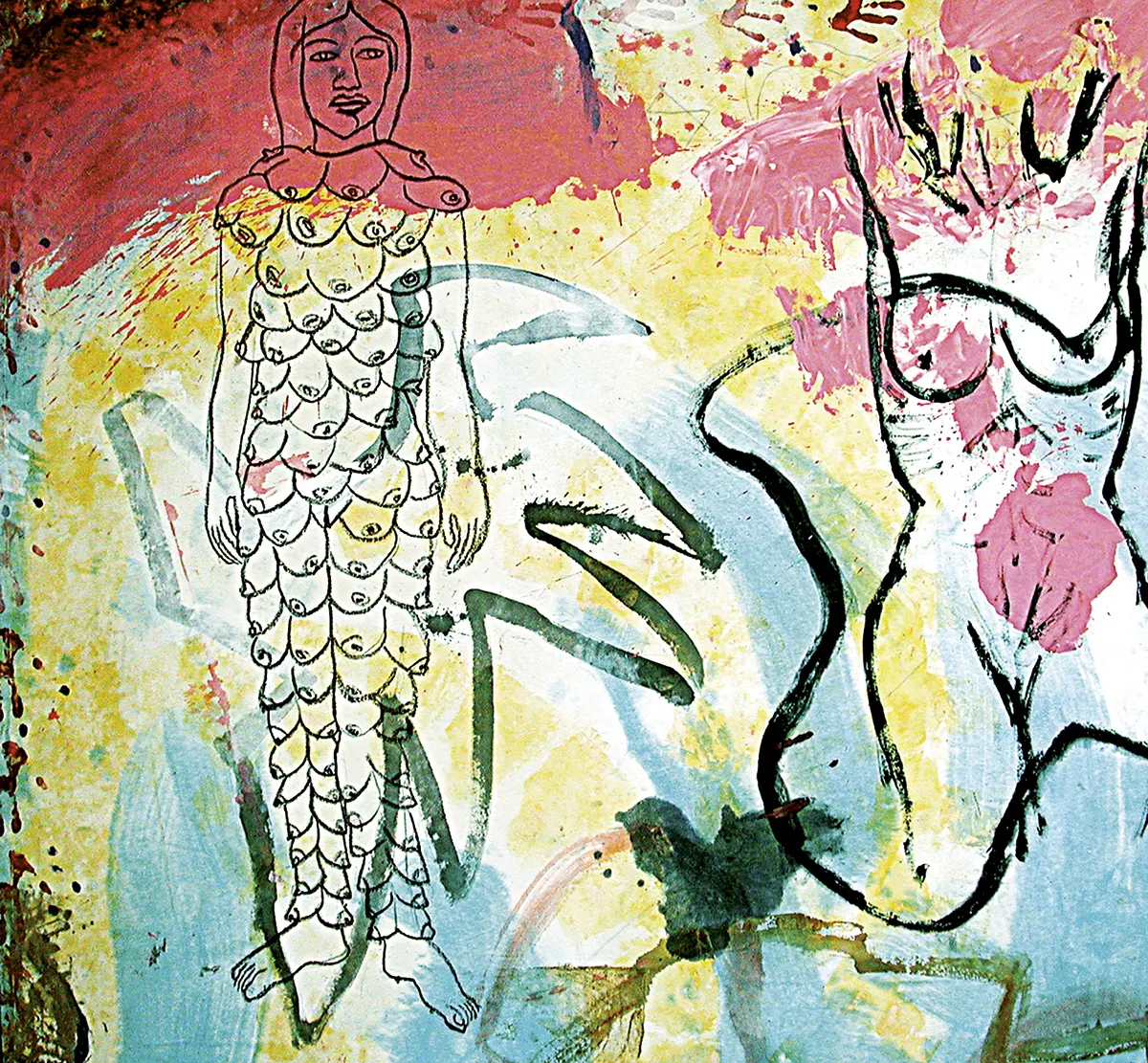
The show presented a selection where painting is preponderant over installation or other means of expression. Works like Mayahuel (2005-2006) display a clear interest in linking schematic drawings with expressive painting, where myth and personal elements dialogue within the pictorial space, always in a clear reference to a return to the primordial. In this painting —one of the most emblematic in the show—, the artist speaks of the goddess of maguey and, thus, of pulque and intoxication. Tarcisio represents maguey as a woman clad in hundreds of breasts, nourishing, a giver of life, and at the same time erotically charged, yet not abandoned but dignified, standing on her feet, looking at a different, fragmented, dislocated female body. In Tarcisio’s paintings, there are recurring allusions to the desiring body: the kiss and the heart, transparency, and couplehood, always in the form of schematic drawings that makes us think more in idealizations and memories. This is the case of works like Primera pareja (2005-2006,) clearly allusive to myths of origin, wherewith quick strokes he creates two outlines against blots and drips, which bring to mind pre-historic paintings, traces, marks. The important thing in Tarcisio’s painting is the unity he achieves between his materials, his stroke, and his titles, so intimately connected that separating them becomes impossible.
Pirámide is a particularly interesting painting in the exhibition, a pyramid on a canvas painted with mole is enough for the artist to arrive at a series of reflections about the idea of Mexicanness as this constant hybridization not only of cultures but of cultural moments, mixing ancestral cosmogonies with spices brought from India by the Spanish, but also visions of the exotic and the touristic with a kind of somewhat decayed nationalistic pride.
LARISA ESCOBEDO