Emilio Sanchez was a product of two worlds. After a youth spent in Cuba immersed in Caribbean culture, he was then immersed in the Manhattan art scene during its “triumphant” years of the 1950s, and onward. From 1952 until his death in 1999, Sanchez resided permanently in Manhattan, but during this time he traveled extensively, first throughout the Caribbean and later through the Mediterranean countries. Despite the relative obscurity of his name in some quarters, he exhibited consistently throughout his life and is represented in most major museums and collections in the United States, Europe, and Latin America. Today, the Emilio Sanchez Foundation is the first charitable foundation based on the work and estate of a Latino artist.
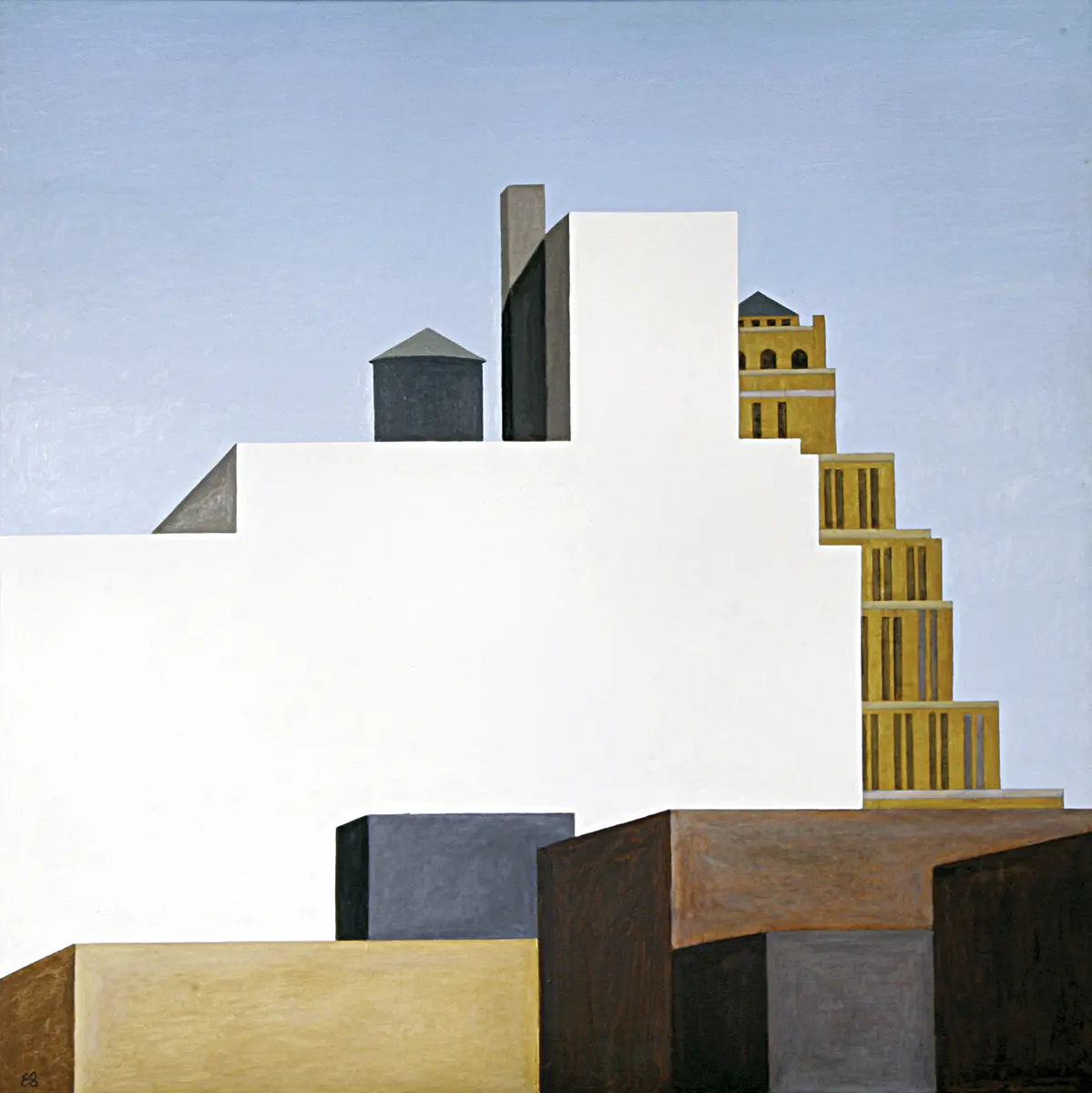
Sanchez’s subject matter and styles were so varied and eclectic that any attempt to superficially label or categorize his art would be a false endeavor. His production ranged from academically mimetic still-lifes to scenes of street life and urban barrios, from highly detailed and brightly colored Cuban houses to formalized renderings of New York cityscapes. A recent exhibition at Latin Collector, which focused on Sanchez’s Architectural Abstractions, demonstrated just how familiar and yet elusive his art could be.
The works in this small, tightly edited exhibition spanned a few decades, ranged in scale, and were executed in different media. They were all urban abstractions but varied from intimate details to broad views of skylines. Though on some level stylistically consistent, Sanchez’s art was one of the contradictions. At first glance, these paintings exuded a fresh immediacy, almost a naiveté, which belied their formal sophistication and the artist’s versatility of aesthetic choices. One was tempted to make instant associations between Sanchez and other artists, but the list that most readily comes to mind—O’Keeffe, Sheeler, Crawford, Moscowitz, Pippin, and Hopper—revealed the heterogeneity behind his work. Untitled (Looking West From My Studio) reduced the architecture of New York to pure blocks of color, with the composition’s central building rendered through its absence rather than being drawn in, and seemed to take Precisionism a step further. Untitled (Almacenes), on the other hand, shifted from a panoramic view to the detail of a ramped doorway and a bit of wall, making the strong areas of light and shadow a tangible part of the composition, like a starker version of a Hopper. In yet another direction, Sanchez made a very dark and opaque watercolor that reveled in the grid patterns of midtown Manhattan. This painting’s stillness and directness, combined with its odd scale and formalized rendering of the figures on the street, flirted with a Surrealist effect.
There was not much room for thematic range in this exhibition, nor was this by any means the most comprehensive view of Sanchez’s art. But the virtue of a smaller but well-chosen show is to shed light on some of the more particular dimensions of an artist. This exhibition demonstrated how interesting Sanchez could be as a painter. While some opinions of Sanchez as an artist may be very different from the one presented by this exhibition, the works remained true to his core values of sophisticated directness and themes of architecture and place. Just as Sanchez’s life took him to very different environments and exposed him to different cultures, he managed to assimilate and appreciate the different styles and artistic choices surrounding him while maintaining his own voice. Despite his personal love of architecture and geometry, it would be wrong to try to fit him neatly into one box.
John Angeline