
The works of the artist, curator, and art critic Gean Moreno take one by surprise as soon as one sets foot in the gallery. It is not a false or negative surprise and, without one being able to tell exactly why it does not dissipate.
When one talks about art penetrating a space, most likely what comes to mind is Helio Oiticica. While Oiticica’s work involved Rio de Janeiro’s Carnival celebrations in order to create a space for sensation or a different kind of reflection, Moreno refers to the streets of Downtown Miami or to his experiences in Woodstock in the late 1960s.
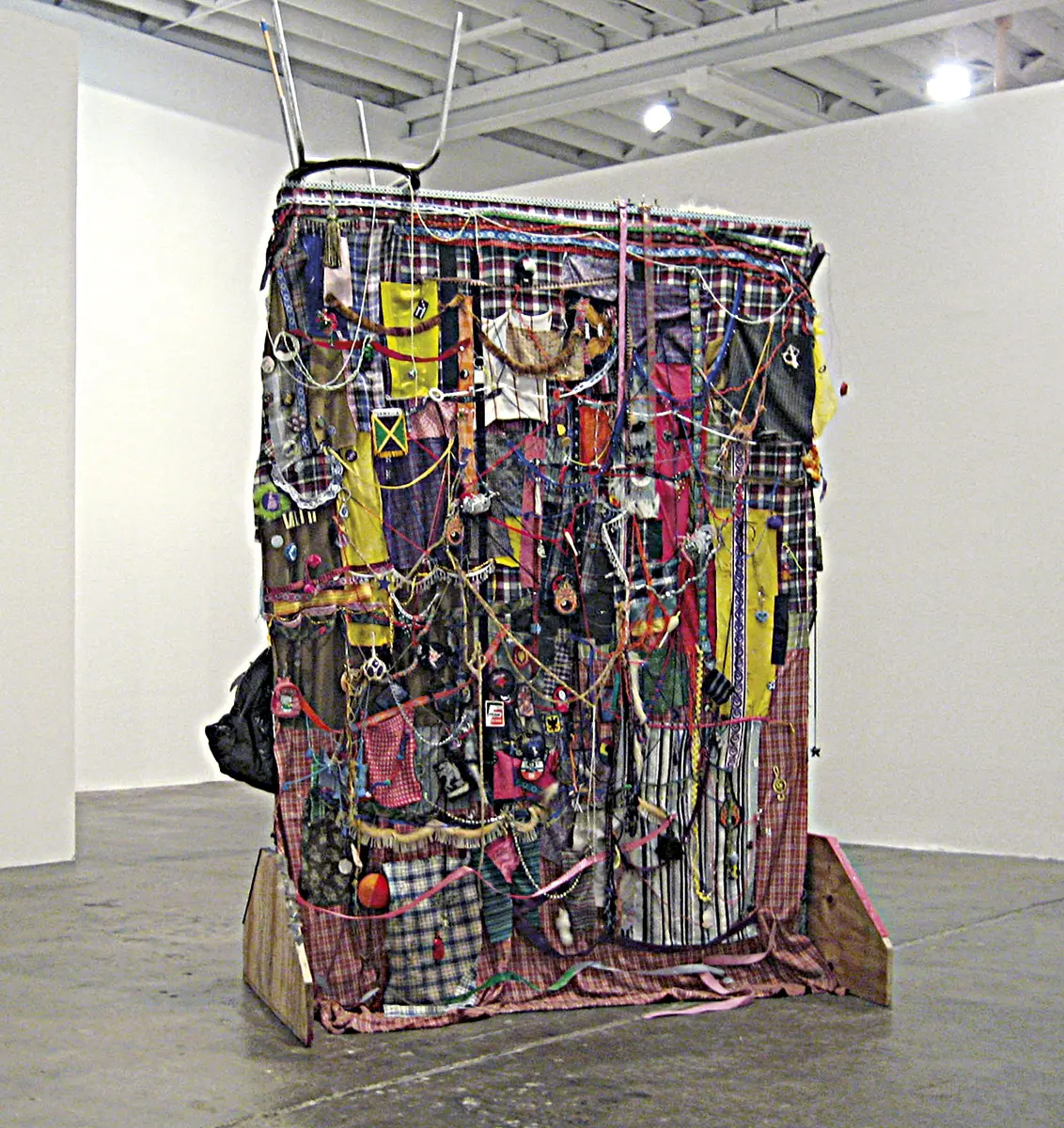
Nobody knows anymore what it means to be a Miami artist; it is increasingly difficult to answer that question. The city itself seems to not know, either, and it seems it would like to know where it is going. Moreno, who in his capacity as an artist is also a consummate researcher into social and artistic issues, writes for art publications and also directs Locust Projects, one of Miami’s most authentic contemporary art spaces, where local and international young artists carry out first-rate projects.
Moreno’s paintings are concerned with problems of identity but more as fiction than as a possible reality. However, he is able to affirm the crisis of painting, which never ceases. Arguing that crisis is almost like negotiating a country’s external debt.
Many artists are identified by the way that they finish their work. Robert Storr says that the exquisite in art doesn’t really work in the U.S. and neither do the whimsical or the humorous; he adds that what is publicly celebrated is rustic, and any refinement is looked upon with suspicion. Moreno’s paintings are spontaneous and are not interested in the finish as such; they are unencumbered and do not create rules. They never come close to refinement, but some are attractive as paintings, despite the fact that they are always felt in three-dimensional space. It is important to note Moreno’s interest in common objects such as combs, belts, labels, etc. These objects occupy a large part of the surface of his paintings and are what give them texture and color. In a world where capital says it all, which is the “I” that can move and express itself in a real way? This question could be the underpinning of Moreno’s work, and perhaps this show was an attempt to find adequate answers.
Behind any attitude reflected in Moreno’s works, he is evidently interested in creating a kind of painting where quality is not the product of a rigid or painful process. His compositions are resolved based on rhythm and indifference, and he knows very precisely how to retire while ahead. The use of three-dimensional elements accurately captures what occurs inside and outside the work. Everything seems in place, both what is just and what is excessive. Color and materials are expressed like rebels without a cause, but they work.
Moreno’s paintings alter the gallery environment, which is accustomed to traditional marketing methods. Moreno’s works invite the public to discover rather than interpret. But the gallery looked festive and delirious, due to the diversity of accessories that referred back to the days of Janis Joplin and Jimi Hendrix. The work Elephant was perhaps presented as a ritual expression, not as an offering to the gods or to natural forces but its opposite: the rites of another magic, one that each artist must invent for himself.
EUGENIO ESPINOZA