
“... A kind of art that breaks through, that is not entirely recognized, that is fundamentally experimental, that in many of its postulates see itself as an ‘art of the streets,’ ‘of the corners,’ ‘of the garage,’ ‘of the rivers or small parks,’ art to be made even under the ground of a city park, an art, in sum, of the people’s commonplace.”1
In the art of recent decades, there have been extraordinary examples of artistic interventions that breakthrough urban or suburban spaces. Begun in 1988 in forgotten parts of Argentina, the activity of the group Escombros–Artistas de Lo Que Queda belongs in that line.
Known as members of the Grupo de La Plata, Luis Pazos and Héctor Puppo were among the early experimental and conceptual artists blazing a trail in the local scene in the 1970s.2 The performance Compañía de Excursiones S. R. L., which according to the artists was “a good example of the dissolution of traditional forms of expression,” took place during the Third Tandil Arts Festival in October 1970. Before that, they represented Argentina alongside artists from France, Spain, the U.S., Italy, and other countries in Novísima Poesía ’69, which was understood as the use of words in which meaning and figuration condition and explain each other, playing with the visual and tactile nexus of the traditional linear and grammatical order.3 During this period, they were part of “Arte de Sistemas,” led by Jorge Glusberg, with contributions by Horacio D’Alessandro. The founding triad of the group, including David Edward, remains and received the additions of José Altuna, Claudia Castro, and Adriana Fayad in 2003.
From the late 1960s and the 1970s, the group retained the critical spirit that characterizes their activity, joining forces as needed with people and institutions that shared their goals. Their message is one of permanent support to those who defend intellectual freedom, ecological balance, and human rights. Their first manifesto, La estética de lo roto, dates from 1989. They declared: “We are an open and horizontal group. The number of our members is not fixed and has no limits. We all, without exception, have a right to voice our opinion and make decisions. Escombros is born, dies, and is reborn continually... The site where our works gain concretion is the street; it is there that reality is found without disguises or conditions... The artist is the amplifier of the collective consciousness.”
Their proclamations have been confirmed and amplified in subsequent manifestos: La estética de la solidaridad (November, 1995); La estética de lo humano (November 2000); La estética de la resistencia (November, 2003). With fiery words, they invite a critical reflection to solve urgent problems of contemporary society. They attack corruption, abuse of power, and economic inequality with declarations and actions like El gran sueño argentino.
El gran sueño argentino consisted of containers filled with debris from the former Warnes hospice, with labels alluding to the originating location—what was supposed to be Latin America’s best-equipped pediatric hospital but became a pathetic testimony of poverty and marginality. The boxes were delivered to the personalities of Argentina’s cultural scene.
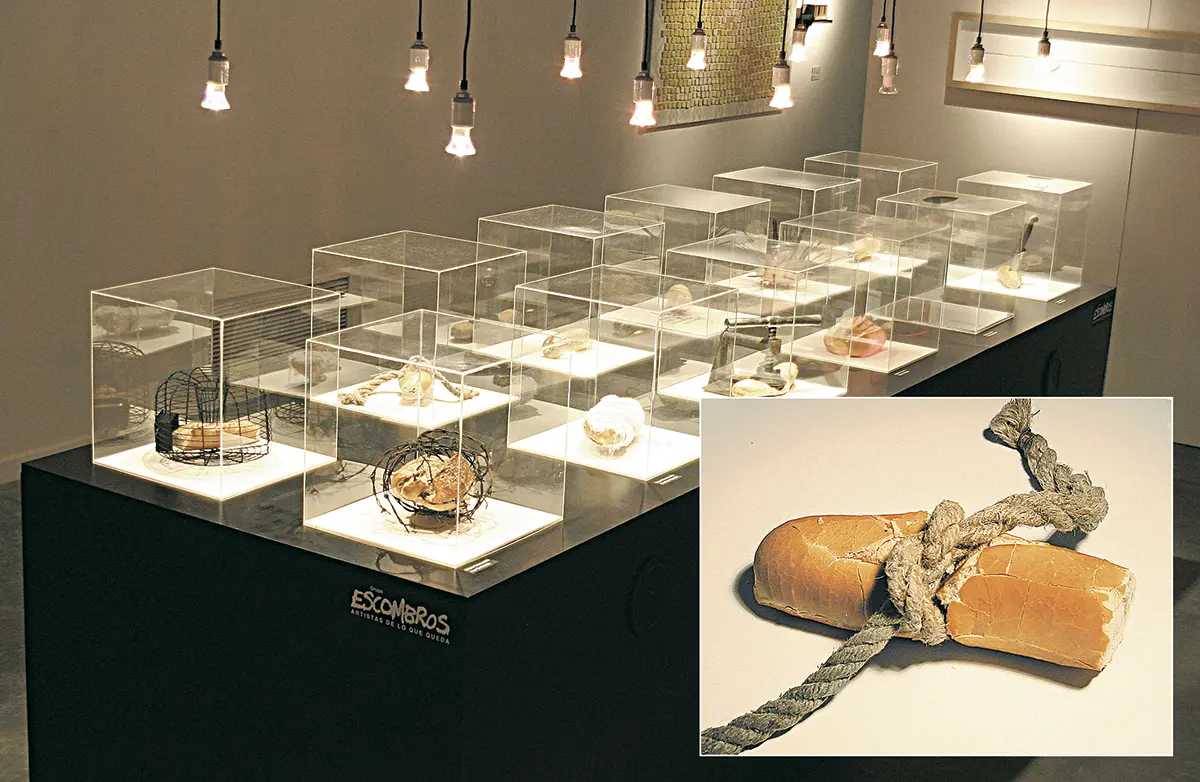
Arte al plato was a show presented at the Centro Cultural Recoleta, where Grupo Escombros took part in an installation on the topic of bread. It featured twelve loaves of bread, modified as a testimony of and protest against the daily absence of bread at the table of the poor.4 This series, which included Pan con púas, Pan incendiado, and Pan apuñalado, was accompanied by the image of a hand and a piece of bread that turned around one another without ever meeting, thus demonstrating the inaccessibility of everyday sustenance for those that society marginalizes. A similar metaphor is proposed by Mate argentino, a serial work in which the popular drink with its promise of warmth is presented in a state of obstruction, with a blocked, inaccessible pipe that cannot be shared.
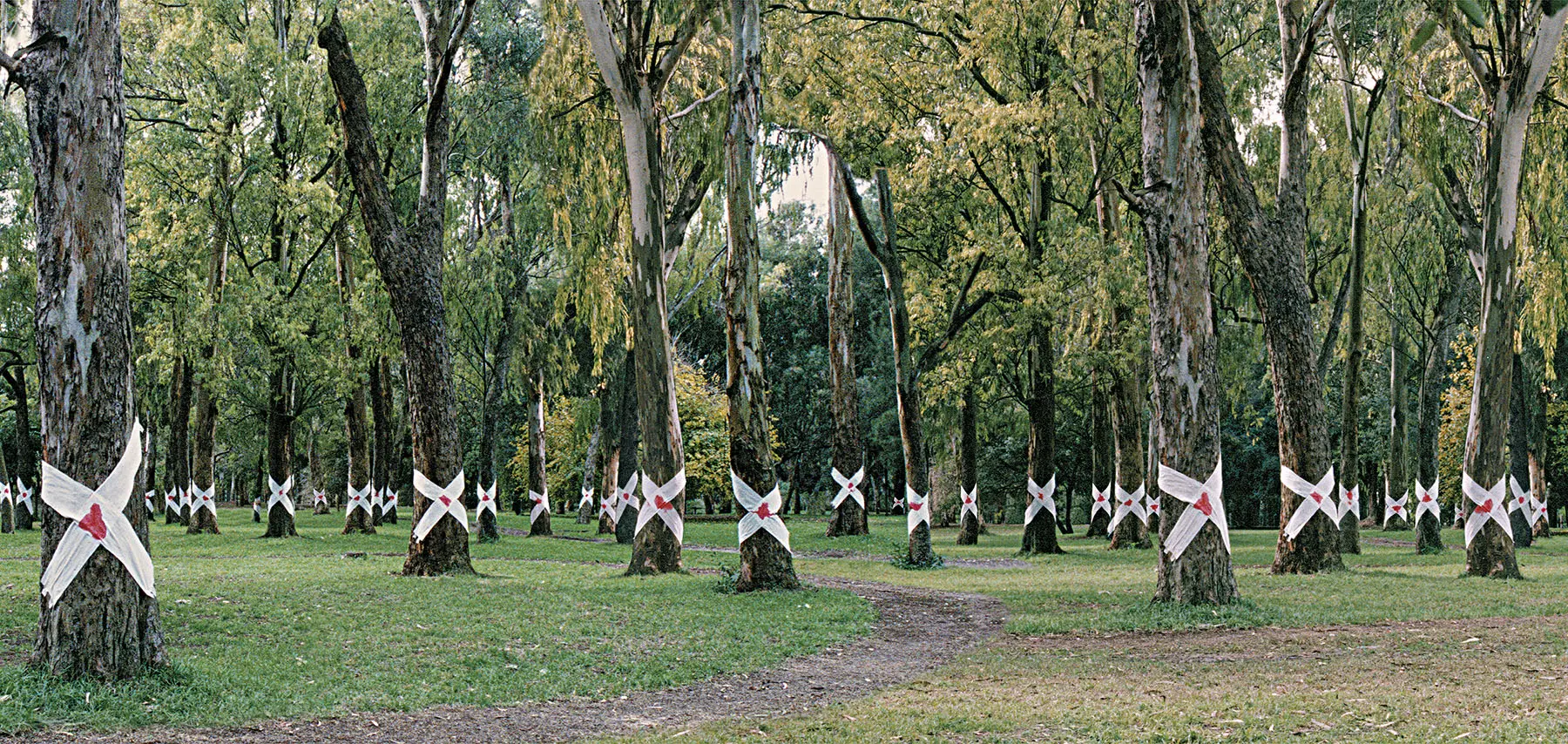
The group’s committed, militant activity has also been expressed as ecological demands. Crimen seriado was a performance in La Plata woods, where the group placed bandages on more than 700 hundred trees, as warnings about the dangers of deforestation. Another performance featured the pouring of water from the Riachuelo into serialized bottles. The intention was to bear witness to the fact that the Secretary of the Environment’s commitment to clean up the place in one thousand days turned out to be yet another lie and political failure. In collaboration with Greenpeace Latin America, this performance took place in the early 1990s in an abandoned factory in Avellaneda under the umbrella proposal De la cultura del abandono a la cultura de la recuperación. As part of this project, the artists also presented a four-meter-tall, three-meter-wide Pirámide built using plastic containers recovered from garbage dumps.
Also demonstrating the group’s ecological concerns is their Camposanto action, in which they nailed thirty one-meter-tall, white, wooden crosses that each bore the name of an endangered species.
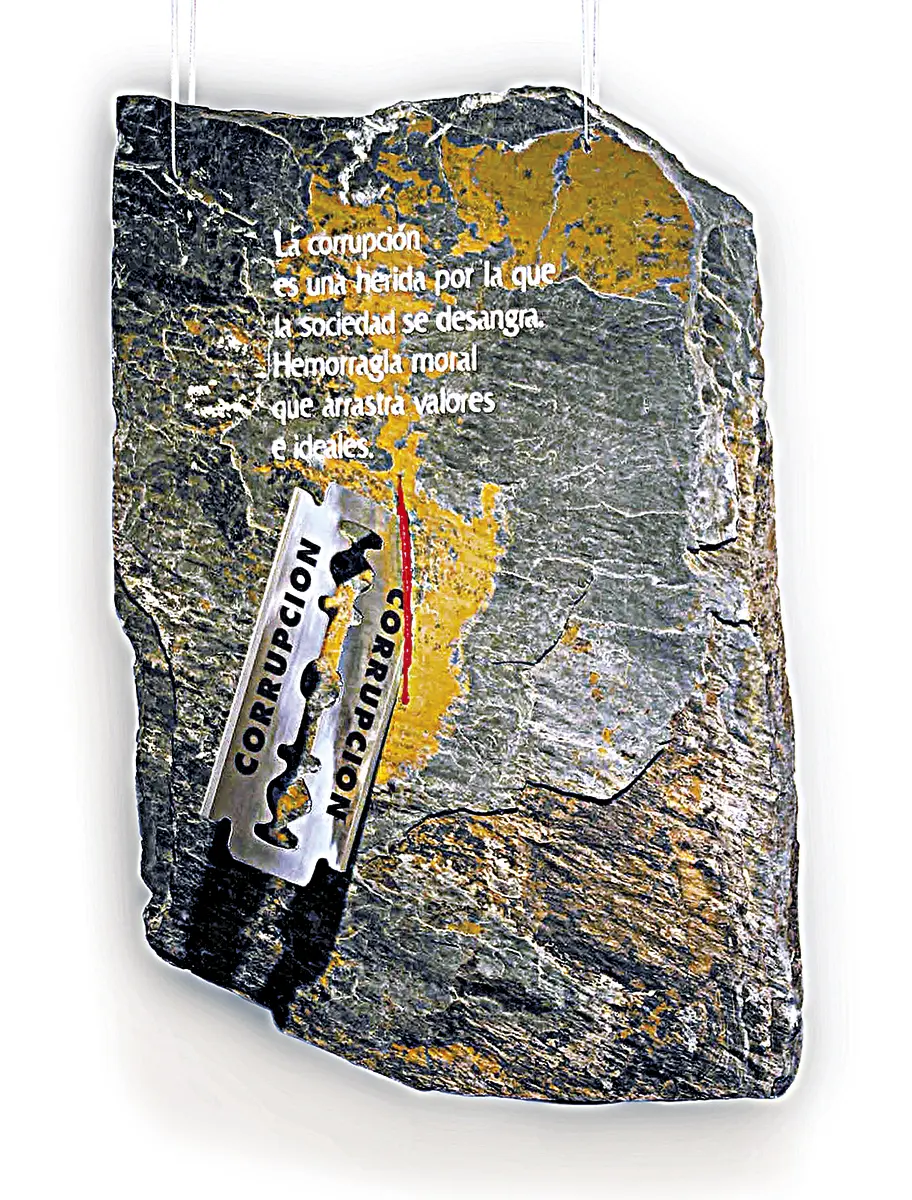
In another work, a shaving razor referred to corruption, at the moment in which it causes a wound and blood starts to flow. “Confronted with this work, it is inevitable that we think of the economic hemorrhage caused in Argentina by bribes, crooked privatizations, the purchase of consciences, the financing of electoral campaigns with public funds.”5
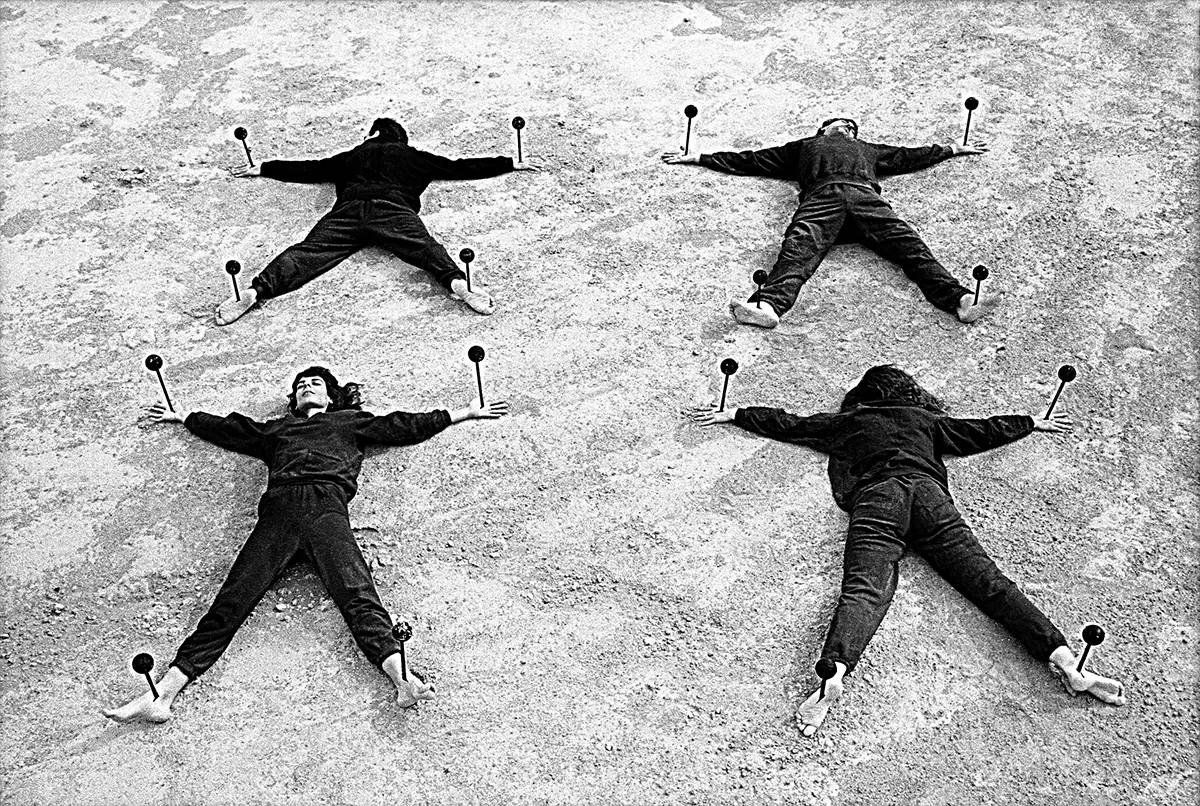
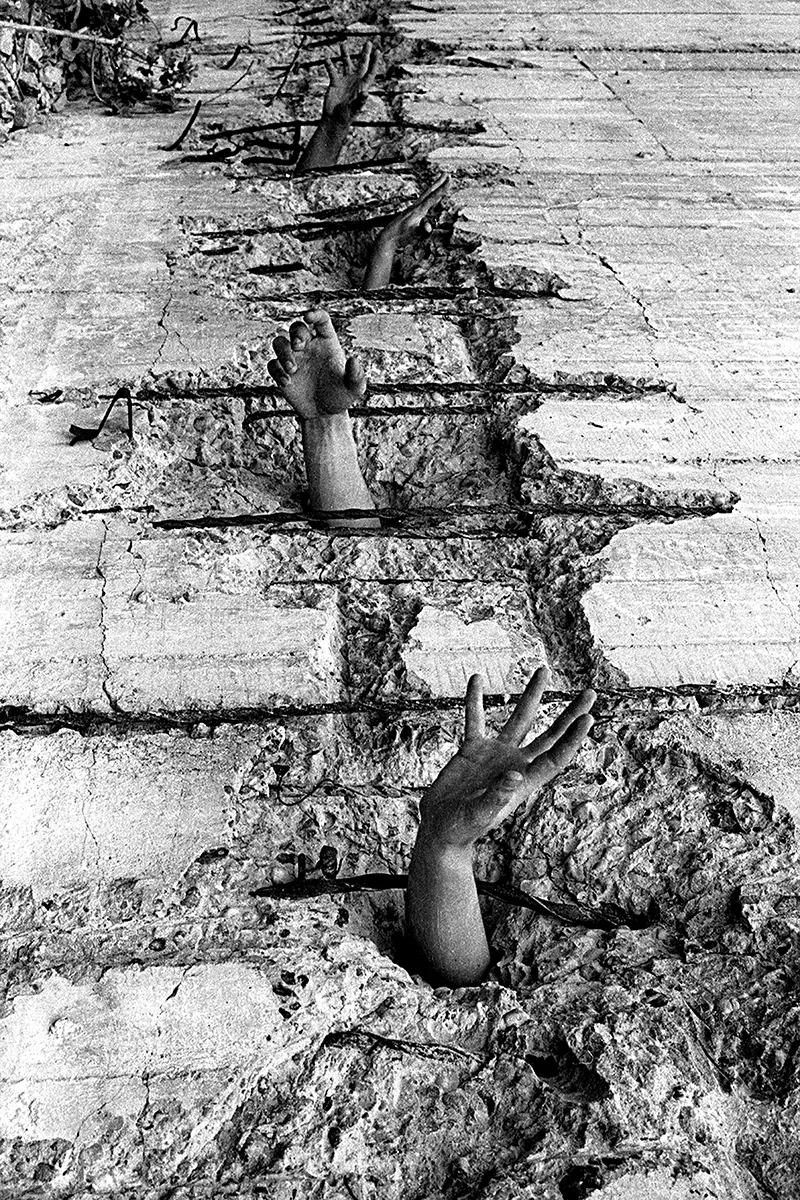
These protests have shown the most sinister side of humanity. Homo hominis lupus refers to Man persecuted, stalked, tortured, and destroyed by his own kind. The works stir a collective awareness of crimes against humanity and especially the unfortunate period of the 1970s in Argentina. Three photographic documents taken in 1988—Mariposas, showing beings nailed to the ground; Brotes, showing hands that emerge from the asphalt; and Procesión, showing a group transporting a dead body—are among other testimonies of the expressionistic, the blood-curdling way in which Grupo Escombros confronts the most destructive aspects of contemporary life.
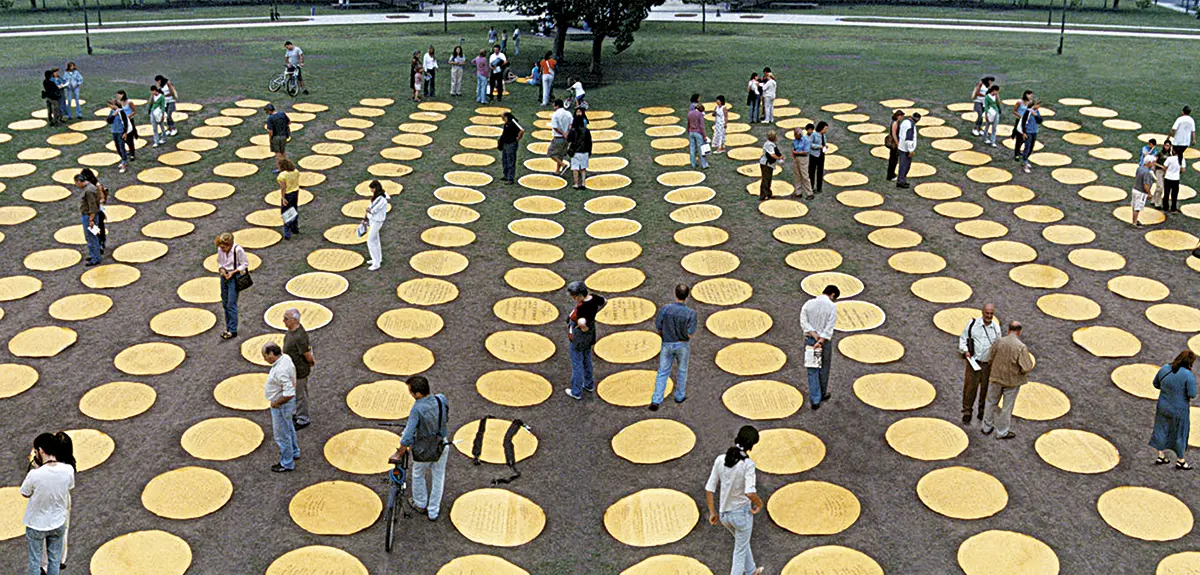
There have also been Grupo Escombros actions more related to poetry, like El bosque de los sueños perdidos and El sembrador de soles. In the former, the group hung fifty white cardboard sheets from trees in the La Plata woods and invited citizens to “write about dreams they have lost of had been taken from them.” In the latter work, they invited poets from three cities—La Plata, Berisso, and Ensenada—write their poems inside large-sized yellow circles distributed around Plaza Malvinas.
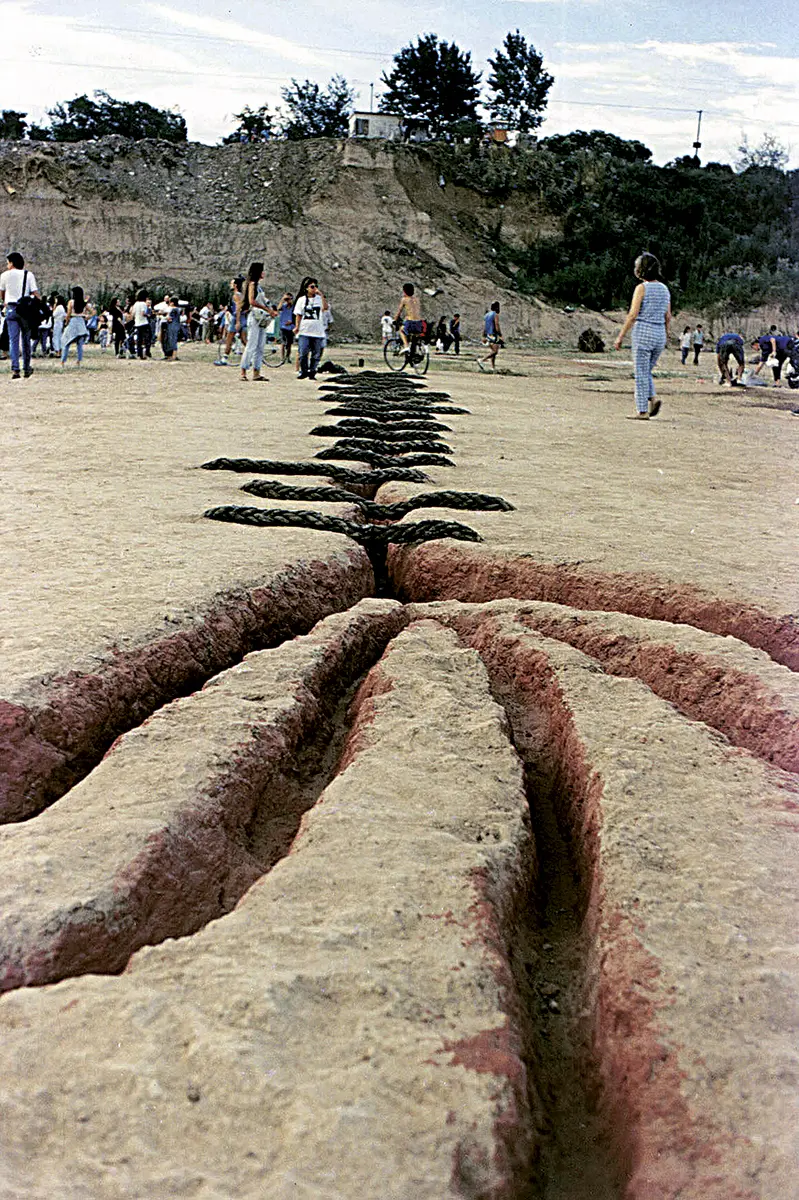
In December 1989, the Cantera de Hernández in La Plata, a devastated landscape, was the site of another convocation to create, fleetingly, La ciudad del arte, a “privileged place for material and symbolic exchange.”6 Grupo Escombros contributed Sutura, a thirty-meter-long, a one-meter-deep scar on the ground, sewn with rope—perhaps a metaphor for the separation between the earth and contemporary Man.
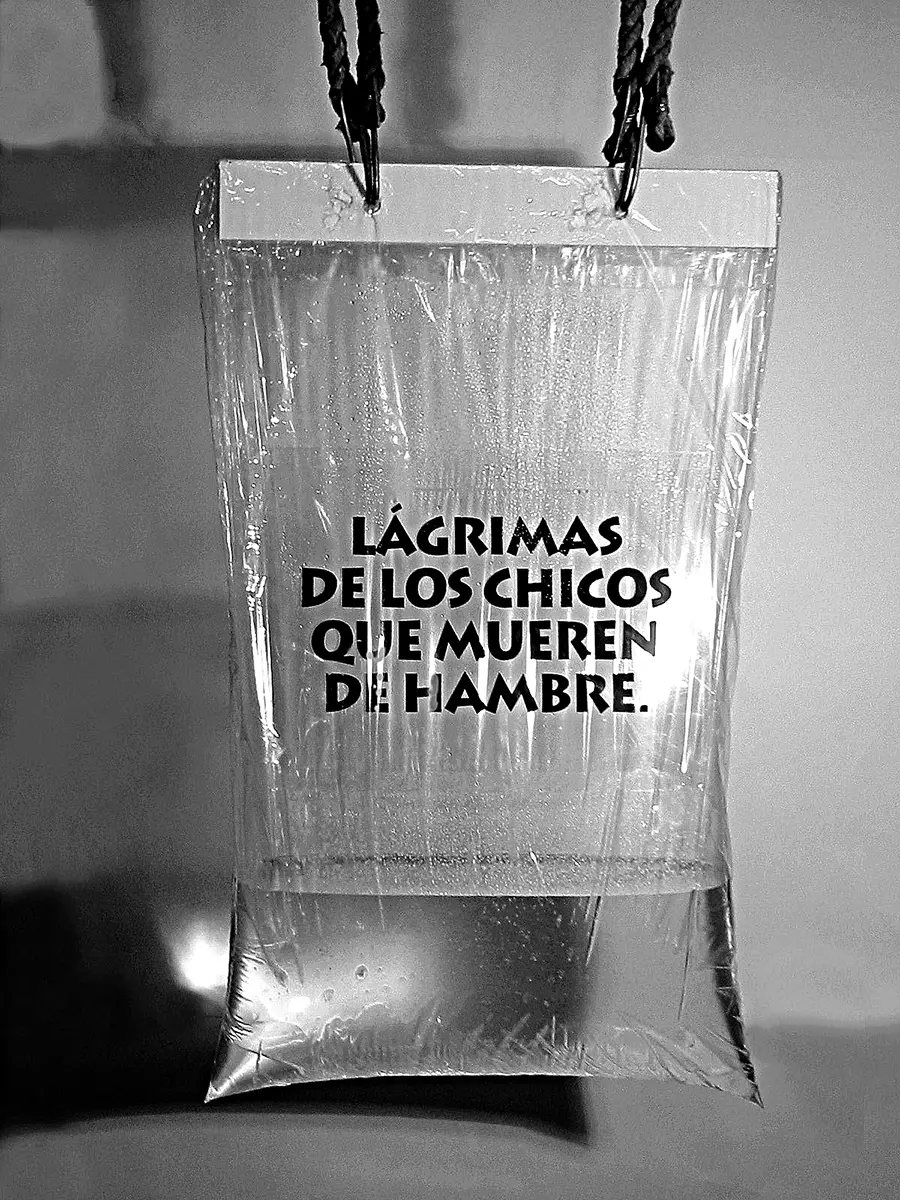
Starting with the show, they presented at Galería Archimboldo in 2003, the Grupo Escombros artists accepted the creation of symbolic objects as an alternative to their actions in public places. País de lágrimas consisted of clear polyethylene bags filled with water with inscriptions of provenance—tears from those who die of hunger, from those who can’t get an education, from those who are jobless, and so on.
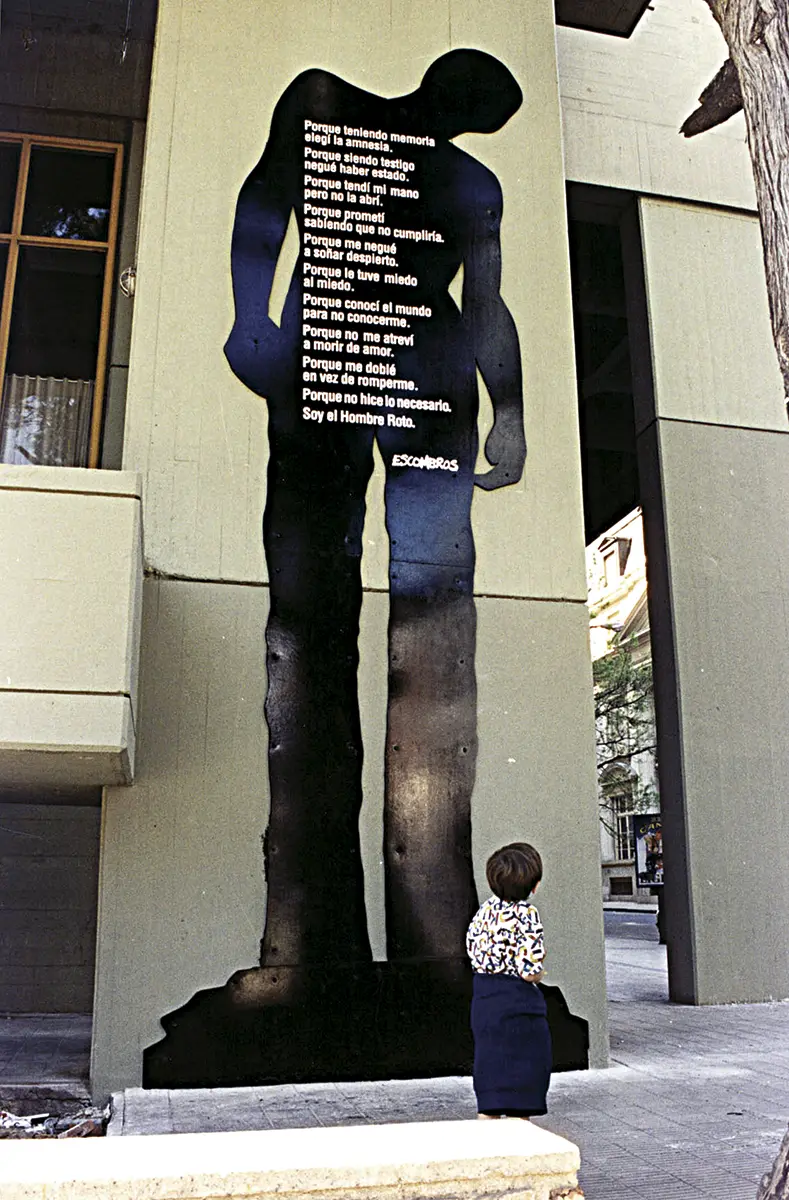
An “object of conscience” titled El hombre roto, with aphorisms inside, meant for the group another means of communication, adding to the more than 100 actions, installations, objects, and manifestos the members have created.
The group’s intention has always been to widen their public, not only by facilitating access to their messages but also by establishing a commitment from the starting point of work and affecting their observers with participation. Their efforts have been synchronous with the transformations that occurred in Argentina with a new generation of filmmakers. Pizza, birra y faso and Mundo grúa are vivid examples of the shift that is taking place in the perspective of locally produced films.
Against the banality propagated by the mass media, the message of artists who work with explicit ethical demands seem to respond to the program described by Fluxus as “to save the gap between art and life” and which had significantly driven the Italian Futurists in the early twentieth century. At the same time, by addressing problems shared by today’s urban denizens, these artists show their commitment to avoid the cultural industry’s general practice of aestheticization.
Grupo Escombros seems to acknowledge the words of Argentinean critic Romero Best: “It is not a function of artistic conscience to impose political solutions; its function is to create the possibility of Man to be individually liberated in order to consequently achieve social liberation.”7 The group’s work is deeply rooted in the contemporary. It situates itself in alternative spaces, in a line that rejects institutional limitations and the autonomy of art and opens itself up to an active exchange with a wide public outside traditional circuits. In this way, the work joins other urban interventions, video, and photography as formal and discursive innovations that attempt to amplify art’s potential for communication and critique.
Michel Maffesoli8 has said that the old social contract of a society based on rationality, a belief in the future, and the idea of progress is being replaced by a kind of fragmentation—a constellation of heterogeneous groups, of tribes of belonging that have to find ways to adjust to the needs of others until a balance is reached. The political has become so abstract that it has ceased to have any meaning for common people. What is needed is a domestic practice of politics: groups interested in what happens in the neighborhood, in what the man in the street really needs.
It is possible to say that the work of Grupo Escombros attempts to create a space for reflection about the demands of the community, and it finds—beyond any classification or label—a place to belong.
NOTES
1. M. E. Ramos, Acciones frente a la Plaza Caracas. Caracas: Fundarte, 1995. Quoted by Elena Oliveras, Estética: La cuestión del arte. Buenos Aires: Ed. Ariel, 2005.
2. The city of La Plata is the capital of the province of Buenos Aires.
3. This is according to Max Bense in the catalog for the show, held at the Museo Provincial de Bellas Artes de La Plata and the Torcuato di Tella Institute.4 4. This exhibition was organized and curated by the architect Liliana Piñeiro and held July–August 2003.
5. María de las Mercedes Reitano, Entre la esperanza y la desesperación, from the catalog of the show held at Galería Archimboldo, Buenos Aires, November–December, 2003.
6. María de los Ángeles Rueda, "Utopía en la calle" en La ciudad de las artes visuales. Buenos Aires: Ed. Asunto Impreso, 2003.
7. Política artístico-visual en Latinoamérca. Buenos Aires: Crisis, 1974.
8. "We are in the era of nomads and tribes", La Nación. August 31, 2005.
NELLY PERAZZO
Is a member of the National Fine Arts Academy and curator of the Badii Collection, Banco Francés (BBUV).