The exhibition Guillermo Kuitca. Punctual Works will be open to the public through January 29, 2007, with Sonia Becce as curator. The show comprises on one part, the highlights of his previous oeuvre in a selection of important works framing what has been his career as an artist and includes an overview of the formal and thematic development he has accomplished from the 1990s until the present day.
A pair of large-format maps welcomes the viewer to the third floor of Museo del Banco de la República. One of these features an intense blue color with cartographies marked by fonts and white outlines, and the other one, a strong pink color as the background. These two canvases titled Everything, 2005, contain the general context of the exhibition for they serve as an introduction to what is inside the hall: they bring the viewer to a scene that is familiar to them as is the artist’s work with maps. From afar they seem like abstract pieces with very subtle strokes as if they were an elemental drawing on a plane surface of only one background. The initial perception of simplicity in these canvases contrasts the overflowed information that one can notice once near them, in cities, streets, and determined places with numbers, cardinal signaling, and all kinds of explicit locations that make the viewer conscious about the infinite universe of referents that exist in the dialectic from the general to the singular. Thus, from such immensity, a classified and ordered world rises highlighting the ever-present hurry of mankind for pointing out limits, for defining their place in space, for labeling the surroundings, which somehow allows him to feel in control of himself.
The series of circular works, titled Diaries, calls to our attention; it is a production carried out in intervals from March 2000 through May 2005. Each of the 19 works is a canvas that gathers notes, drawings, paint spots, plane surfaces from other works by the artist, telephone numbers, scheduled appointments, and all sorts of elements that register a particular portion of everyday life which can not necessarily be told in a lineal way and which is even impossible to decode literally. In such register, Kuitca finds a less conventional way to give a testimony of his daily life and involves the creative essence of his activity as an artist in outnumbered components that build up his own imagery. Each work slowly becomes pictorial mobility. Each canvas is the unique tale of a context, a moment, and environment of concepts that the artist gives priority to, and altogether they become an amazing clue of the passing of time.
In another segment of the exhibition, we encounter canvases from the “nocturnal” works series in which blueprint surfaces sustain aerial views of various places that though defined as specific (offices workplaces, mini-golf fields, legislation chambers), do not necessarily correspond to a certain reality. These “imagined sites” demand somehow some truth for their representation circumscribes as an architectonic blueprint, which is a careful document and supposedly credible in a three-dimensional spectrum taken to two dimensions. Once again the model of representation and classification is questioned. The artist plays here with the dilemma of dimensions in such a representation. These deep blues are allusive to the rendering rulers with which image assemblies are done in television productions. The renowned beds from 1992, are placed in the middle of the exhibition hall. Here, the made-up maps take over the mattresses again. The artist draws imagined cartographies of rivers, highways, paths, regions, and even mountain chains of the world and of punctual regions such as the Departments of Santander or Caldas in Colombia.
The yellow prison cell is another canvas with a drawing that resembles the architectonic blueprint of a pentagon space in which Kuitca distributes what would be the cells for the inmates, with their corresponding beds and pillows. The fact that this prison compound does not have any doors or exit ways, at least represented in the drawing, is shocking. The idea of a “jail” becomes much stronger for it implies a total and hermetic closure. Even in the borders of such pentagon building, with an overwhelming careful work, the artist draws with infinite rounded and small lines, what would be a wall made of stones, also without access from the exterior to the interior and vice versa. It is almost an unsolvable labyrinth-like riddle.
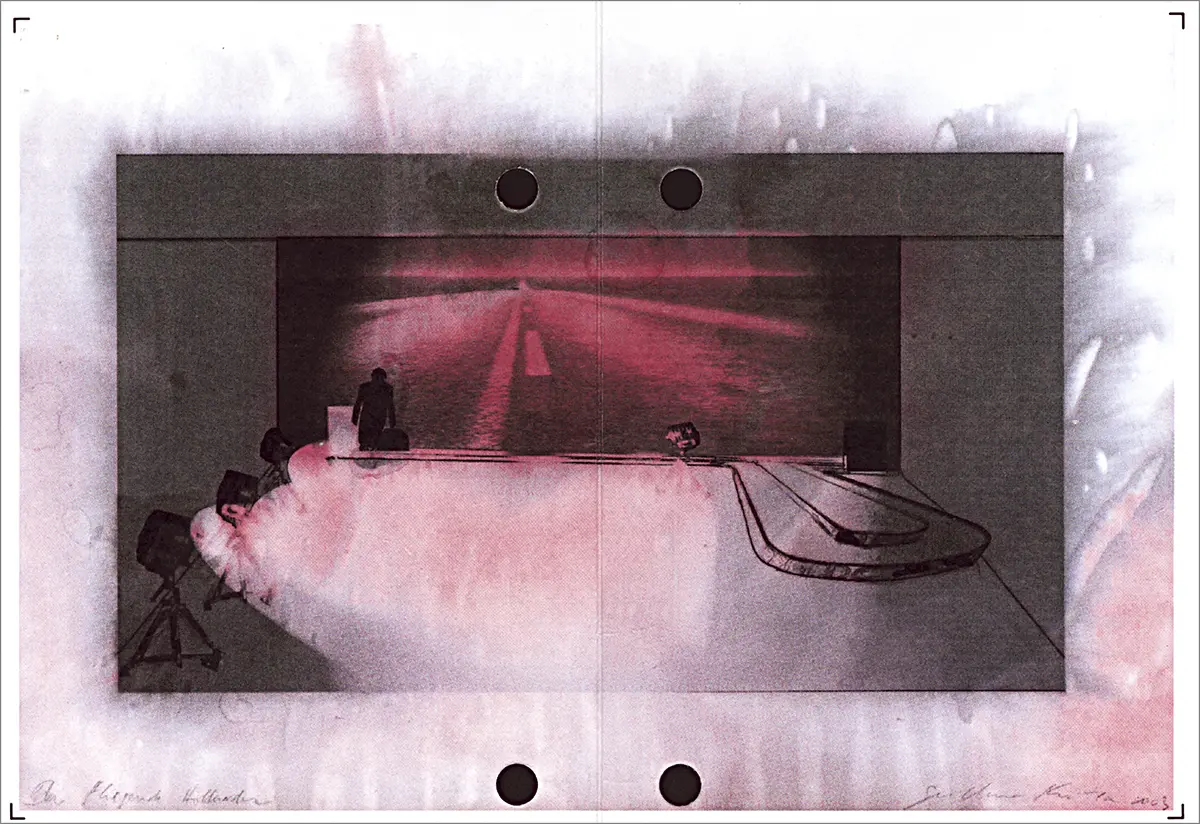
A little further are several models of Kuitca’s moving bands and documents of the real installation that was set in a theatre space, representing an adaptation of Wagner’s The Drifting Hollander. Again in the mobile bands (used for traveler’s luggage in airports), the concept of the passing of time is present. The surface that transports is the metaphor of the Drifting Hollander’s ship. All this exhibition is an exploration of the rupture of limits since it analyzes the possibilities of infinite formats, even involving sound, video, drawing, and theatre performance as tools that give the main focus of his work (painting) a renovated impulse. Such focus defines Kuitca’s production in general, but in a singular manner, it defines the construction of immensely rich reality in the sense of expression, materials, and media, which describes thousands of possible worlds departing from abstraction.
MARÍA JOSÉ RAMÍREZ