
Con la derecha furthers the development of a project the artist is carrying forward on a peculiar support: the armrests of school desks for right-handed users, heavily intervened by the students that originally worked on them, with the caveat that all the armrests were purchased by Junca in the school he attended years ago.
Junca’s exploration expresses a sustained interest in taking into account that visual activity that is not part of the institutional art world. This project is devoted to disentangling commonplaces of adolescence, unveiling them and reminding us of the transgressive sense implied in our intervening an object on which we are not supposed to write, but which is nonetheless carved, drawn on, scratched by anonymous students, with the result of a unique visual pattern. Junca’s interest in creating works of art that do not seek a one-dimensional, evident reading is visualized in this reference, devoid of nostalgic undertones, to spaces that were common to most observers, with elements that are there to be used and to become controversial.
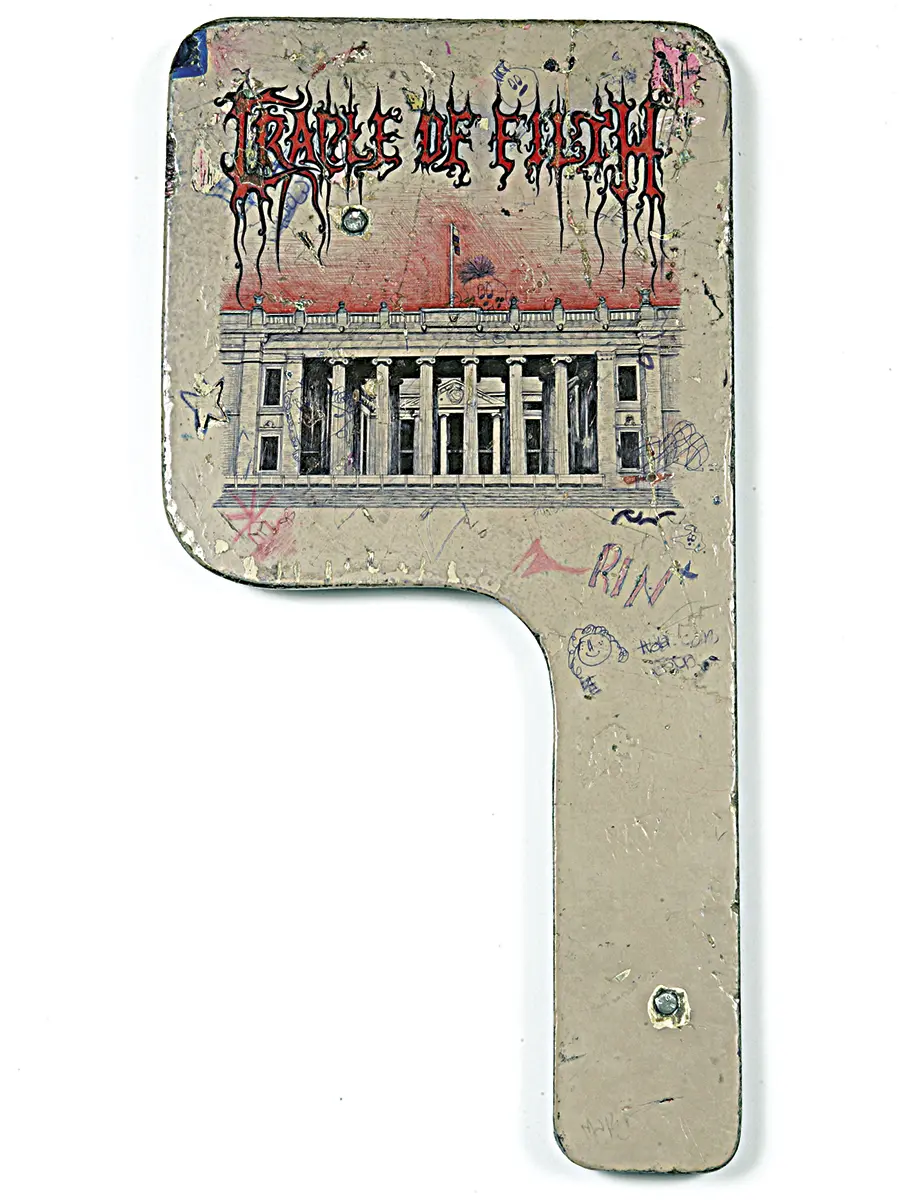
The show presented three series, interconnected through their way of mixing and relating different signs. Dawn Right is a triptych with mages that underscore the symbolic meaning of the physical sites of power such as the Capitol building, and the characters that possess it: the presidents of the United States and Colombia. This direct allusion to power comes accompanied by another area of interest in Junca’s investigations: urban musical genres such as rock. Each section of the triptych alludes to a rock band that has a referential status for different generational groups: Kiss, Sodom, and Cradle of Filth. These bands’ logos, carefully rendered, accompany the images of hot contemporary political situations, in a transgressive relationship between symbols of power and rock bands. But the reference is not gratuitous; it alludes to the origin of the object because those who write on the desks usually include the name of their favorite band. Junca’s use of a drawing ball pen generates greater complicity between the original students and the artist, through a tool that is common to both.
The second series, Ornamento y Delito, alludes to the title used by Adolf Loos in a polemical 1908 text that questioned the use of ornamentation as a holdover from the past and argued in favor of abandoning it as part of a process of necessary changes in art and architecture, and was very influential on several modern movements. Appropriating this phrase, Junca refers us to the present, to his particular use of those desks intervened by teenagers without artistic legitimacy in the eyes of institutional art, but validated by his further intervention.
The images in Ornamento y Delito record the portraits of fifteen ex-presidents of Colombia, a gallery of important men selected not based on a personal decision by the artist to highlight certain characters, but by an editorial group, as the cover of a book on Colombia’s presidents between 1810 and 1990. The traditional presidential portraits are contaminated with rock-band logos in a kind of prediction of the future: the increase in the level of contamination that is allowed and even promoted from positions of power. The irony is not absent, because the relationship that the image establishes is between those influential figures and rock bands that tend to criticize them in their songs. Also, the logos chosen are of Black Metal and Dark Rock bands, genres that focus on the Middle Ages, obscurantism, a return to the primeval. The logos, operating as texts under the portraits, are also conceived as elaborated images, in a relationship that surprises us and controverts the archaic presidential portraits.
The third series, from which the show takes its title, Con la derecha, records a new intervention by the artist, respectful of the pre-existing doodles. On those desks, the themes are various, with images accumulated over the course of an entire school year and accounting for interests, preoccupations, and points of view about everyday events. Besides the political allusion he makes in the title, the artist illuminates the collective nature of the work, as he finishes what the transgressive students began.
Junca’s approach to the concept of the bricolage allows him to detour the traditional use of objects, so that what is considered an act of vandalism, scratching one’s desk becomes an artistic resource. The idea of the bricolage deployed here seems to take into account Levi-Strauss’ characterization in La Pensée Sauvage, when he says that whoever uses this method appropriates elements found in their surroundings, already loaded with their own meaning, and by reordering them within new codes, gives them a new meaning. And undoubtedly Junca achieves this with his desks.
IVONNE PINI