
Pospretérito is the title of the exhibition presented by Jonathan Hernández (Mexico, 1971) at the Sala de Arte Público Siqueiros (SAPS) in Mexico City. Comprised of five works, the show emphasizes the passage of time, the frantic changes undergone by cities, and the nostalgia that overtakes us as inhabitants of those metropolises.
For several years, Hernández has been researching the urban environment, its alterations, and the traces of registers left by the passage of time. In the same line, this exhibition makes reference to the urban environment and its continued metamorphosis, in specific the evolution of Mexico City.
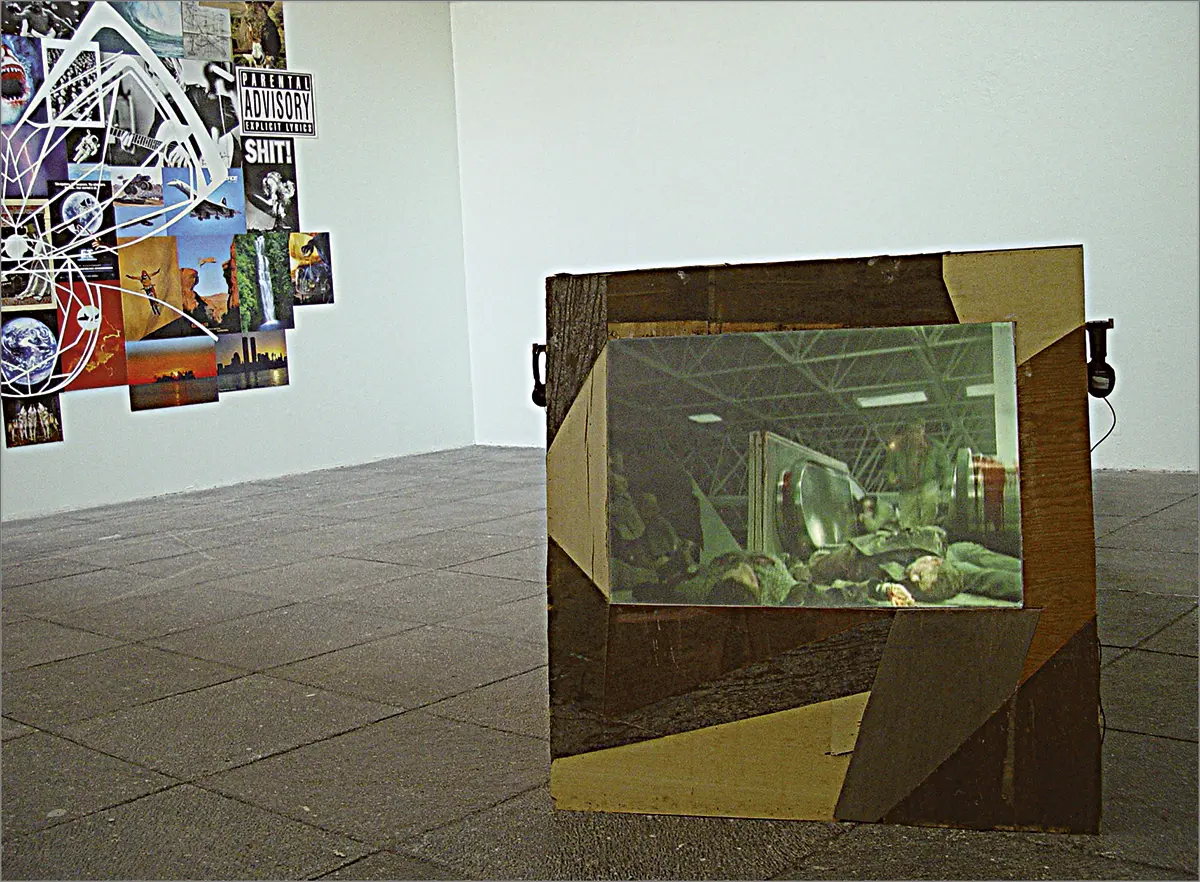
The exhibition’s centerpieces are two projections placed at each end of a single structure built in recycled wood, in the form of two conjoined sections of a transversal pyramid. This sculptoric element makes reference to the clashing perspectives used by muralist David Alfaro Siqueiros, with whose work, like almost all the artists who exhibit in this space, Hernández sought to establish a dialogue.
The work that welcomes the visitor is a video titled Recall Total, a fragment of Paul Verhoeven’s 1989 film Total Recall, which was filmed on location in Mexico City, which stood in for a post-apocalyptic city where chaos had triumphed over order while life continued its course. Hernández revisits key scenes filmed in the Insurgentes subway station plaza and inside the Chabacano subway station and intervenes in the film’s original audio. While Arnold Schwartzenegger and other characters engage in an intense chase, in the background we hear music by Stravinsky, interrupted every so often by a brief messages —similar to the subway’s PA announcements— in which Hernández makes clear that everything we are seeing is fiction and brings us back to the reality of Mexico City. The artist plays with the inversion of the film’s title as he names his work in order to convey the idea that what we see in the film is a total, but fictional, recall, like a lot of what takes place in this city’s everyday reality.
The second work, Antes y después D. F. —projected on the structure’s opposite end— is a dual projection of images. On the basis of a series of old photographs found in a dumpster, Hernández creates a new project. The old images present various Mexico City locations in the 1960s and 70s, from a restaurant façade to newspaper stands to general views of the city. Hernández returned to those locations and photographed them, thus not only bringing to the fore the passage of time but visually determining the transformation of the city. Besides Mexico City’s obvious architectural evolution, this work shows changes in fashion, style, automotive design, and urban expansion both sideways and on a vertical axis. A series of images that on the one hand allow for a game with memory and on the other communicate nostalgia for what has been lost, for what was never ours.
A series of postcards published in different decades comprise Pofupoji (2005-2006.) Images of the Popopocatéptl volcano, the guardian of Mexico City, encounter —and occasionally become indistinguishable with them— images of Mount Fuji, the guardian of Tokyo.
Souvenirs, bulky letters made with mirrors and acrylic brings to mind prior works by Hernández in the same format. Mounted on the wall at eye level, these letters form the word “souvenir.” Placed in front of them and reading the message, the viewer is reflected. By way of metaphor, this works seeks to bring to the viewer the memories of what he or she has seen, lived, remembered, and to reflect it, thus losing it in the infinity that results from the encounter of reflection and imagination, as if in contraposition of mirrors. Hernández appeals, then, to the viewer’s imagination, and allows the viewer to glimpse a different way of perceiving time through imagined memories.
The last work, titled Mural, is comprised of a series of posters chosen by Hernández, displaying various images, which could very well hark back to other works by the artist related to tourism and displacement. On top of these posters, we see lines and tracings that refer to one of Siqueiros murals at the SAPS.
While the works in Pospretérito can function independently, in their contraposition Hernández generates an interesting dialogue where we can read the effects of memory and imagined remembrances, and determine the way to hold on to time, to record it in order to understand it and in this way to better face the future.
ANA ELENA MALLET