
It is a privilege to witness the pre-history and the history of Landings. This contemporary-art project, led from the beginning by the curator Joan Duran, has completed its third edition and is preparing its fourth for next year at the Museo de Arte y Diseño Contemporáneo (MADC) in San José, Costa Rica. Another of Duran’s project, ZERO, was Landing’s antecedent and was carried out as part of Duran’s duties as Belize’s ambassador, with the explicit mission of helping to promote that country’s art. The same can be said of Belize’s award-winning delegations to the fourth and fifth Caribbean Biennials.
In all of these cases, what is notable is the relevance reached by the curator in contemporary art exhibitions. It is a role in between that of a good film director and that of a teacher because the task is to coordinate individuals without smothering them, helping them extract from themselves that which is most their own, and providing a balance for the whole. As in any creative line of work, personal styles are always present. With Duran, his style is direct and immediately obvious: a balance of two- and three-dimensional works, video and performance works to represent movement, and even sound, alongside a serene orchestration of space and light, impeccable attention to detail, and excellent catalogs that document the works exhibited as well as the process of implementation.
An Instrument for Coexistence
If, following María del Corral, one takes the position that the goal of contemporary art is not to create masterpieces but “instruments for coexistence,” than a project like Landings, despite its extreme formal rigor both at an individual level and at the level of its staging, is more than current.
The first Landings were located in the former Yucatan convent of Conkal, a few kilometers outside Mérida, Mexico. This seventeenth-century Franciscan building already housed a small religious art museum with works like a St. Michael, a reminder that the Christian archangel was syncretized with an indigenous wind deity in these hot lands. With the wind or against it, young artists from Belize, the Yucatan, Guatemala, Cuba, Trinidad, and Honduras arrived there on the occasion of Landings 1. They appropriated the spaces of the convent, provided them with new meanings shared the experience of creation with their cohorts from different countries, and then left. Landings 2 was held in early 2006 in a specially conditioned former primary school in Mérida and Landings 3 was at the Centro León in Santiago de los Caballeros, Dominican Republic, an institution that specializes in the culture and art of the Caribbean region.
Present in the first three Landings have been artists from Panama, Costa Rica, Nicaragua, Honduras, Guatemala, El Salvador, Mexico, Aruba, Haiti, the Dominican Republic, Trinidad, and Belize. For Landings 4, the total number of artists will be about thirty, including many new faces, a majority of women, and a majority of artists under thirty years old. The project will continue with exhibitions in New York, Washington, Havana, and Barcelona, and will end in May 2008 at the Museo Extremeño e Iberoamericano de Arte Contemporáneo (MEIAC), in Badajoz, Spain.
Notes on Nomadism
The exhibition would seem to be one of the most typical expressions of twenty-first-century culture, if one agrees with Jacques Attali’s idea that the nomad is the “human archetype for the century.” Since about thirty years ago, five percent of humanity has been nomadic, as landless peasants, political refugees, and migrant workers, and the number is growing. Historically, nomads have always been producers of art, music, statuettes, jewelry, paintings, oral literature, and all varieties of portable works. According to this author, the contemporary nomad is defined by ethics of lightness and by vigilance, hospitality, freedom, interconnectedness through the modern media, and a strong sense of fraternity. Absolute respect for the norms of the sedentary person who embraces him or her is one of the nomad’s cardinal virtues.
Each Landings project is, in that sense, an expression of this very contemporary form of nomadism. Each project is different and adapts to each specific space and its norms. The artists whose work is to be exhibited come in part from previous Landings, but each project also includes new names with new proposals and reveals the curator’s latest findings.
The Wonder Camera
One of the principal characteristics of Landings 3 was the importance given to video art, as compared to previous editions of the project. The box-like structure and the dark walls of Centro León’s temporary exhibition gallery recalled the structure of a movie theater and the sacramental quality of experiencing cinema before the advent of the VHS and the DVD. The exhibition area became a world separated from every day, discontinuous with the pragmatic space of daily labors. Here, magic, reverie, and hyper-reality became possible once the threshold was crossed.
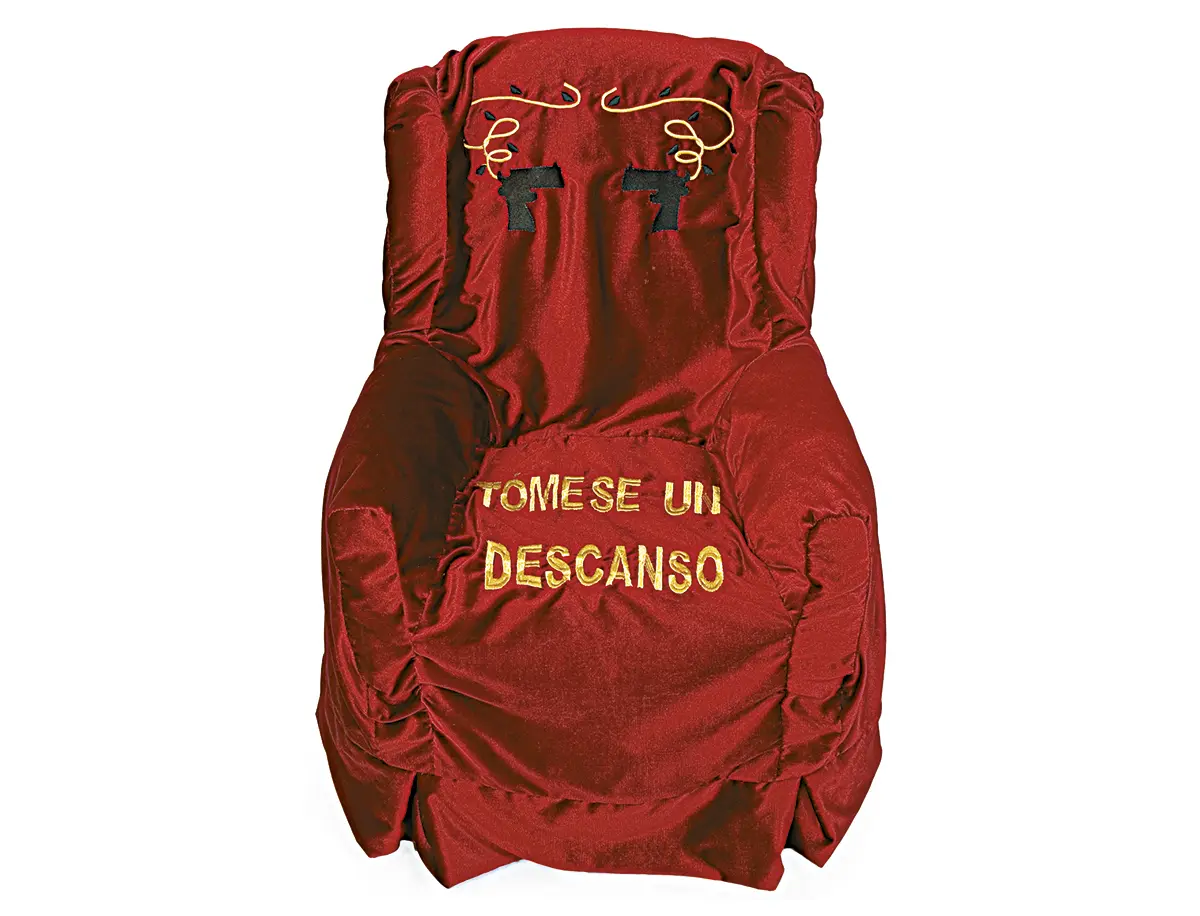
In the back of the room, in a space that could be read as an altar, stage, or large screen, Ryan Oduber’s video traversed the border between fantasy and reality with the image of a golfer striking balls that turned into airplanes. The viewer saw this from a crimson velvet throne-like chair, placed by Gema Ríos, which altered one’s sense of the real and one’s balance; a voice told viewers upon sitting to immediately “find your lane.”
The center of the exhibition area was taken over by a rectangular room that echoed the dimensions of the gallery and featured a series of videos, among which were a few highlights. Thelma García’s work, in which a young woman cries on the New York City subway, oblivious to other people’s attention, was notable because it revisited the artist’s interest in feminine intimacy and encounters of the public and the private, on different terms; in her previous works, García connected more to the theme of eroticism. Ryan Oduber’s vision of a person affected by Down Syndrome singing children’s songs assumed a neo-romantic position by questioning stereotypes not only of what constitutes beauty but humanity itself. In their works, José Alberto Hernández explored images like signs, José David Herrera offered an analytical approach to objects, and Lucía Madriz and Paola Reyes fused formal games to an ecological discourse. For Samuel + Alexis, video art is above all a stirrer of consciousness, while Yasser Musa, with his Fidel Castro's video brought humor to his exploration of political myths. Valentina Bosio, in La risa del agua, rehearsed a poetics of flow and permanence.
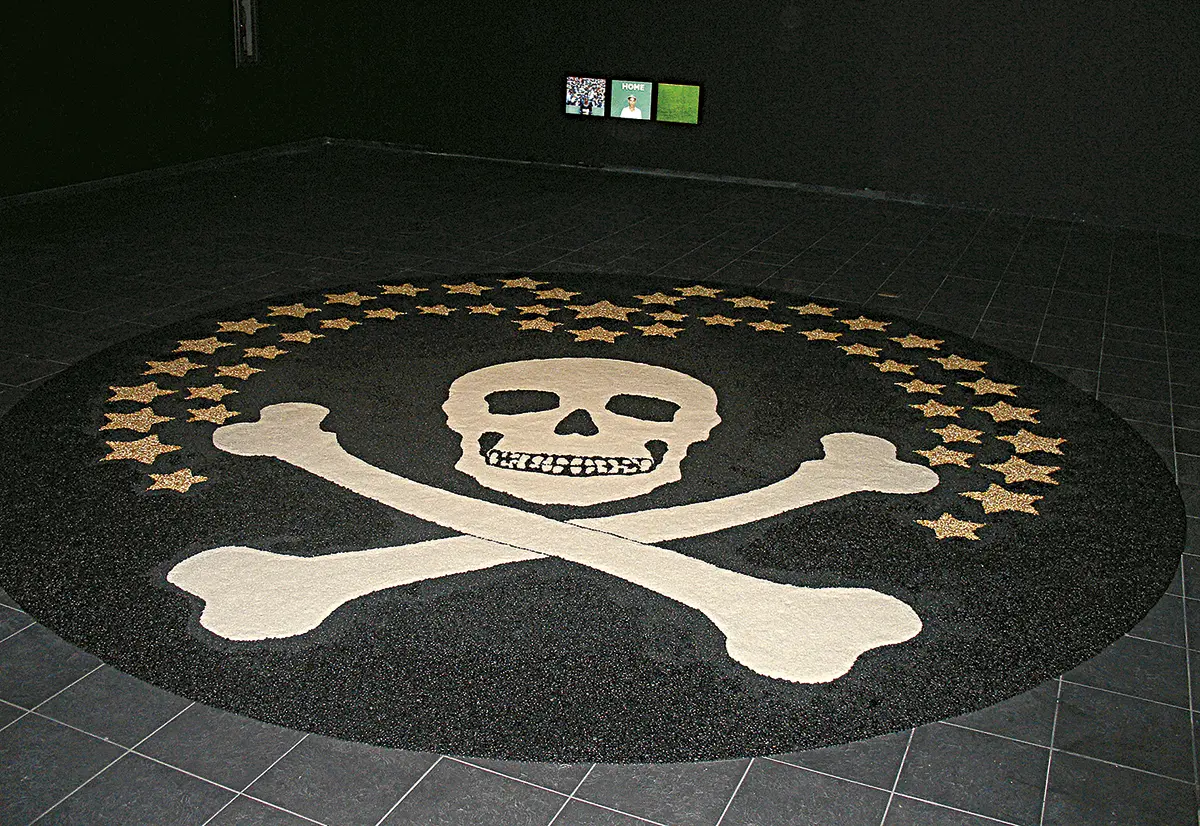
Santiago Cal, one of the most significant young artists in the isthmus and island region of the Caribbean presented a female child figure as enigmatically fascinating as his work usually is, made of estrangement, poetry, and mystery and somehow suspended outside of time, as if she arrived with amazement from a different world. In a work somewhat related to Magritte’s visual paradoxes, Samuel + Alexis executed a complex and imaginative semantic game with a book written in invisible ink and a lamp, which also evoked the dialectics of the visible and the invisible in language that so interested Rilke, Heidegger, and Merleau-Ponty. In his work, José Alberto Hernández identified the victim with the projectile that hit her. Lucía Madriz, with a “carpet” made of seeds, surprised the viewer with the immediacy and communicative efficacy of her ecological message.
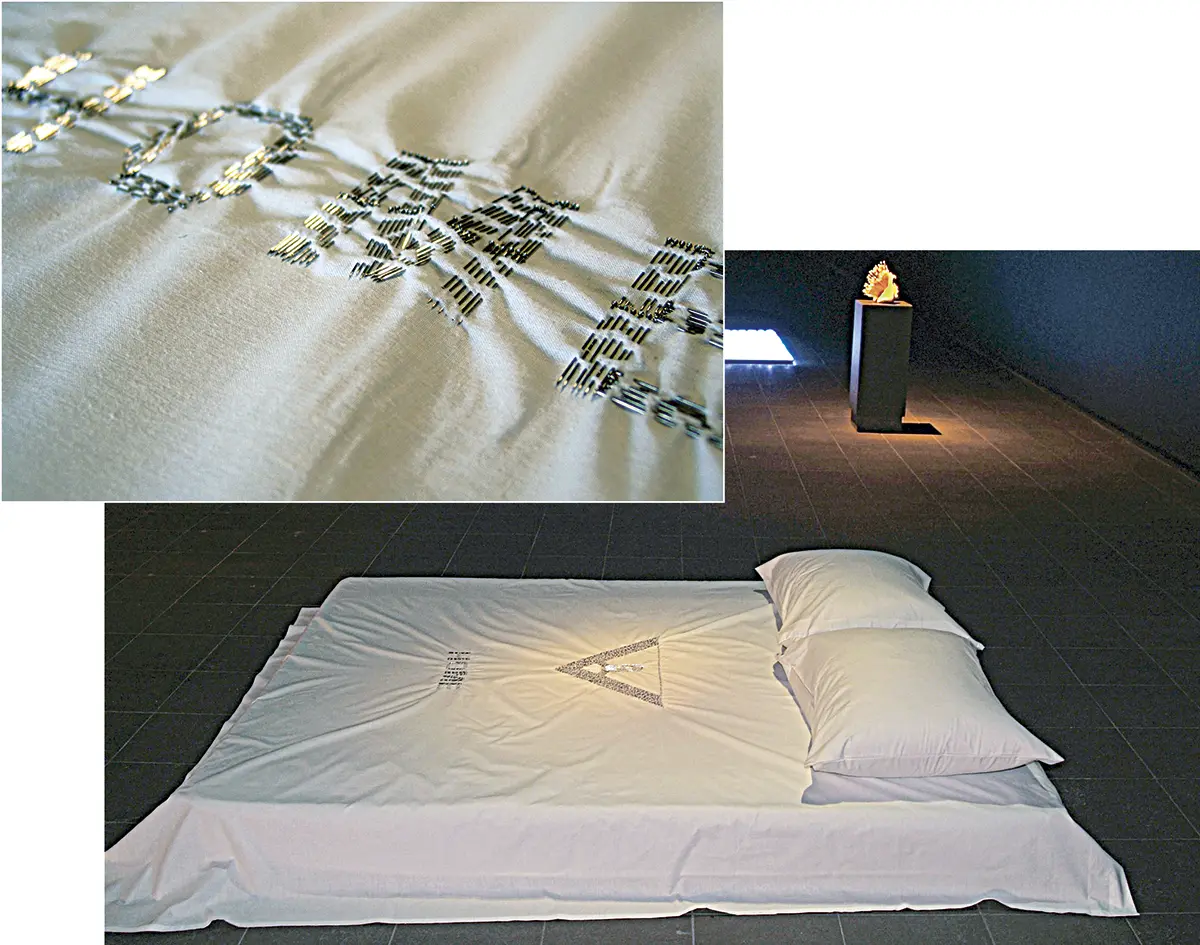
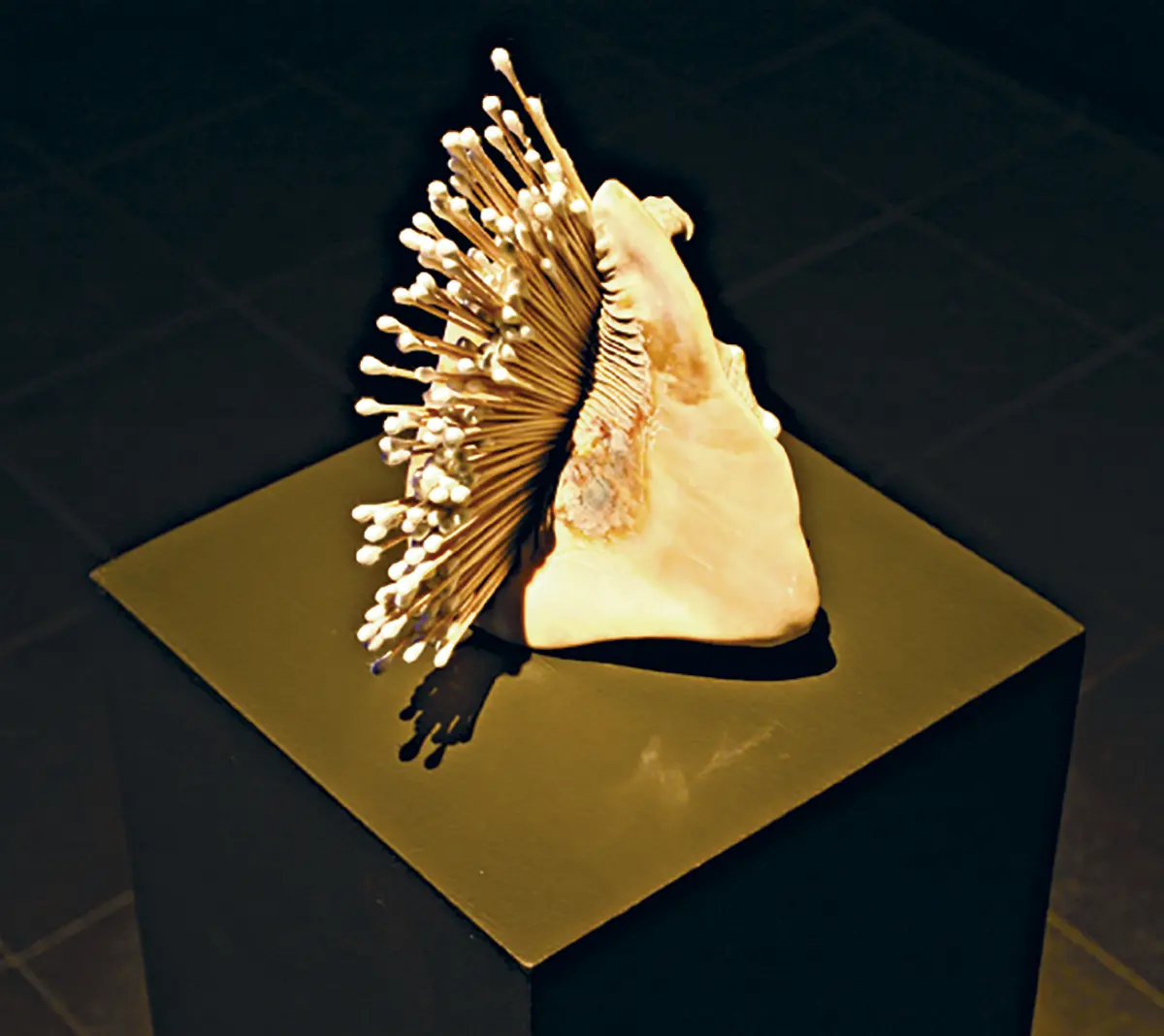
Anyelmaidelin Calzadilla analyzed the socio-political connotations in the semiotics of everyday objects, Isenberg + Zafrani explored the socio-cultural importance of playing, and Richard Holder monumentalized the figure with a kind of unfazed eroticism in the photographic image. In his work, Said Omar Charruf transformed an electrical oven into a lightbox. Adán Valecillo is a virtuoso of the found and intervened object, and of verbal and formal games, as seen in his integration of shells, ships, and Q-tips. As in previous Landings and the Yucatan Biennial, Vanessa Rivero took the art of embroidery and its connotations of a private female realm to the terrain of conceptual art. The Dominican artist Patricia Castillo defined a poetics of opposites, giving shape to shapeless water with small plastic bags and controlling the interplay of light and reflection that, for the Impressionists, was the paradigm of the uncontrollable ephemeral, of the world’s essential impermanence.
LAURA GIL