
Challenging Francisco Goya, the canonical artist whose work is justly considered a precursor to modern art, is not an easy task, but that is precisely what María Brito assumed in her recent exhibition, Las Goyescas. She fulfilled this task rather well.
With the elegance and the boldness of an artist who knows what she is doing, the exhibition revisited twenty of Goya’s famous prints known as Los Caprichos—those disturbing images of greedy friars, forced marriages, or witches’ covens. Brito’s well-crafted technique transfigured these images into small white sculptures that shone like strange apparitions throughout the gallery. With misleading ease, Brito achieved the singular metamorphosis of transforming Goya’s dark descriptions of nineteenth-century Spanish customs into white three-dimensional tableaus that are also an opportune commentary on current events.
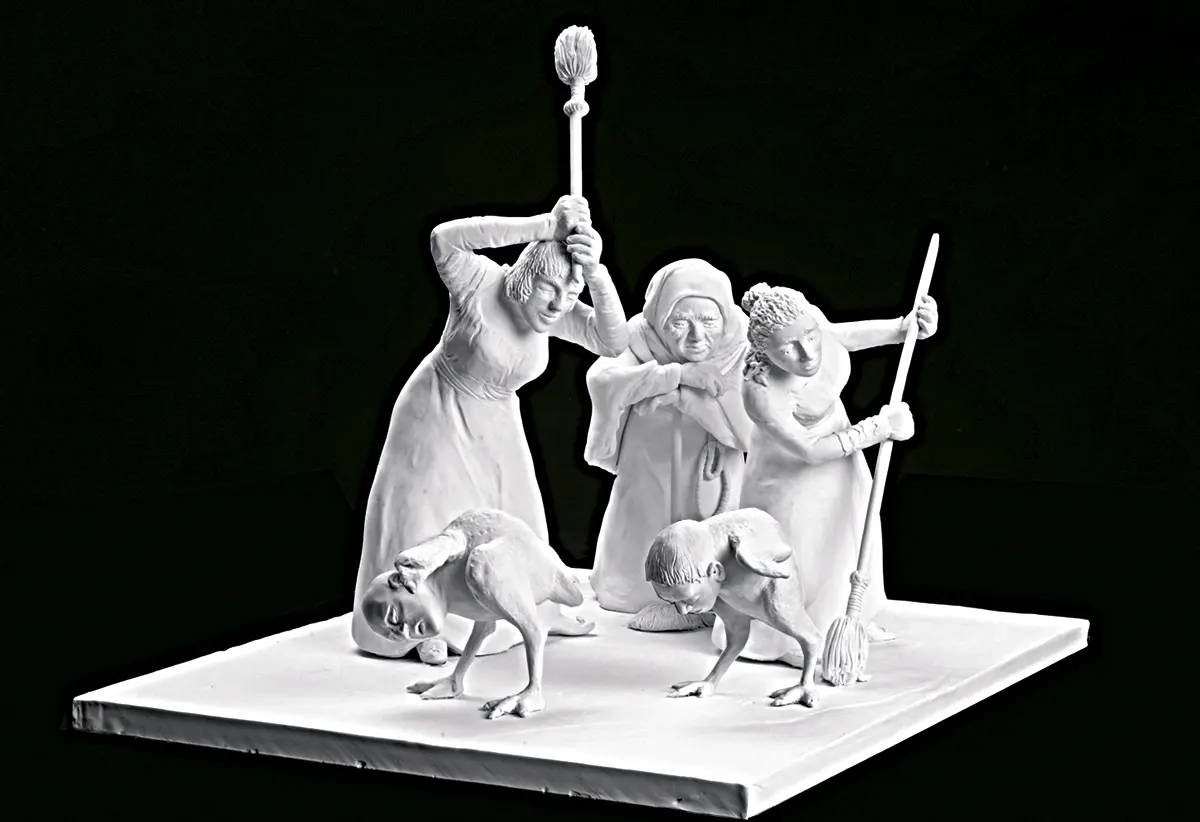
The works were situated on high pillars, above which they seemed to float. Brito created a series of synthetic-clay miniatures (11 x 15 x 13 inches) of prints like Ya van desplumados (There they go Plucked), Hilan delgado (They Spin Finely), Mucho que chupar (There is Plenty to Suck), ¿No hay quien nos desate? (Can't Anyone Untie Us?), and El sueño de la razón produce monstruos (The Dream of Reason Produces Monsters).
The two contrasts employed, of switching the prints’ original black to white and the two-dimensional images to three-dimensional figures, could at first be seen as anathema, another postmodern attack on the glory of the Spanish painter, similar to the one carried out not too long ago by the Chapman Brothers, who disfigured an original series of Goya prints, Los desastres de la guerra.
However, one of the main features of Brito’s Las Goyescas is their respect for the work on which they are based. The cleanness of both their execution and their material felicitously renew the impact of these beautiful and macabre works of art. Brito’s new works move us to re-evaluate the relevance of Goya’s commentary at a time when the American invasion of Iraq has clear parallels with Napoleon’s invasion of Spain, which was represented by Goya in his well-known Los desastres de la guerra.
Like the Napoleonic invasion of Spain, the American enterprise in Iraq had the supposedly benevolent intention of bringing down a tyrant and bringing the country out of Islamic obscurantism. Two hundred years ago, the Spanish reaction was documented both in popular songs that proclaimed “With the bombs thrown by the fanfarrones (the French), the women of Cadiz make themselves tirabuzones (braids)” and in the famous scream “Long live the chains,” a succinct expression that any Iberian king, even Fernando the Seventh, was preferable to a French tyrant, regardless of how enlightened and liberal he presumably was.
The same occurs today in Iraq. Once the construction of lies about Saddam Hussein’s weapons of mass destruction came crumbling down, the United States insisted on imposing a deformed idea of democracy that has been resisted by a large portion of Iraqis, demonstrated with daily bombings and guerilla acts that are surely captured in local folklore without the outside world knowing because freedom of information doesn’t go very far.
Like Goya—whose best-known print, El sueño de la razón produce monstruos, is an unequivocal warning against the mental paralysis that periodically afflicts peoples and nations and results in various forms of tyranny, elected or not—Brito posits through her reinterpretations the urgency of social, political, and cultural change. If Goya’s Los Caprichos are a series of fiery critiques of the Church, the State, and the cruelty of popular customs, which today would probably be seen as political propaganda, Brito’s Las Goyescas recover the cruel narrative thread about injustice and impunity and make it current and redefined for contemporary sensibilities.
Goya’s modernity resides in large part in the fact that he was the first artist to reveal the cruelty of society and of war in prints that are not the work of imagination but possess the bluntness of facts and palpable reality. Brito’s modernity resides in establishing, with fine delicacy, this fact: despite the passage of time, we continue to live the same nightmares.
JAVIER MARTÍNEZ DE PISÓN