
The group of works recently exhibited by Milton Becerra (born 1951, Venezuela) was affective, perceptual, and reflexive. The artist’s vision has reached the level of a synthesis of his own creative experience, manifested in plastic encounters free of rhetoric—encounters that, like solitary gravitations, can be perceived through a thread that extends to infinity through a weaving that, as a constructive image, has no known limits. In this image, there are no immutable containers of signifiers and signifieds. Movement, virtuality, nothingness, and tricking the eye are associated with the characteristically monochromatic temperament. Each work is a site of celebration of the spirit of art, which shows itself without being seen. But one is well aware that it is there, like an esoteric gnome yearning for the immortal. Geometría Orgánica was Becerra’s title for this exhibition, comprising works that display a certain distance from previous periods without losing the obsessive continuity of materials from nature, rocks, and linen or hemp rope. Becerra continued his exploration of space with his analytical vision, what critic and historian Alfredo Boulton has defined as “the artist’s interest in volumes and strong structures,” and viewers found themselves in front of “an object that is at once solid and light, fragile.”
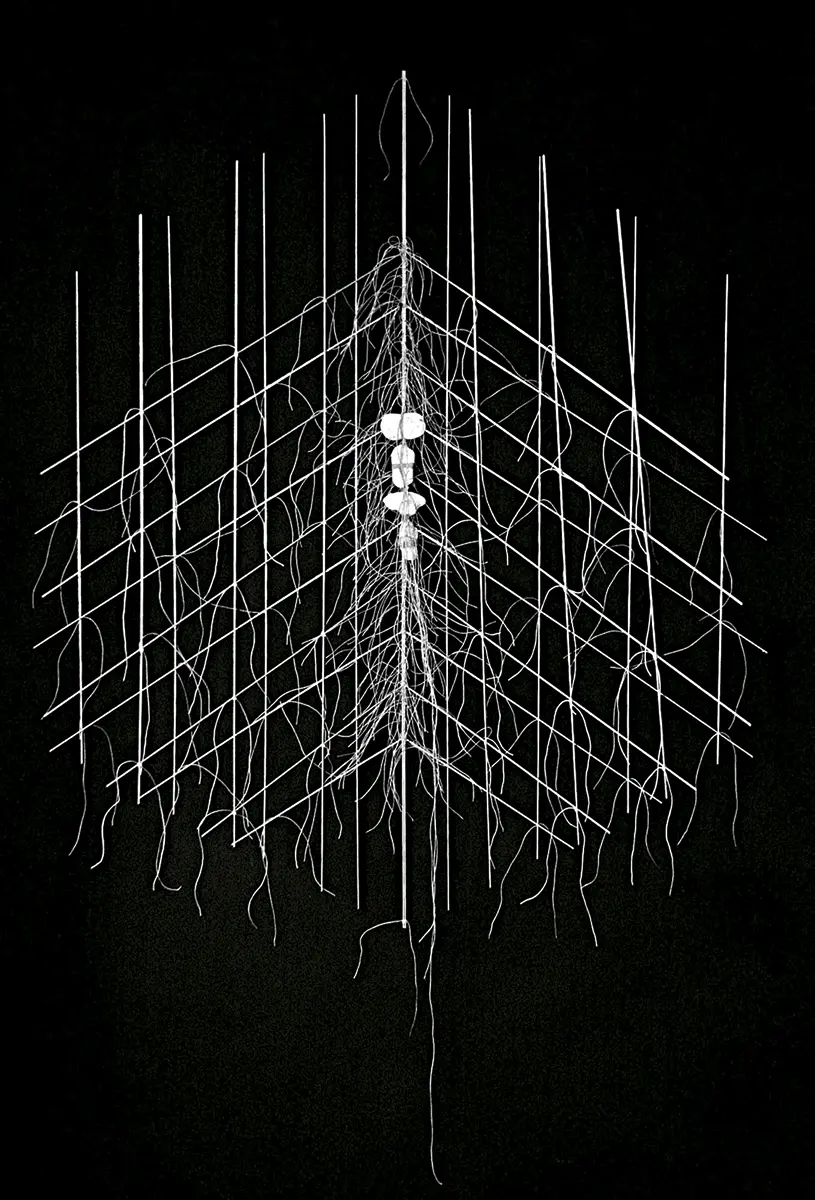
Two things are essential to capture the meaning of Becerra’s oeuvre in depth. First, he is profoundly interested in presenting open forms in open spaces because his work focuses on the exploration of physical space transformed into plastic space, and from there it acts as a formal element. Space is support and matter simultaneously. This corresponds to the artist’s experience in confronting the frames of reference; the work is marked by the autonomy of its own space in relation to the surrounding space, but with an indivisible quality, while at the same time non-real drawing takes advantage of both. Second, the matter is translated into a transparent form as opposed to gravity, to the point of being immaterial. Paradoxically, transparency is made even more evident thanks to the form/rock/object that exists between the spatial and the material, thus consolidating the signifying and connotative rules of theme/no-theme and form/no-form. It is also important to note the manifest absence of color, the monochromatic the tone expressed in the local color of the linen threads, the rods, and the rocks that form the work’s structure.
Like any good work of art, Becerra’s inscribes itself within the coordinates of universal art and in the recent history of the artistic avant-garde that has posited new languages on the basis of those historically known, such as Op Art, minimalism, kinetic art, geometry, constructivism, and installation. Created in the past few years, the new series starts with exercises from previous periods, always addressed to a dimension of the sensorial that expresses an aesthetic of absolute space, silence, and plastic stillness. Becerra’s oeuvre is based on the link between its non-existent yet paradoxically visible corporeal condition and the aerial space it inhabits. It creates an illusion of the real, thanks to a geometry connected to perceptions and sensations that result from the intricate crafting of compositional lines and axes arranged in a strict structural order, which implies the organic—a live, dynamic, natural element. Nothing is aleatory or unplanned. Becerra leaves nothing to chance. Each work is a calculated structure in its parts and as a whole. There is no contradiction between the geometric/constructive and the organic; the artist handles his means, resources, and elements with the authority of someone who knows what he is doing, and in consequence, the result is anticipated.
BÉLGICA RODRÍGUEZ