On the tile floor of the church of San Giuseppe, in Faenza, Italy, a few meters in front of the altarpiece, Nicolás Leiva created El Séptimo Día, an installation that expands the correspondence between the material and the creation of the world. The works included in the installation are unique originals and were on exhibit at the church in the Palacio de Exposiciones from June 2nd to August 31st, 2006. When Leiva was invited to this space reserved for special projects, he thought of ceramics—which involves a process based on earth, water, and fire—as related to the six days of the creation and the day of rest, the seventh day, when God contemplates what he has wrought. In a primeval world, it was on Earth that God made his creation.
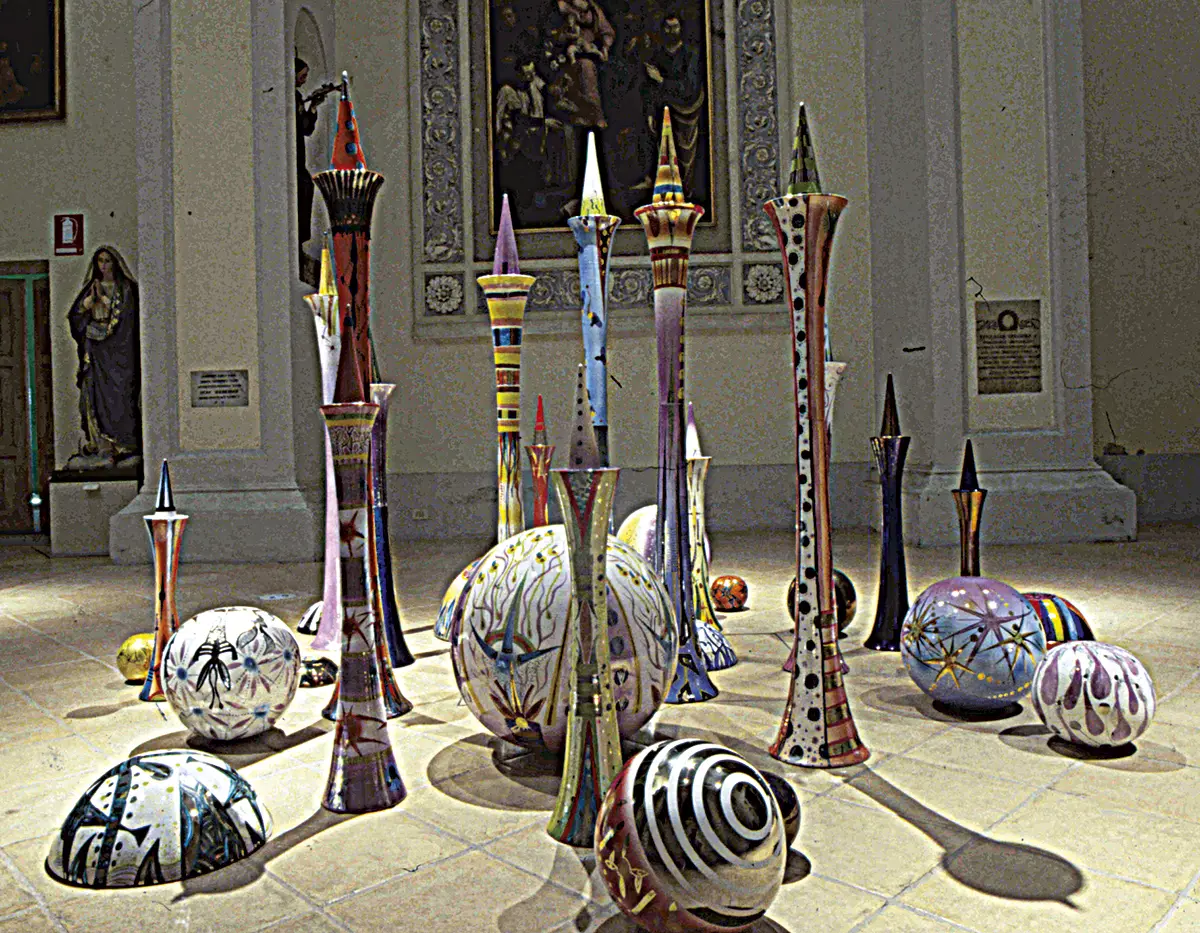
The installation is composed of thirty-two pieces. From the start, the viewer is confronted with a fantastic vision of spheres, half-spheres, and cartridges in different sizes intercepted by tall and even taller stylized jars, with ascending lids that form a vision of quiet and luxury, of study and rest. El Séptimo Día creates the perception of a great monument located in a space where the passage of time has stopped. The vertical pieces—between sixty-five and eighty centimeters tall—and the spherical works that refer to the shape of the world—from fifteen to seventy-five centimeters in diameter—create an interesting balance of heights and diameters, of horizontal and acutely vertical expansions. All of this is integrated into a vision where stellar shapes, ribbons, dots, and droplets create a reserved, light-filled stage for those who approach the installation. The work exerts a magnetic force revealed in the different interstices—the shadows projected on the floor, the metallic effects, and above all the perception of an action that has entered a state of rest. Leiva acts as the generating agent of this transmutation of opaque clay into luminous, iridescent earth that rises into space, seemingly turning even as it is serenely resting on the ground.
Born in Tucumán, Argentina, in 1958, Nicolás Leiva has lived in Miami since 1990. He is an artist of a restless spirit who puts into practice the “equilibrium of migrations”—both Argentina and the United States are cradles of infinite peninsular immigrants. Leiva travels from Miami to Faenza several times a year, carrying projects and drawings, a thousand ideas in his head, and the will to transform all of that into form and color, acting upon and tracing matter. Throughout Faenza are small, discreet, ceramic plaques on the walls of some houses, reading bottega—a ceramics workshop. Leiva has worked for years in one workshop with great historical and artistic importance, the Bottega Gatti, which was founded in 1928. In this same studio, artists such as Lucio Fontana and the Futurists also worked in ceramics, and a few contemporary artists who carry on and widen the tradition of clay are developing their work there. In 1997, Leiva began his experiment with ceramics, from which he can no longer be separated.
The artist’s baroque fantasy, expressed in his early paintings, drawings, and marble sculptures, finds in ceramics a wide-open creative field, with which Faenza’s ceramic specialists have been able to assist. Leiva works with shapes that do not refer to human beings, but he does include some that are animal-like, such as snouts and claws. His works are inhabited by the fantasy and the lushness of the Middle and the Far East, by the magic and the risk that characterized the world of the early explorers. Visually, the installation seems to allude to alchemical processes, although Leiva’s work is not centered on metals but on earth—gold, copper, and silver are implied in a twenty-first-century transmutation. The illuminated quality of the ceramic works of El Séptimo Día implies bringing light into a spiritual space. The fantasies of the thousand and one nights seem to emerge from Aladdin’s magical lamp and softly rock on the Venetian waters, in a new encounter with the man who set sail at Puerto de Palos—although he is said to have been from Genoa. These are only allusions, nothing is evident; these are readings of Nicolás Leiva’s gestures that the tiles seem to reveal.
GRACIELA KARTOFEL