Sandra Gamarra’s most recent exhibition Gabinete trapped the viewer between time and concept, recreating quotations from art and toward art. Reflections about hierarchies, autonomies, and the myths of postmodernism, which overestimate the value of the supposed original, were the terrains of her discourse.
Gamarra’s major project, the Museo de Arte Contemporáneo de Lima (LiMac), an imaginary museum, was the genesis of these preoccupations. In 2002, Galería Wu Ediciones presented the exhibition Souvenir, an installation that displayed all the merchandising generated by the LiMac. In 2004, the project expanded with the LiMac paradoxically opening inside the Museo de Arte Contemporanéo de Castilla y León (MUSAC); it was a replica of the MUSAC, a museum within a museum. Visita guiada, the name of the show and project, offered a selection of works generated from catalogs published by other museums and contemporary artists. These printed works were reproduced in painting and the appropriations were transformed into new originals, which formed the collection.
The LiMac was created in response to the lack of a contemporary art museum in Lima. Its physical space exists in the galleries, art centers, or institutions that house it for a period of time. Besides existing in virtual form through a website, it also publishes catalogs. With a logo and conceptual foundation, it displays the same functions and interests of other contemporary art spaces. Currently containing over one thousand works, as its website shows, the LiMac rotates exhibitions in its permanent gallery, and two temporary galleries are reserved for guest exhibitors. Its main objective is to recover the historical memory of Peruvian artists of the last ten years and to dialogue with or confront international art productions. During the 2005 ARCO fair, the LiMac materialized as printed materials, objects, and souvenirs similar to those that are offered through online or museum stores. The latest event has been the presentation of its architectural project.
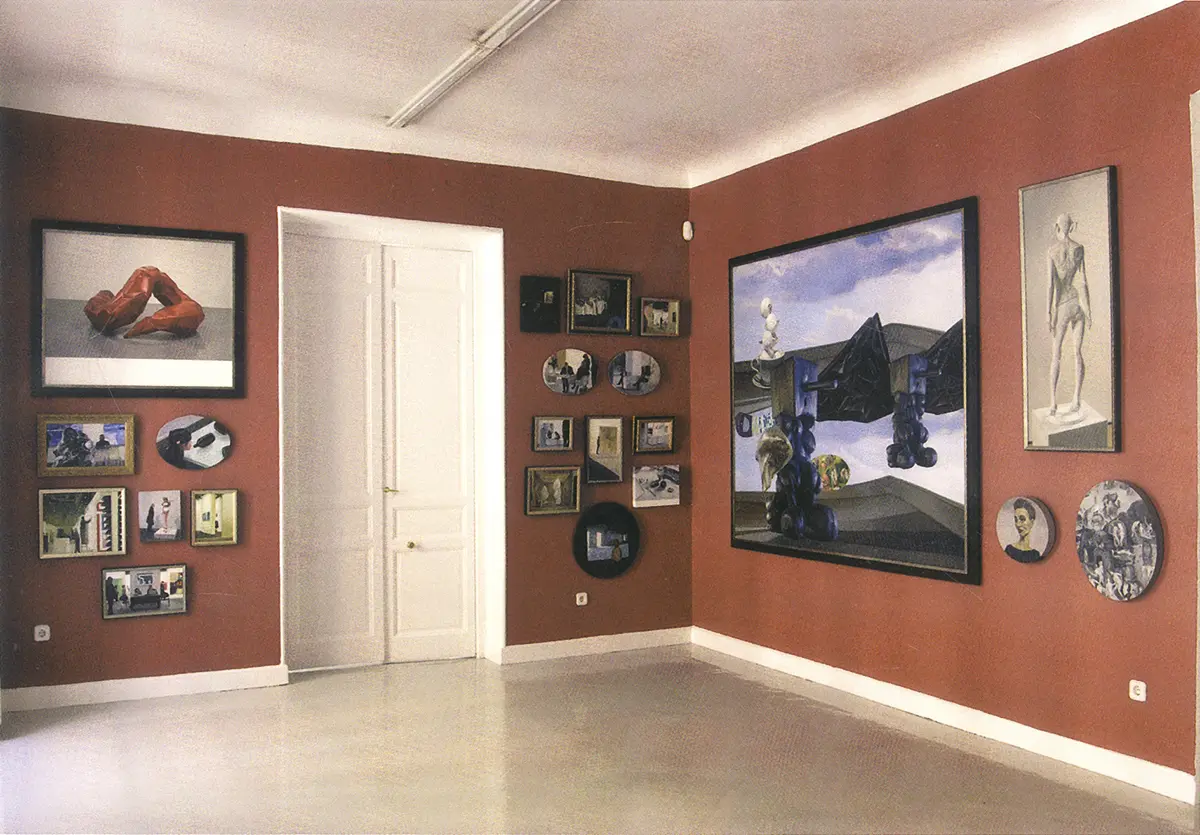
Starting with these premises, Gamarra’s recent exhibition personalized the discourse in two seemingly different yet complementary spaces. The first area, the Gabinete, was an installation that was similar to an old curiosity cabinet, a site characterized by its crowded and multifarious arrangement in several layers as if attempting to escape the horror of empty space. Red paint on the walls contrasted with the white of the doors, emphasizing the impression of an authentic environment. Similarly, two lounge chairs were placed around a circular table, which gave the installation greater theatricality and expressive force. Appropriations from classical and contemporary art were grouped into thematic sets: portrait, landscape, or still life. The visitor discovered works quoted from Yoshitomo Nara, Takashi Murakami, Franz West, Andrés Serrano, Claude Monet, and Hieronymus Bosch, among others, mixed with images gathered at fairs, biennials, or exhibitions of the gallerists, artists, and viewers. There were allegories to works that come together and give life to a visual superposition, or collage. The works overflow with mastery and technique, producing in the viewer both recognition and estrangement in the discovery of the referent and the unveiling of a new character in its symbolic content.
Exhibited in the second gallery were seven canvases under the title Detalles. The protagonist here was the social subject, realized following the same pictorial canons as those in the Gabinete. Here, Gamarra appropriated Thomas Struth’s series of museum photographs. Canceling the original color and using a palette narrowed to blacks and whites, the paintings were selected details from the original photographs. The intention of these details was to partially or completely cancel the original work and give greater importance to the viewer, who is alone with one’s self. Gamarra’s visual language is governed by questioning of paradigms of art and society. It attributes to the viewer's voyeurism shared between the pictorial dimension and reality.
Gamarra, who was born in 1972, investigates and develops a critical revision of the real access to knowledge and consumption of art from the periphery. These issues focus on the scarcity of culture-generating institutions and centers, not only in Lima but also in other cities far from the cultural nuclei. It reveals a distinctive and unfavorable feature, in which knowledge and enjoyment of classical and contemporary works of art only occur through magazines, slides, or reproductions. Scale, color, and texture are automatically reinvented under a two-dimensional and small-size framework. For these reasons, the recourse to palimpsest, to reconstruct history on the basis of quotations, appropriations, and fragmentations, is a valid option for the perpetuation of our identity and the vindication of artistic memory.
ELVA DIEGUEZ