
In São Paulo, the city of syncretism and amalgam, the opening of the 27th International Biennial began a period of intense activity and exchanges that mobilized the energies of artists, museums, cultural institutions, galleries, collectors, critics, curators, art theoreticians, and important public and private collections. The intention of this flurry of activity outside the Biennial is to impose a varied and heterogeneous aesthetic sensibility with the capacity for projection and dominance, which is significant and in a sense the achmé, the coronation or culmination of all the internal and external strategies in play. These aim to extrapolate a central component in modern and contemporary Brazilian artistic culture, to blur the borders that separate artistic creation and life, in order for the work of art to increasingly be something closer to lived experience.
Among other exhibitions held on the grounds of Ibirapuera Park is Paralela 2006, the exhibition of the Museo de Arte Moderno de São Paulo’s integral collection of Brazilian art at the OCA museum. Also significant for their medullar historical contribution and their relevance to the history of Latin American art is the important individual shows of Cildo Meireles at Estación Pinacoteca, Hélio Oiticica at Galería Nara Roesler, and Mira Schendel at Galería Millán Antonio.
Paralela 2006, or The Art of Operating Through the Juxtaposition of Diverse Languages
The Armando de Arruda Pereira Pavilion, located in Ibirapuera Park and designed by Oscar Niemeyer, along with the entire building complex, holds a comprehensive exhibition of contemporary Brazilian art from October 6 through December 17, with the participation of 150 artists and groups of artists, represented by twelve São Paulo galleries—Baró-Cruz, Brito Cimino, Casa Triángulo, Fortes Vilaca, Leme, Luisa Strina, Marilia Razuk, Millán Antonio, Nara Roesler, Gabinete de Arte Raquel Arnaud, Vermelho, and Valu Oria—under the curatorial direction of Daniela Bousso.
From inclusiveness to expansion, the previously noted outwardly projection, extroversion is such a central feature of Brazilian art and culture that it becomes a principle, a systematic method, and a hybrid paradigm. For Bousso, it was essential to generate a synchronic and diachronic look at her country’s contemporary art, selecting works whose languages proceed from diverse codes, which were in many cases made possible by the presence of the artistic artifact and the language/object that generated it, as well as the critical discourse opened by this interplay. The show emphasizes the works’ empirical and sensorial impact and the theoretical discourse they promote. This is what can be called a hyper-codification. It implies a reach beyond theories about artistic production to analysis and concepts of the codes from which a work of art is created and sustained. In many of the strategies of the exhibiting artists, there is a process of play, constructing and deconstructing codes of codes in a kind of infinite spiral. The spirit of playfulness is to be understood in the context of Paralela 2006 by looking at the work of art as an instance of irony, parody, and humor.
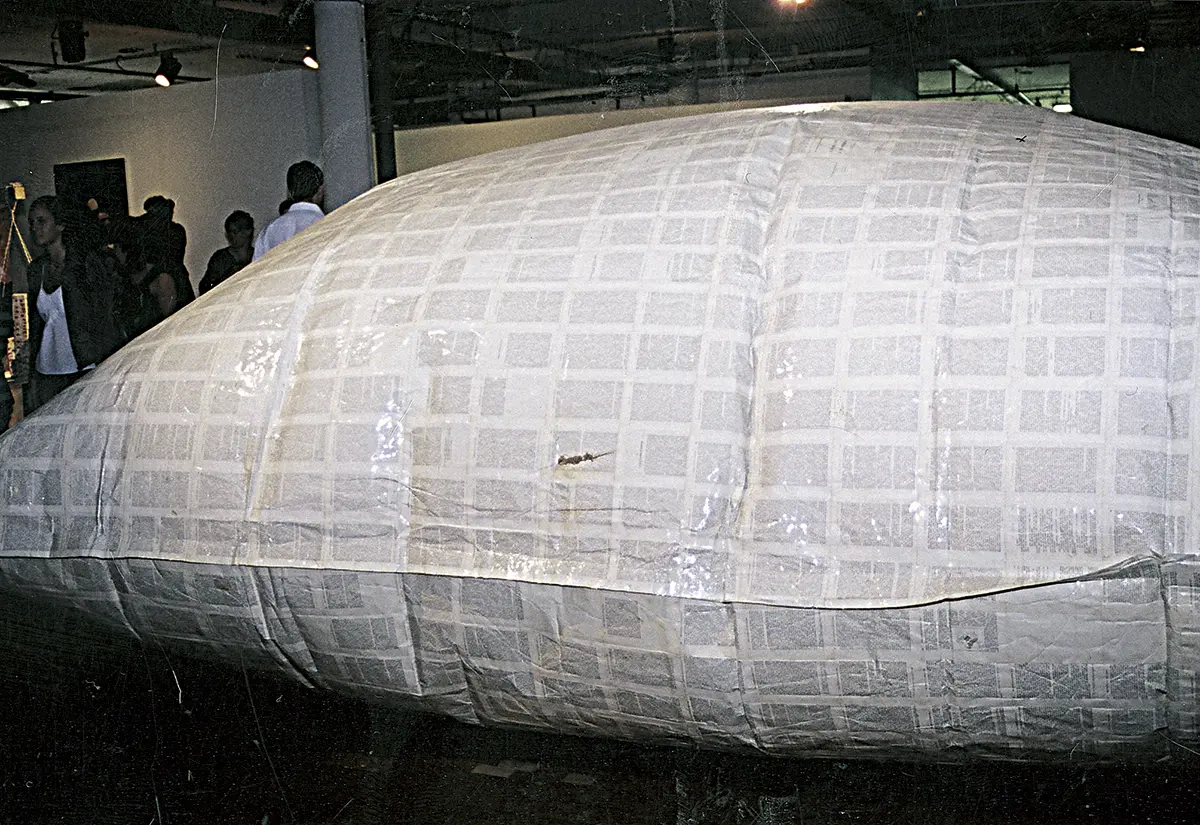
For example, Franklin Cassaro’s Abrigo Freud is an oversized, soft, flexible, and inflatable object made using pages from the collected works of the illustrious father of psychoanalysis and vibrated by the mechanical action of six fans. With this installation, Cassaro proposes a metonymic not metaphoric relationship with the body, one that is not a substitution, where the site-specific object becomes a veritable celibate machine. This is a current trend as various artists return to certain values—of identity, of life, of friendship, of death. Also noticeable is the way in which the subject emerges and does so with unexpected force as the true protagonist of the times.
In Mariana Palma’s Sin título, a 250-centimeter square pictorial diptych in oil, each module represents an example of hyper-baroque painting with an intentionally dense, magma-like, and thick corpuscular structure and manufacture. This work’s morbid beauty is infused with a subtle convulsiveness, at the limit of the estrangement that emanates from its chromaticism and its textures, which acquire shape in their inexhaustible need for physical expansion.
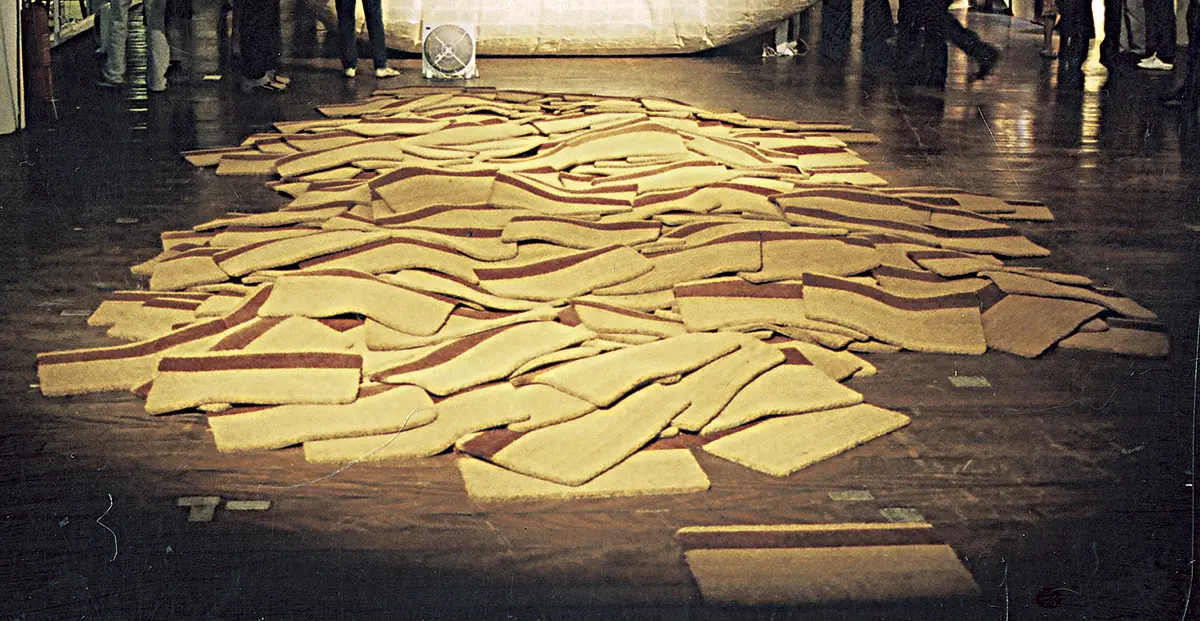
José Damasceno’s Credit Carpet is an installation made with 300 rustic coconut welcome mats in variable sizes. Each utilitarian object is there as a leftover or residue to be freely manipulated by the viewer. Nelson Leirner’s Arte e Nao Arte is an assemblage of indisputable symbolic potency, in which the artist once again intervenes critically through his mania for accumulation.
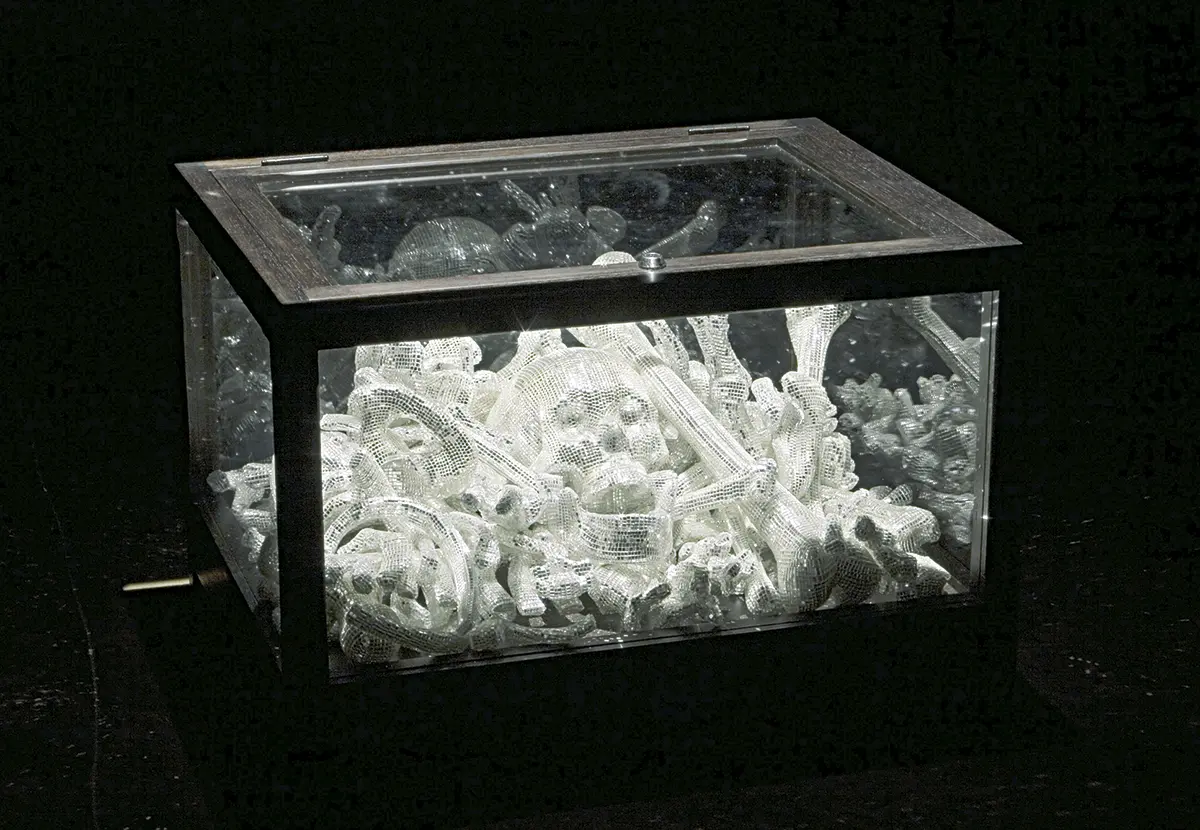
With his installation De la naturaleza de la luz y la imagen, Albano Alfonso creates an environment with highly theatrical lighting that appropriates the vanitas from Spanish Baroque painting, such as that by Valdés Leal or Holbein, placing at the center of the darkened gallery a trunk containing simulacra of a human skeleton and bones wrapped in silver-colored, diamantine, and refulgent chain-mail. In an ironic and silent allusion to the non-representable, the ideas of “absence” and of “being on the verge of non-being” join hands. Here, the artist re-elaborates in three dimensions what is not absorbed by reason, with a sweetly intoxicating objectiveness that uses light both as vision and blindness and brings the image to the brink of dissemination. Alfonso’s paradoxically ambient work warns that so much light can blur perception.
In his photograph Young girl sewing, Vik Muniz once again takes a stroll through the history of art with his well-known propensity for hidden citations. His cheeky and unexpected appropriation of hallowed iconography situates him as one who has fled tradition but also as a consummate user of the great encyclopedia of art. This kind of work confronts the task of reproducing the image with a different type of aesthetic imposture, just as it is the most nihilistic negation so far of the idea of style or of the creator’s originality. As Picasso had announced: “Style appears after one dies.”
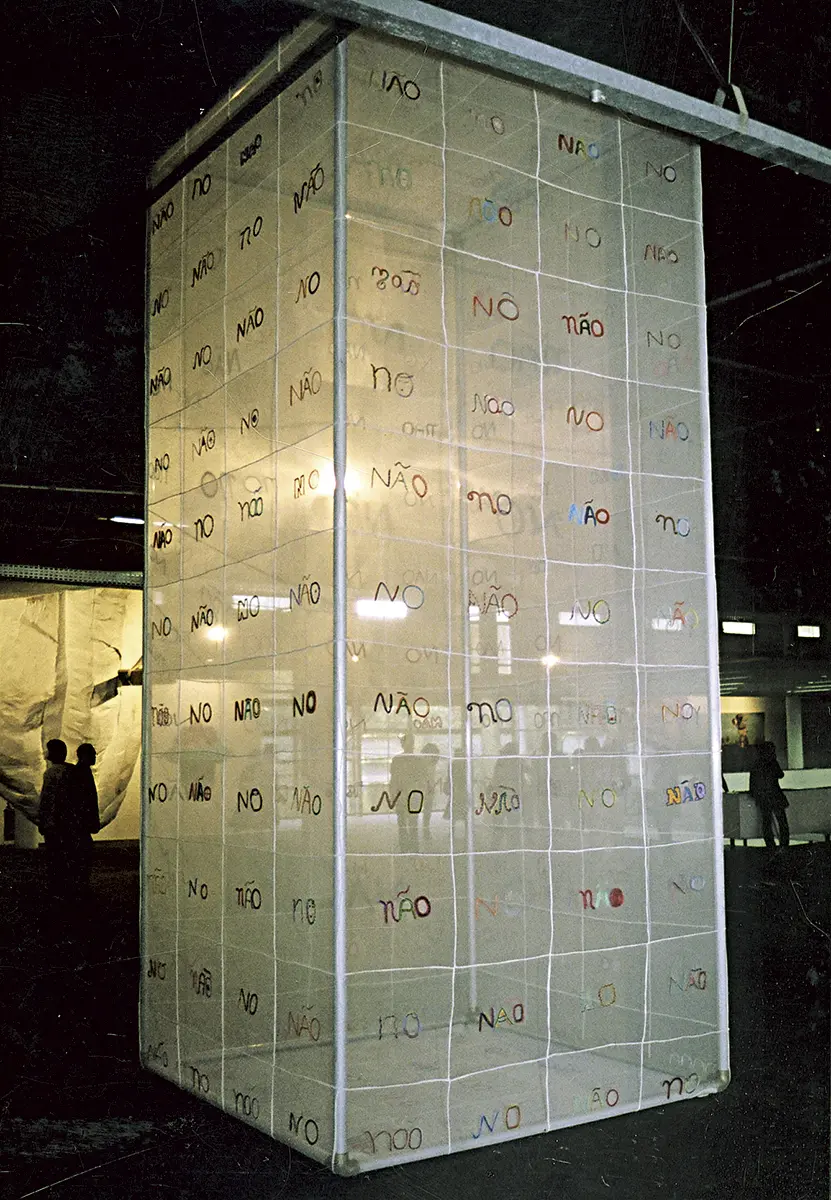
Ernesto Neto’s column titled Nao comprises an iron structure wrapped in white Lycra, embroidered with the words “No” and “Nao.” Neto proposes a defective attitude, one that is orphaned of models; the three-dimensional object attempts to bring down the minimalist tradition and the purely stereometric qualities of geometry without referents. His work is a truly useless monument in which rigidity is absorbed by the flexibility of the veil that envelops it. In his current work, Neto proposes the tension of the unfinished and has a greater interest in the questions asked by his art then in the abstract operations of which he takes advantage.
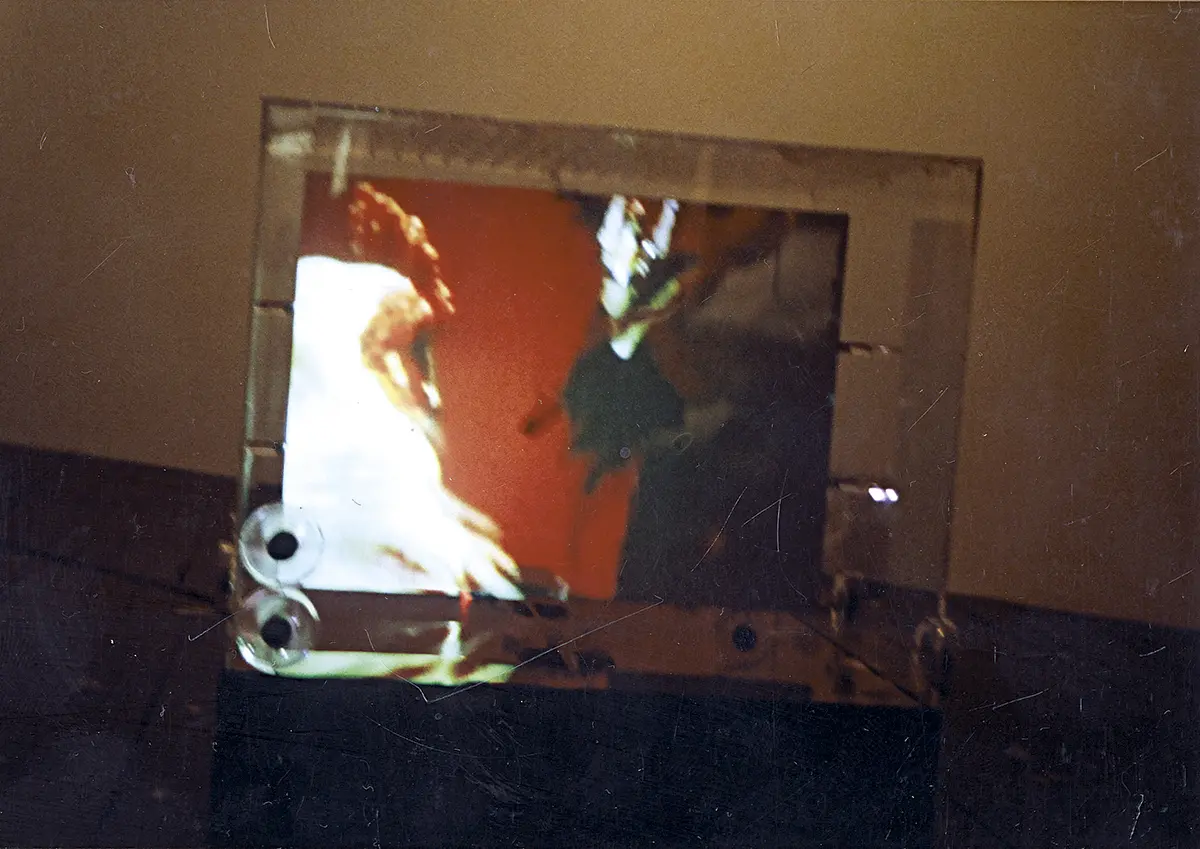
Eder Santos’s Coq au vin is a video installation with mirrors mounted on a pedestal in which an aestheticized cockfight presents itself as an inflexible, obsessive ritual. In this work, the game is a face-to-face encounter with death, reinforced by the quick succession of images of the prey’s destiny and nihilistic possibilities that wink toward black humor and eschatology.
Other highlights in this large show are site-specific installations, works that break invasively into the first and second floor of the fairgrounds with their proliferation of material, weight, gravity, and textures, or deploying their activity in the three-dimensional field in a more contained, circumscribed manner. This dual veneer is channeled through the works of Henrique Oliveira, Leda Catunda, Artur Lescher, Cássio Vasconcellos, Lole de Freitas, Cildo Meireles, Odires, Niura Bellavinha, Laura Vinci, Luiz Hermano, Marcelo Silveira, Rogerio Degaki, Marcia Xavier, Nazareth Pacheco, Valeska Soares, Jac Leirner, Dudi Maia Rosa, and Paulagabriela, among others.
The language of photography is revivified by purely analog proposals of the image as well as digitalized processes in substantial works such as those by Caio Reisewitz, Miguel Río Branco, Rafael Assef, Elaine Tedesco, Rogelio Canella, Ding Musa, and Anna Maria Maiolino. In works of drawing installations or series, the autonomous line as the protagonist can be seen in the different poetics of Brígida Baltar, Adrianne Gallinari, Fernanda Chieco, and Fabiano Gomper.
Seen from the short view of the present, the exhibition has significant relevance. However, it has two weaknesses in its constitution and internal structure. First, there is a noticeable absence of several fully active galleries from the São Paulo art circuit and marketplace. As the Biennial’s parallel activities grow, it would be appropriate to include these galleries as well as their artists. Second, the exhibition lacks a catalog, an effective tool for scholars as well as for the general public as a document, a critique of history, and iconographic instrument.
Collections and Institutional Exhibitions Facing the Future
The splendid Museo de Arte Moderno de São Paulo’s (MAM) patrimonial exhibition at the OCA posits an initial question about the fate and the public exhibition of a museum’s entire collection. It encompasses the four floors of the Lucas Nogueira Garcez Pavilion, which was also designed by Niemeyer. The curators of this large-scale show—Tadeu Chiarelli, Felipe Chaimovic, and Caué Alves—underscore the need to provide a larger site or another public building, in order for them to exhibit all of the works that were acquired by or donated to the MAM since it's founding. While the museum collection grew, the gallery space didn’t follow suit, and there has been no chance to present most of the works that are currently exhibited as a whole at the OCA, except sporadically and in thematic shows limited by the lack of space.
The curatorial appropriation of the OCA by MAM proposes a path and a new reading for its collection, leading to a wholly self-questioning re-interpretation of modern and contemporary Brazilian art. It is a polemic about certain pre-established and obsolete canonical models that must be overcome; the result is a dynamic interrogation of the educational and pedagogical role played by collections either public or private.
Today, the MAM has seen its bequest grow by 130% and it has accumulated 4,450 works of art, including paintings, sculptures, installations, objects, videos, performances, drawings, and prints—all of which await, in a not-too-distant-future, for the chance to provide collective enjoyment.
Cildo Meireles and the Work of Art as Potentiality
It is essential to consider the exhibition of works by Cildo Meireles (born 1948, Rio de Janeiro) titled “Babel” and curated by Moacir dos Anjos. The show of Meireles’s site-specific works, drawn from the collection of the Museu Vale do Río Doce in Vila Velha is the first outside the original museum space.
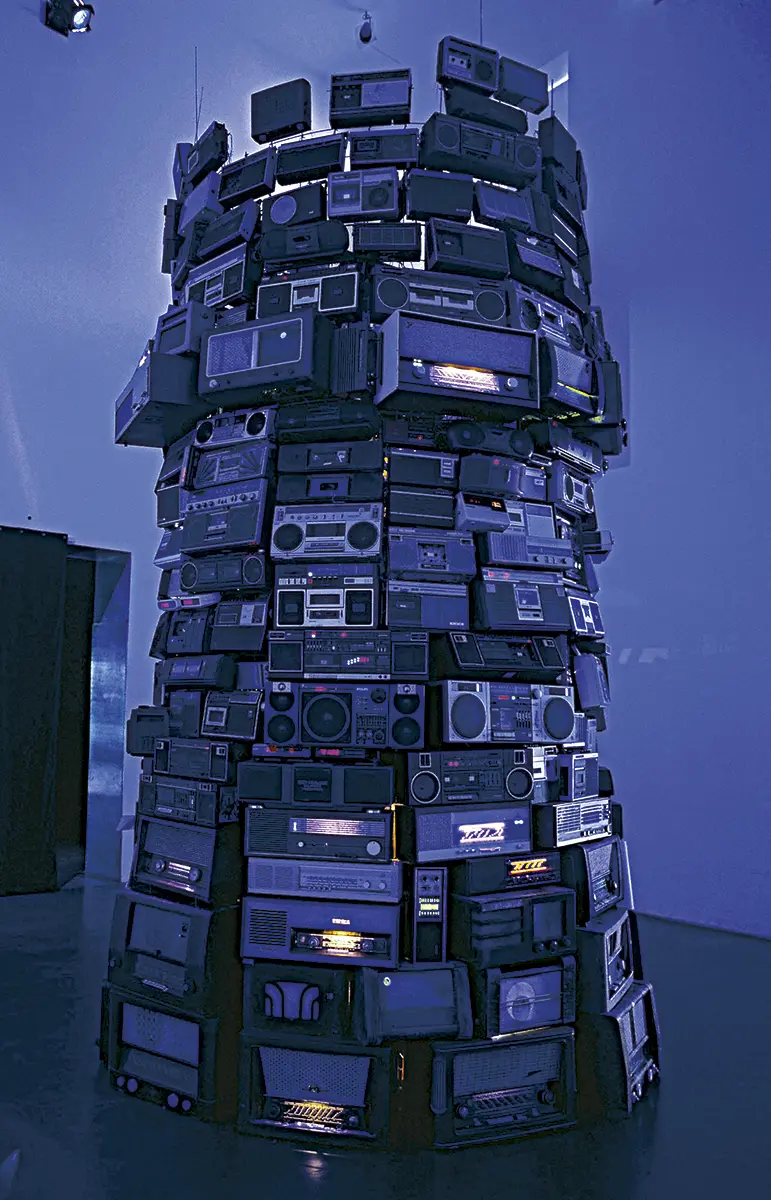
Babel is an immense tower, extending seemingly into infinity from the perspective of the viewer, that reaches five meters in height and is composed of thousands of radios in different designs, makes, uses, and periods. These instruments are recast as “anxious objects,” celibate machines producing uncertainty in the visitor; they are tuned to myriad stations and frequencies from all over the world. Meireles plays with the idea that we are submerged in a post-communication Alexandria, a clearly globalized era when languages and speech no longer serve the purpose of creating channels for the diffusion of messages, as they intermix and multiply at an exponential and chaotic rate. The communicative act is also prolonged in its reading. Babel is a pure author project, a communication that reveals the fallacies and detours of inter-subjectivity, provoking a reaction of self-criticism in others.
Meireles’s second sculpture/installation, Marulho, dialogues closely with Babel. Here, a platform made on book covers allows visitors to walk through the exhibition, as the word “water” is articulated in several languages. Finally, Cruzeiro do Sul is a minuscule cubicle structure of pine and oak that returns to the spatial tensions and frictions that are so characteristic of Meireles’s work between rhythms, operational programs, and the current value of topographic installations.
Hélio Oiticica and Mira Schendel: Sounding Boards for Contemporary Brazilian Art
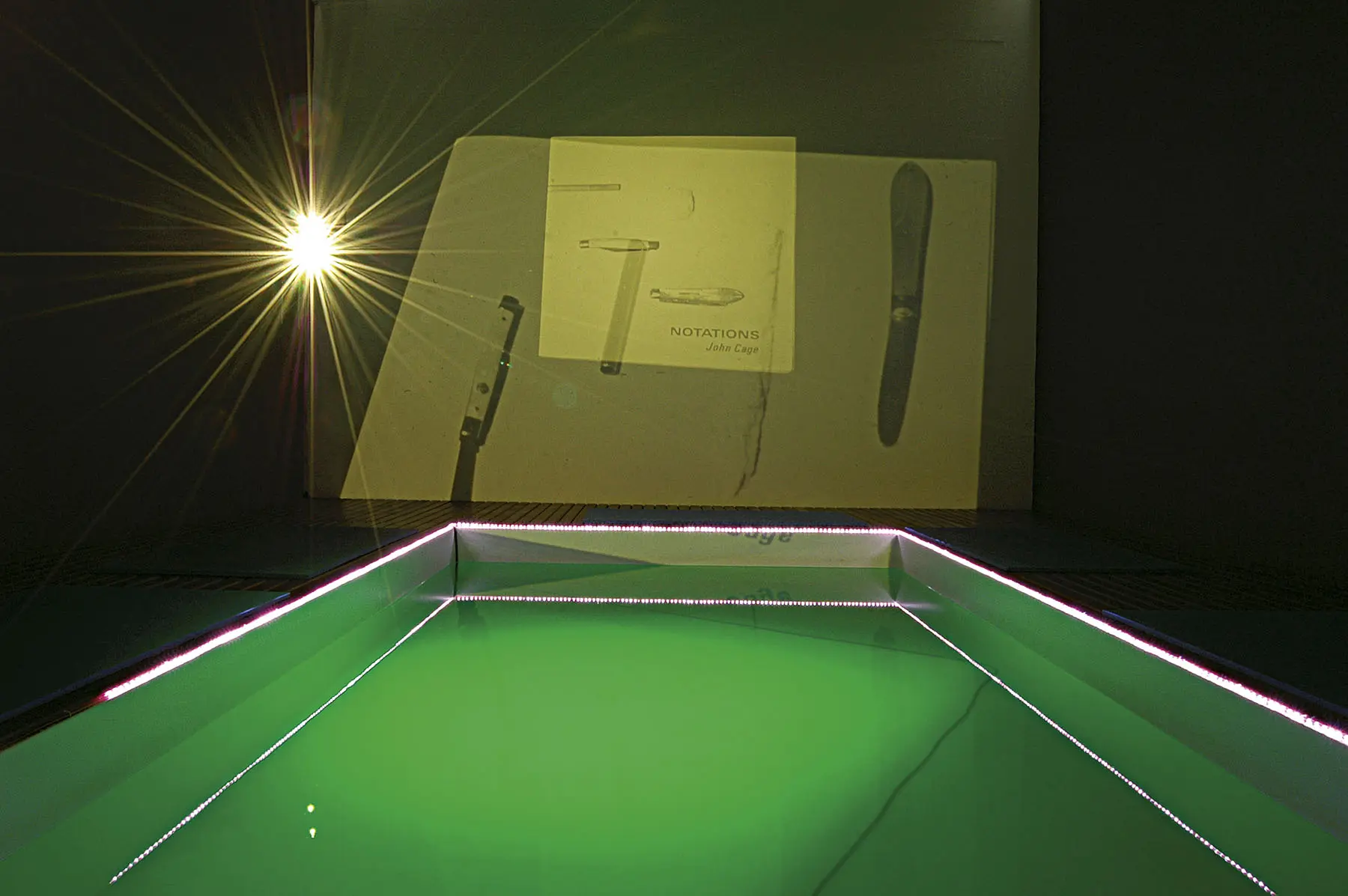
Hélio Oiticica’s individual show at Galería Nara Roesler offers a close look at the artist’s oeuvre. Oiticica created the concept of the penetrables in 1962 manifesto and later materialized it in works preoccupied with the visitors’ mobility, founded on their anticipated interactive nature, with viewers placed in a space that implied an opening to habitation or environment. Two replicas of Oiticica’s celebrated penetrables are exhibited in the gallery’s lower level. The first of them is a reconstruction of a box with rolling panels conceived as mobile structures, which would later originate his series of the “labyrinths.” The second one is Cosmococa CC4, Nocagions (1973), which was made with Neville D’Almeida. It is a traversable and inhabitable swimming pool conceived as an interactive light installation with light, sound, and movement and is dedicated to John Cage.
Oiticica’s idea of the penetrables is derived directly from his neo-concrete works, specifically his series of “meta-schemata”; based on this, he created individual nuclei or mobile satellites where situations could take place, like the earliest happenings in compartmentalized spaces by Allan Krapow in 1959.
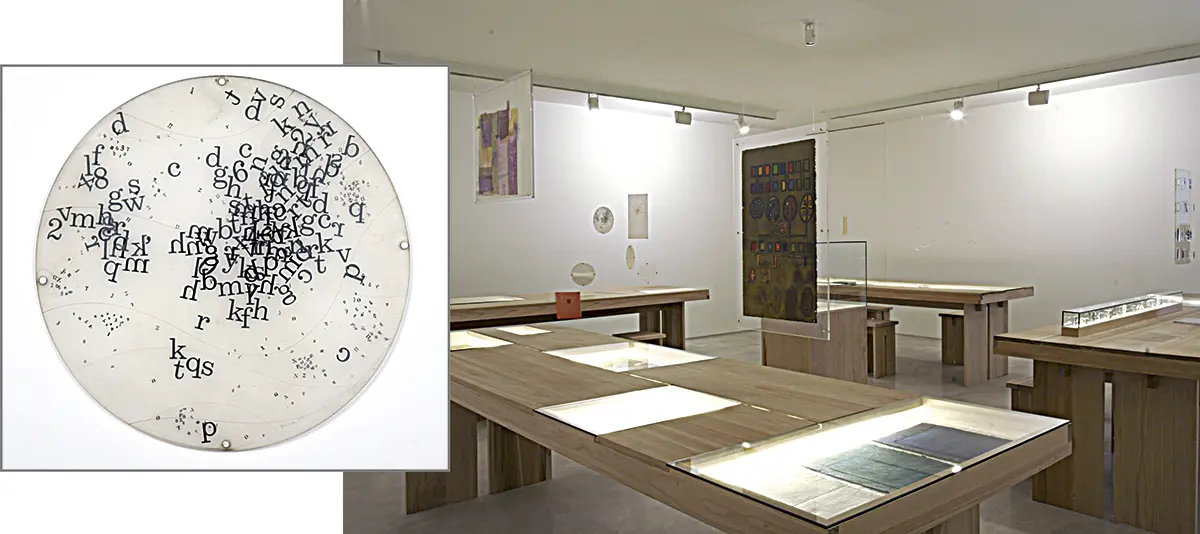
Mira Schendel is also the subject of a large anthology show at Galería Millán Antonio, conceived by André Millán and Ada Schendel. This show explores two foundational issues in the work of the Zurich-born, Brazil-based artist: the conception of the work of art as text and the value of transparency. All of her work deals with the vacuum considered as an amorphous, fluctuating continuity.
On the gallery’s lower level is an installation by the artist, titled Ondas Paradas de Probabilidade, which was presented in two editions of the São Paulo Biennial, in 1969 and 1994. This ambient enclave comprises thousands of translucent white nylon threads, which create a space that can be related to Duchamp’s proposal of a search for that which is beyond subtlety and light.
On the upper level is Schendel’s studio, reproduced with certain licenses—the locus of her experimentation and investigation, where one finds her writings, journals, notes, and alphabets arranged on four tables. Concepts of the vacuum, infinity, the cosmos, the inapprehensible, transparency, and immateriality underlie this show of work by an artist who originated the practice of art as language.
*Photos León Birbragher.
CLAUDIA LAUDANNO
Art History and Theory from the Universidad de Buenos Aires (UBA). She is a contributor to ArtNexus, Professor of Latin American Art History at the Philadelphia Art Institute for Advanced Studies, an art critic, and a semiotician.