After almost a century after its appearance as the most revolutionary aesthetic discourse after Impressionism and competing with Cubism and Dada—strategies that break from Renaissance canons—from the second half of the twentieth century, abstraction continues to be expressed and reinvented in all corners of the world with impressive force and originality. Could this be a reaction to the fact that one is bombarded daily, through television, the Internet, movies, and billboards, by billions of figurative/realistic/surrealistic images, and that both artists and the public long to be exposed to and enter secret realms capable of communicating everything from peace and mysticism to violent “games” that invite “the initiated” to contemplate their interior struggle, as Pollock did? Or, could it be that abstraction—although certainly capable of great strength and energy and of creating veritable complicities—does not force one to “see” or ”read” a story and can thus be very attractive or convenient as harmless decoration in spaces like offices, banks, hotels, etc., since it does not offend anybody in the way the representation of a crucified Christ or a historical event might? What is obvious is that Puerto Rico continues to produce admirable abstract works, including those by masters who have been painting and sculpting since the 1950s and those by greatly talented youngsters like Ricardo Avalos, Boricua Rivera, and Melvin Martínez.
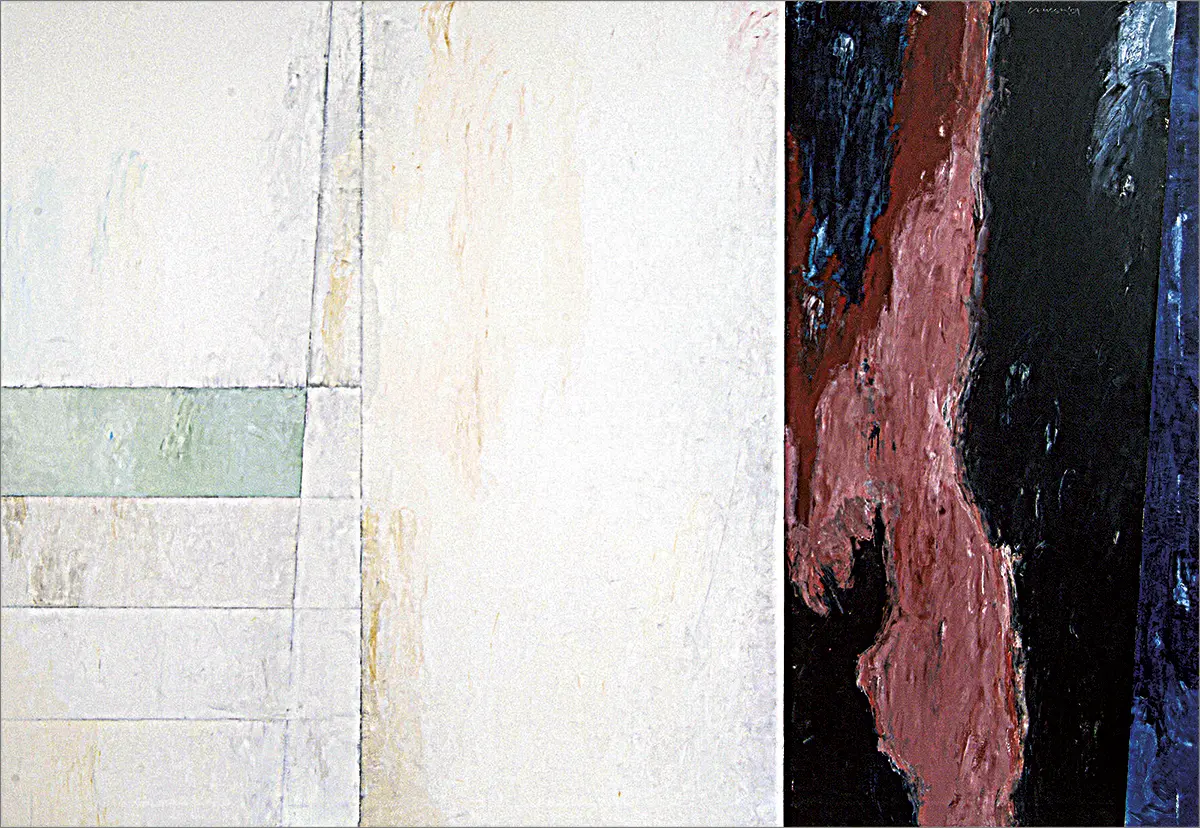
An exhibition of excellent abstract paintings by Wilfredo Chiesa was presented recently at Galería Biaggi-Faure in San Juan. This exhibition, along with the one that followed—a beautiful show by another refined abstract painter of Chiesa’s generation, Jaime Romano—demonstrated clearly that this is a living and boundless discourse both on a small island such as Puerto Rico and in the most adventurous capitals of the world.
Chiesa belongs to the second generation of abstract artists in Puerto Rico. The first one includes artists like Julio Rosado del Valle, Luis Hernández Cruz, Noemí Ruiz, Rolando López Dirube; the second one—already over fifty years old—includes Roberto Bonilla Ryan, Julio Suárez, Jaime Suárez, Melquíades Rosario Sastre, Carmen Inés Blondet, Rafael Rivera Rosa, and Jaime Romano, among others. With his art, Chiesa has intrigued art audiences for over three decades. He lives in Boston and teaches painting at the University of Massachusetts and is truly humble. Chiesa titled his show Lumina and with it, he gave a veritable master class in the use of light within his geometric/minimalist discourse.
In Lumina, this creator of consistently elegant and enigmatic works exhibited a series of paintings that reaffirm his style with maturity and new freedom. Arches and rectangles are interacting protagonists in the compositions, which remind one of some fragments of Romanic, Gothic, and Renaissance churches and cathedrals with which the artist has decided to “entertain” himself. But in this discourse, there is a highly personal vision of abstract painting in the use of space, color, and light, in the translation of the aesthetic and an existential vision shared by Chiesa and three close artist-friends: Luis Hernández Cruz, Julio Suárez, and the late Marcos Irizarry. Hernández Cruz summarizes this vision as: “Art is the metaphor of Life, of the Earth, and of the Universe.”
Perhaps for Chiesa, the constant interplay of arches and rectangular spaces is a metaphor for life’s steps, paths, dreams, and tests and for the moments in which one must stop and accept limitations, borders, and limits. His close friend Julio Suárez has perhaps been able to capture this vision the best. A schoolmate of Chiesa and his companion in adventures for many years, Suárez is also an extraordinary abstract painter. When speaking about his own work, he also refers to Chiesa: “In every painting I make, what is there, no matter how simple, is everything I have learned up to that point, what I have lived up to that point. Each feeling represented in my works is an illumination that cannot be expressed in words, and that is why I need to express it visually.”
Using sober and elegant colors, combining them with great skill, and building refined tensions and harmonies, Chiesa achieves a geometric interplay of light and mysticism in each work. It would seem that Chiesa has been carried into a fascinating labyrinth and wants to share some “points of entry” and some “escapes,” where light gives strength for when one confronts darkness and precipices.
MANUEL ÁLVAREZ LEZAMA