
An abstract beat traverses the entire exhibition. (Perhaps the word beat is a word that tells the tale of my age; it is possible that a rhythmic pulse is named differently today.) I celebrate the renewed presence of the abstract in art, because in the end abstraction is the rhythm, present in writing, in photography, in a blot, in architecture, in every moment of our life. I celebrate the reappearance of the abstract because at times so much information, so much narrative, distance us from those more atavistic —animal?— worlds that can only be reached by following a beat; worlds that can be reached through music.
In Ana Laura Alaéz’s exhibition, rhythm creates its own architecture: sometimes those who “stroll” through this sound architecture (the name of the exhibition, Arquitectura de sonido) are surprised by certain caverns in which sound is concentrated. Red caverns, triangular windowlets, amplifiers with bodies. Sometimes they follow the blue light on the floor.
We need to consider for a moment the tilted floor that builds a space definitely independent from that of the museum. Many artists have done this before: I remember Louis Bourgeois or Carlos Capelán, who created cells and living to ritually separate their referents; to give them the importance they deserve with regards to the Official Story, consecrated by the institution of “the artistic.”
It is difficult to find a space more independent from everyday life than a discothèque. The music invited viewers to walk through it at a leisurely pace. The exhibition definitely connected them to their experiences.
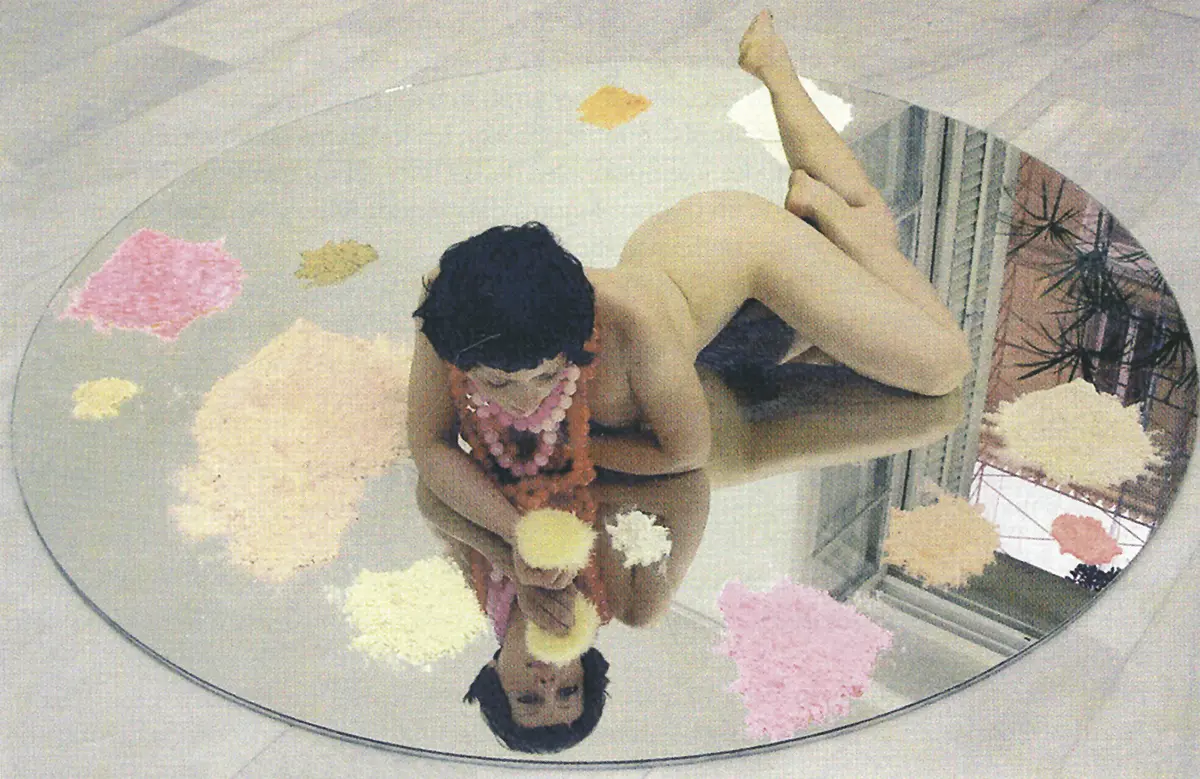
I also celebrate the photographs in this exhibition. Bambi and Afraid to be in love (femininity and its extreme fragility in two different situations.) Void (a woman decided to create her own gazing device.) Pink Room (the video of a woman absorbed in her changes of outfit, that first layer of seduction.) But, above all, two of them captured my attention: Shiva and Venus. They interested me for several reasons: because the stage of the gaze is very complex —like the feminine gaze upon itself—, and also because the nude makes it possible to establish all kinds of links with the history of classical artists and with nature studies.
Confronted with those two large photographs I remembered an idea explored by Amelia Jones about Cindy Sherman. It posits that women look at themselves being looked at. As I said before, a complex device is created in these photographs: the artist herself, with her legs raised, a position that nullifies rationality and is open to playing. The perfect skin. The skin as light (an abstract beat. I remember Baroque nude paintings that, among other things, amplified the light coming from the candles in courtesan spaces.) She is nude but not entirely because the device she creates in order to see herself being seen has elements that, in part, cover her: labial sculptors and color dust.
Amelia Jones tells us that women go through three female acts with regard to the gaze. An indifferent, passive one; a more active and perverse one, when she creates all the conditions to be looked at in the way in which men look at women, or, to put it differently, as the culture wants to look at women. This is to say, satisfying the culture’s desire, the artist becomes, herself, as desirable as she can possibly be and creates a scene to capture the gaze. Her behavior resembles the biological devices of a flower. The third act is an active gaze in which women propose the way in which they want to be looked at. In this exhibition, the last two attitudes occur in a single stage, one that captures the gaze of a spectator who wants to be seduced, and at the same time, seduction is the proposal.
Women look at themselves being looked at, but they also look at themselves, looked at by themselves, in a mirror, and in the intimacy of their own space. In Shiva, a fragment of the city is reflected on the window, inverted. The mirror and the personal, secret space, a tautological gaze. Sometimes the spirit of contemporary cities is not in their streets, as it would seem, but in their intimate spaces, which make it possible to deploy secret alchemy.
I celebrate works of art that are capable of re-actualizing myths. Venus as the goddess of knowledge, through the senses; Venus is a way of exploring nature. For now, the context that allows for a Venus to construct herself is at least an indicator of the arrival of a post-hippie generation of women, less guilt-ridden regarding their beauty and less interested in assuming such weighty roles.
Seduction is subversive. It is anti-institutional, anti-8-hour-job. It is the oblivion of everything, except for the body and for oneself. It is the empire of “useless” positions. It is a space that gives voice to “the figure,” not to discourse. It is subversive because it can be a world, that of Baudelaire and of Matisse, of “luxury, calm, and voluptuousness.”
NATALIA GUTIÉRREZ