
An exhibition of twenty prints by Belkis Ayón, most never publicly shown before, opened in early October at Villa Manuela. With this exhibition of lithographs and collographs, the Unión de Escritores y Artistas de Cuba paid homage to Ayón, the renowned Cuban printmaker who was affiliated as an artist and as Vice-president with its Asociación de Artes Plásticas. Yet the show’s title, Origen de un mito, suggested more than that.
The 1986 collographs, with which Ayón graduated from the mid-level at the San Alejandro Academy, commemorated her first thirty years of life. But they also revealed solid germinations in the poetics of an artist who was to become central to Cuban printmaking, one whose myth was reinforced with the aura that comes from an unexpected early death to an exceptional artist at the peak of her powers. Belkis Ayón Manso (who was born in Havana in 1967 and died in 1999) left her mark as a teacher in the printmaking school at San Alejandro and at the Instituto Superior de Arte, from where she graduated in 1991. She also influenced the genesis and the first editions of a well-known event—La huella múltiple—that expanded the notion of printing as the defining feature of the graphic arts.
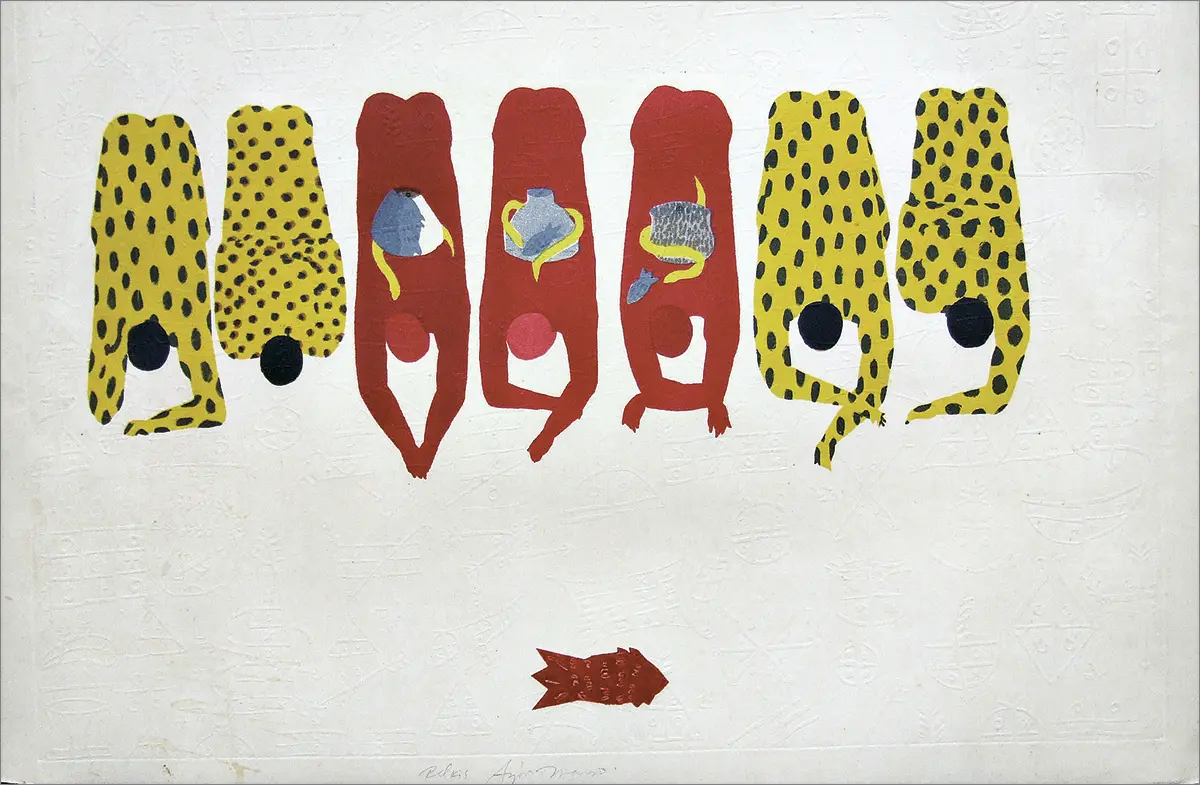
The exhibition’s inclusion of prints created by Ayón in the 1990s allowed the public to understand the consolidation of that artistic discourse. It made it possible to expand and explore the short ten years of quests undertaken by an artist who was already becoming mythical as she entered into and emerged from another myth, an ancestral one: the myth of Sikán. The legend concerns a woman from an African tribe who revealed the secret of the Tanze fish and with her indiscretion condemned all women to exclusion from the ñáñiga or abakuá society. By reinterpreting this myth and creating an iconography to express it, including representing herself as Sikán, Ayón subverted the proscription against females exercised by the fraternity of men. Ayón attempted to vindicate the belligerence of women in a congregation whose secret rituals reemerged in Cuba in the first half of the nineteenth century. For Ayón, the closed abakuá circle was at the same time an open one because it could be imagined in many ways.
Besides transgression and re-conquest—from an ideological, artistic point of view—the show also displayed a duality of color and “non-color.” Two periods on exhibit were segregated and comprised a dichotomy: works from the 1980s, characterized by an explosion of chromatic warmth and works from the 1990s, dominated by whites, blacks, grays, and only occasionally by sepia or other colors. The separation of the “before” and the “after” also displayed the contrasts in the format of the works, which were smaller in the earlier period. The outlining of Ayón’s shapes also served to establish differences between the two periods. In the earlier period, there was a certain primitivism, well attuned to the gestural boldness so common among younger artists at the time; in the later period, one noticed a less schematic draftsmanship and greater relish in anatomical shapes, associated with a growing technical mastery but without abandonment of the silhouette.
Yet, some elements of continuity were also on display in the exhibition, if approached in different ways. This demonstrated the evolution of a set of artistic beliefs, one that was explored in different sources of the same thematic matrix, perhaps with a greater distillation of its theme. Ayón retained her focus on gender and a unique way of assuming and expressing ethnicity. She retained her interest in textures, especially the skin of her characters, which were always deployed with a symbolic rather than merely decorative intent through the pointillism of the 1980s or the “scaling” of later periods, which allowed her to signify the symbiosis of Tanze-Sikán-Ayón. With this process, Ayón appropriated the fish’s secret voice in order to give expression to the woman condemned to exile.
This exhibition did more than just reveal the origin and ascension of a myth. It also made evident how many art-history periodizations conceived in a methodological sense are fragile and have become too schematic from excessive generalization. Belkis Ayón—like other Cuban artists—has been frequently pigeonholed as the paradigm of a decade or a cohort, namely the 1990s. On the basis of this show, perhaps Ayón and her work will be reassessed as part of the rich explosion of Cuban art in the 1980s. The solidity and innovative character of Ayón’s work in that period and the next certainly support this endeavor.
ISRAEL CASTELLANOS LEÓN