
The Contemporary Art Museum of Val-de-Marne (MAC/VAL), which opened in 2005 with the pedagogical intent and the financial support of three public institutions is the first contemporary art museum located in a working-class periphery of Paris. It is an ambitious project—the space measures 13,000 square meters, of which 4,000 are dedicated to permanent and temporary exhibitions—with a post-1950 French art collection that includes over 1,000 works and with a thematic organization designed to pose questions about the place, human beings occupy in the world.
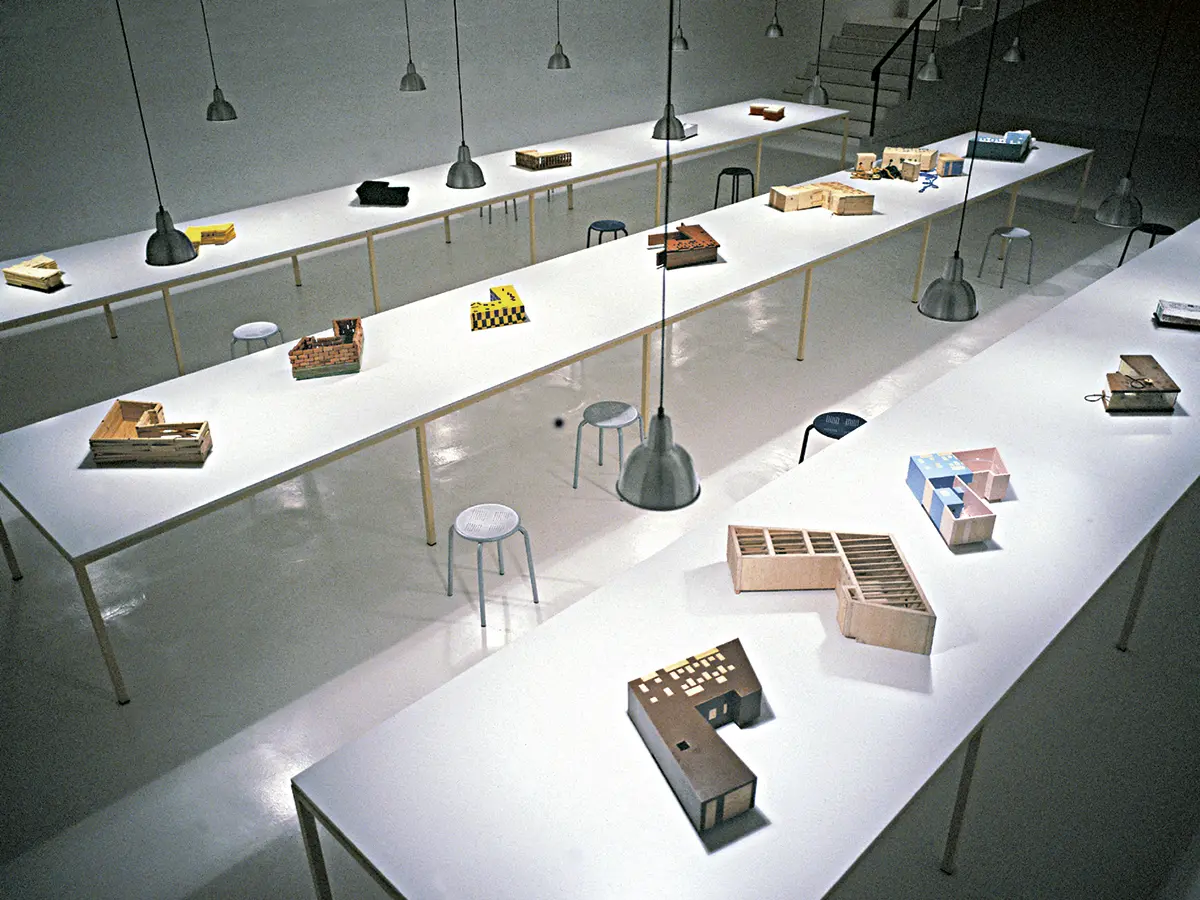
The show titled Concerted Productions Zone was part of a cycle of twenty-one monographic exhibitions to be presented in three stages in 2006 and 2007. The cycle’s first stage was devoted to the relationship between art and economy and intended to bring together different artistic universes that include issues related to economics. “It, however, does not intend to illuminate the problem but to use it as a pretext for the elaboration of a subjective panorama of artistic practices,” according to Frank Lamy, the curator. Each artist’s exhibit was autonomous, although they were all framed within a unique range of analyses that critically addressed the issues of work and the exchange of ideas, production, stocks, activity, function, flows, studios, etc.
The work of Daniel Chust Peters (born 1965, São Paulo) was situated on the periphery of this conceptual landscape, with materiality that was poetic and playful in character and whose underlying utopia corroborated Joseph Kosuth’s words in the sense that “an object is an art only when it is situated in the context of art.” In the exhibition at MAC/VAL, four tables displayed twenty-three small reproductions of Chust Peters’s current studio; two more large-format reproductions were installed at the extremes. The small models were created by the artist while the creation of the large ones, which were also interactive, were partially entrusted to others. In this transfer of roles, one could see the link with economics since another agent interfered in the chain of production. The artist ceased to be the sole person in command and became a dependent being. This duplication also evoked one of the determining aspects of the contemporary economy: hyper-consumerism.
The artist first became known in 1990 for presenting a reproduction of his Paris studio. He has continued to be interested in this unique motif; since 1997, he has exhibited several variations of his new studio in Barcelona, 41 Carrer de Massens. Chust Peter’s working “method,” which some critics see as similar to that of Laurence Weiner (born 1969), is well known: “I have an idea: I reproduce my studio”; “I have no ideas: I reproduce my studio”; and “I have a new idea: I reproduce my studio.” Chust Peter’s concept poses the question of obstinacy or obsession. The artist explains: “It is neither obsession nor resistance. It is an attitude of aesthetic appreciation between the fact of sustaining a constant and the confrontation of several external variants.” Developed as a way to function aesthetically and conceptually, Chust Peter’s works, even when he differentiates his objects, adopt processes of repetition and duplication, two structural and formal constants of contemporary art. Nevertheless, such repetition for this artist is based on the variation of a single thing into something different, and its permanence over time determines the intellectual gesture. Using brushes, wooden massage spheres, boxes of plastic bags, greenhouses or cages, the models of his studio are derived from the quotidian, thus extending the intimate space through a multiplicity of games and evocations. The artist’s workspace has become the exclusive theme of a play between the public and the private. “Given that the studio is an already-existing space,” Chust Peters says, “why idealize a new one?” The artist does not make statements about the meaning of his work and leaves its interpretation to the viewers. At the same time, duplication for Chust Peters is not only material but also linguistic. For instance, the word “air” appears in the titles of his exhibitions: “Airwaves,” “Aire comprimido,” “Airshow,” “Airsystem,” “Air liquide,” “Aire acondicionado,” “Bel Air,” or “Courant d’air.” This word evokes the metaphor of presence/absence that is at the basis of his work.
A great number of artists have reproduced their studios throughout history, but one of the most emblematic in recent years was the French artist Jean-Pierre Raynaud, whose studio was entirely covered in white majolica. Its destruction became a public spectacle, and the artist sold the fragments to several museums. Will Chust Peters one day be tempted to carry out that destructive (and also economic) act to bring his “obsession” to an end? The artist’s resistance to dispersion (which he claims as a virtue) and his loyal and enduring relationship with a single object do not suggest this action in the near future. All we can do is to assume the words of Daniel Buren, who in 1970 wrote: “Repetition is the ineluctable means for the legibility of the proposal itself.”
CHRISTINE FRÈROT