
Once again, Daniel Santoro displayed his Peronista universe, one he has worked on since his earliest solo shows in the 1980s and has become classic. This time it was in La leyenda del descamisado gigante, an exhibition at Palatina Gallery.
As in all of his artistic production, Santoro started from the iconography of Peronism and recreated it in a personal vein. The thematic axis this time was the descamisado (“shirtless”) a worker from the suburbs, uncouth and unkempt (in the eyes of political enemies) but transformed into a Romantic hero battling against the oppressive and oligarchic past. The legend of the “giant descamisado” refers to the 137-meters-long monument to the working class, which was to be provocatively situated in a residential Buenos Aires neighborhood. After the Freedom Revolution toppled Perón in 1955, construction of the monument was halted, and it survives as a myth in Argentinean history.
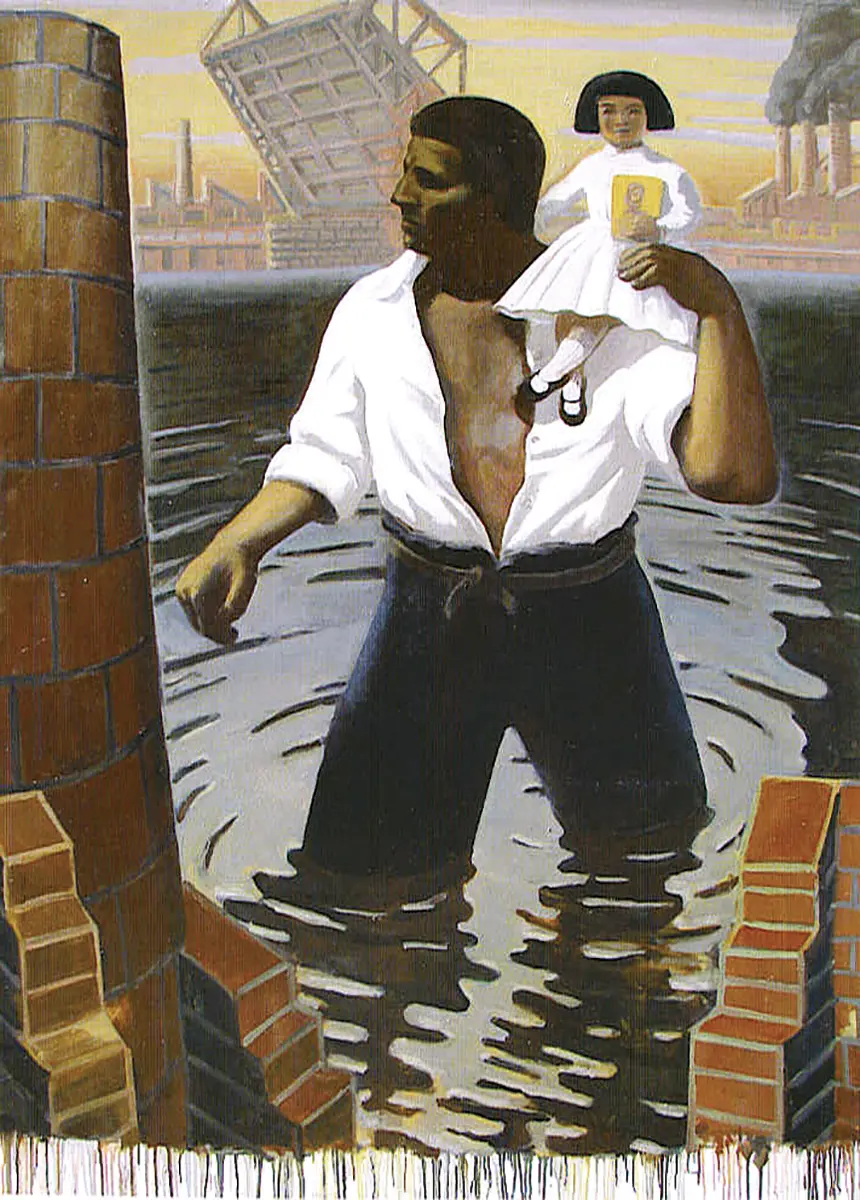
Made with oil and with a clear emphasis on content, Santoro’s works revolved around the universe of Antonio Berni’s characters but were anchored in a Peronista environment. The artist showed the mother of Juanito Laguna as the beneficiary of Eva Perón’s social policies or as being rescued by the descamisado. Like other poor people, she enjoyed the privilege of attending school, where she read the mandatory La razón de mi vida by Eva Perón; she also played in the forest and had a sewing machine at home—the symbol of the social policies advocated by the “standard-bearer of the poor.”
In the dialogue thus established with Berni’s characters, Santoro took some liberties, such as representing Juanito’s mother holding hands with Peronismo. There was a risk here of blurring Berni’s political position; he was a member of the Communist Party for a time and retained his leftist ideology afterward. Berni created Juanito Laguna without the security guarantees acquired by the working class during the peronista regime, not only in the details of the unfinished novel of Juanito but also in the way that he represented the character, most often surrounded by garbage. Thus, it could be confusing to see him represented by Santoro next to a CGT building or next to Evita. A quick reading of these works could end up distorting the universe created by Berni.
Alongside the descamisado and Berni’s characters, Santoro placed the Pulqui airplane, the achievement in technological development that was so heavily hyped by the peronista state, as well as the building that houses the Confederación general del Trabajo (CGT). In some cases, his paintings were based on quotations from Magritte and De Chirico.
On several occasions, Santoro has referred to the lack of a Peronista line of painting in the history of Argentinean art. Decades later, he has filled that void. With the attitude of a “committed artist,” he presents not only in his painting but also in his writing a position that defines him as such. In the prologue to the catalog for this exhibition, he writes: “It is easy to imagine the fear and rejection provoked by the dark masses mobilized in those early, foundational years, showing for the first time the mestizo face of a country that had thought itself white-European.” With his new work, Santoro brought what was marginalized by a hegemonic discourse to the fore. And this is no small achievement.
CECILIA FIEL