
Bittersweet was the title of the Mexican artist Daniela Edburg’s most recent individual exhibition, which opened on December 2, 2006, at the Kunsthaus Gallery in Miami. The artist presented nine works, comprising seven photographs and two installations.
In her photographs, Edburg created scenarios of women encountering popular foods, such as Oreo cookies, cotton candy, and Slim-Fast products. Each of the works depicted the impending or completed “death” of these characters trapped in illogical situations, in a style that defied verisimilitude.
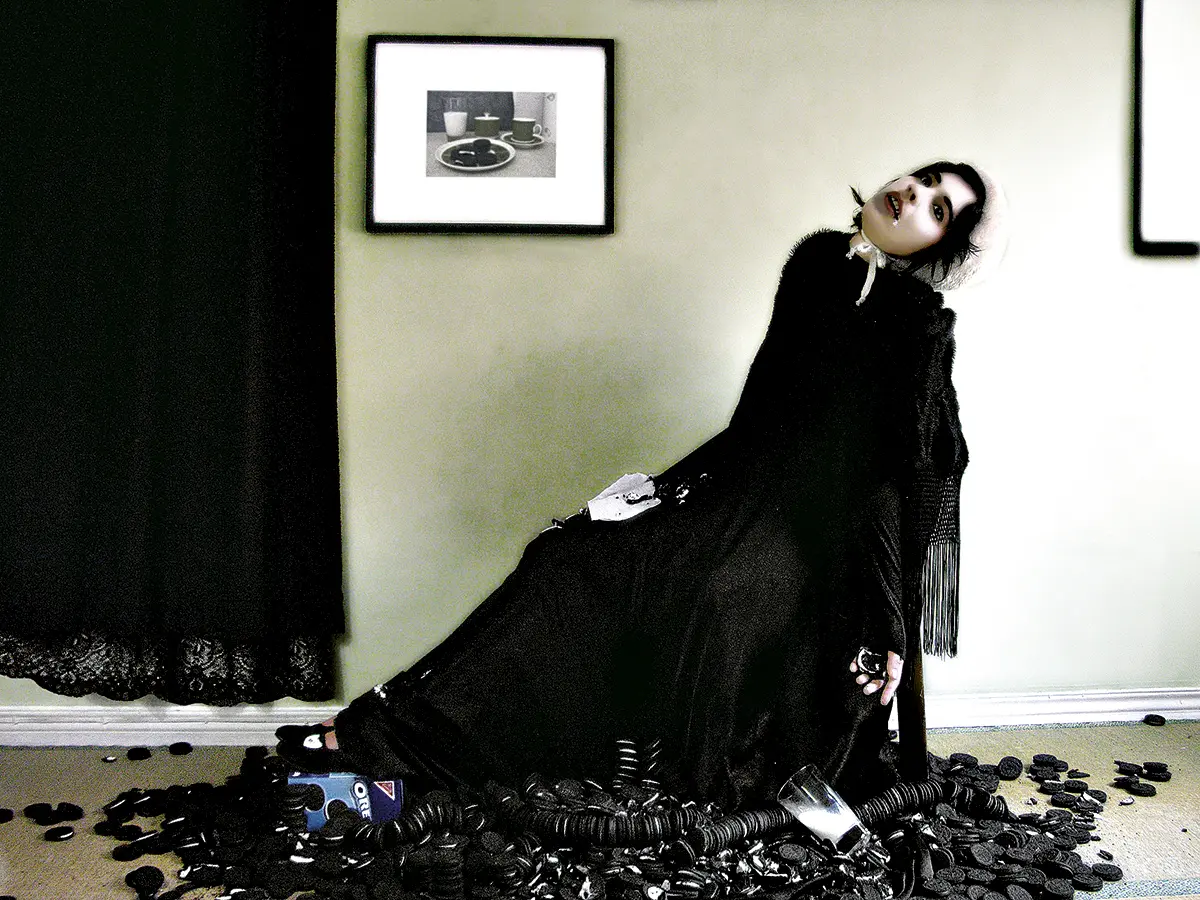
These were works of high dramatic content, not only in that their main theme was death but also because of Edburg’s staging, an essential component of the work. The compositions were carefully planned and unique in each work. Her locations were mostly places from her own environments, such as a house of a friend or family member. According to the artist, she began creating these kinds of works in 2001 as she prepared her graduation thesis. At that time, she mostly painted, but she decided that photography would take her closer to the realistic definition she was seeking.
The works could be divided into two groups: those inspired by Edburg’s environment and those she based on appropriated images or references from well-known films or paintings. Among the latter was Death by Bananas, based on Alfred Hitchcock’s The Birds. Edburg’s work alluded to the film with the inclusion of a bird poster on the right side of her composition. Another work that used film as a source of inspiration was Death by Cottoncandy, in which she referred to the tornado sequence in The Wizard of Oz; Edburg’s “victim” flees from a pink, cotton-candy tornado.
Among the works based on well-known paintings was Death by Slim Fast. The main character’s pose was taken from Ingrés’s Odalisque, which for a time was considered the very model of beauty but would not pass muster as such today. Edburg exaggerated this through the chosen manner of death and through the character’s pose. By using the popular brand of diet shakes as the agent of death, she mocked the contemporary notion of beauty that is associated with an obsession for thinness.
Death by Oreos was another work based on a “classic” referent. Here, Edburg quoted one of Whistler’s best-known paintings, the portrait of the artist’s mother. Edburg intentionally used a composition almost identical to the original, the difference being that in the place of the mother she placed her “dead” character, surrounded by Oreo.
Against the current trend of large-scale projection, Edburg chose to present her video installations in a small format. They could almost be overlooked, and that was precisely the artist’s intention. She made the viewer peer into the work as if through a keyhole, forcing the viewer into a rather intimate posture in order to see her videos. It suggested a kind of voyeurism that intrigued and captivated. The titles were consistent with the general tone of Edburg’s recent work: the absurd death of her protagonists. One was titled Chocolate and the other Pastel de cerezas. Although Edburg did not include the word “death,” as in her other works, the theme was the same; one saw the inevitable death of her central character among silver-foil chocolate wrappers in one case and a sea of cherry marmalade in the other.
The work of Daniela Edburg possesses a high element of drama, but it also has a sense of kitschy humor; the viewer witnesses somebody’s death, but there is a playfulness that holds one beyond the morbidity. With an irony that touches on the macabre, she presents the story of her characters based on a magnified and exaggerated reality—those who have not found their space in society and end up dead.
IRINA LEYVA