
Between November 23rd, 2006, and January 27th, 2007, Lisa Strina Gallery held an extensive individual exhibition of works by Dora Longo Bahía (born in 1961, São Paulo). This thematic show was titled “AcordaLice” and covered three floors of the gallery.
In principle, “AcordaLice” dealt with the proverbial interplay of visual and sonic images of female literary characters: Alice, from Lewis Carroll’s Alice in Wonderland and Alice Through the Looking Glass, and Ana Livia Plurabella, from James Joyce’s Finnegan’s Wake. To that end, the artist created a wide array of objects, a sonic-visual installation, and two video-installations.
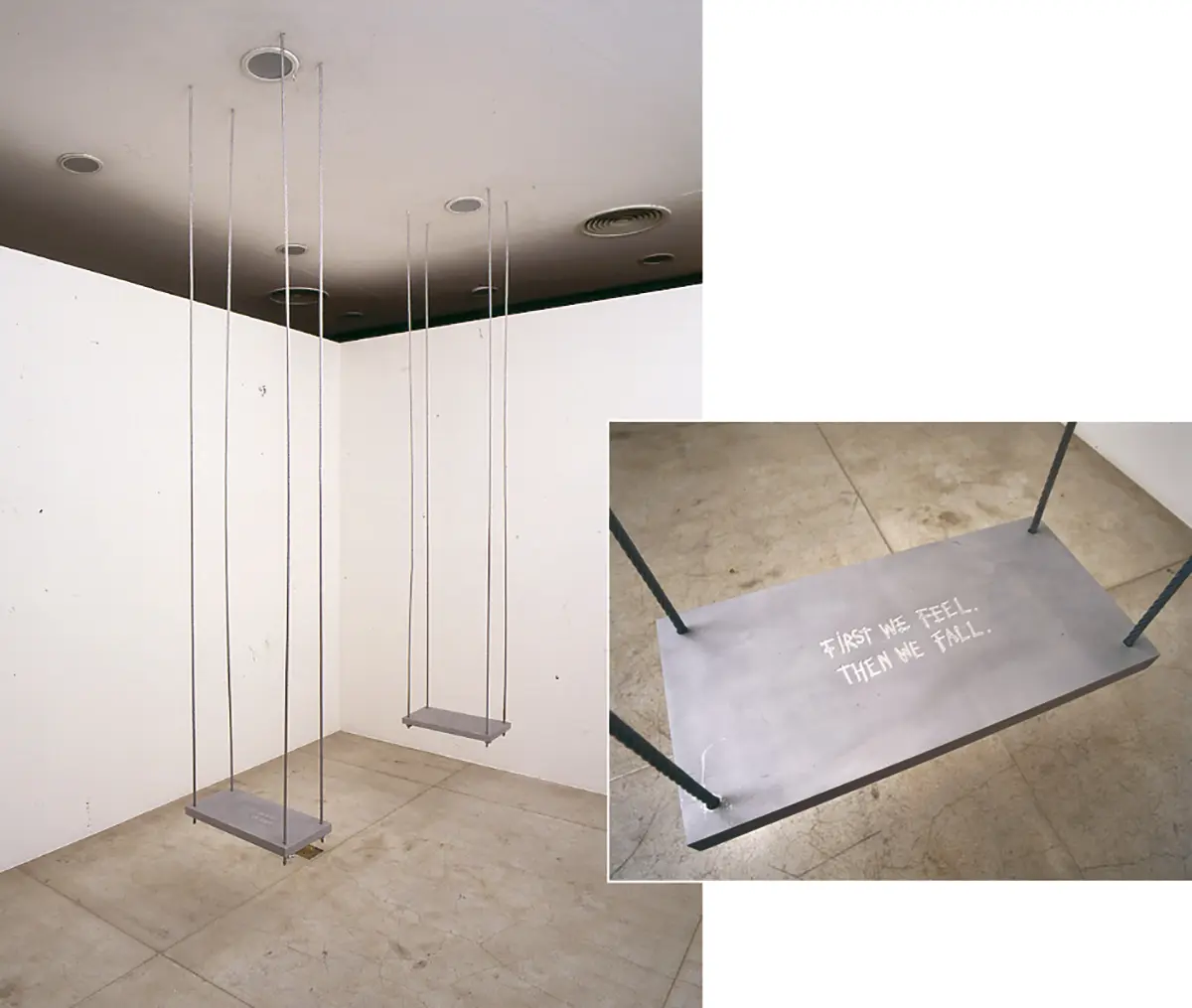
It is important to underscore the poetry of the exhibition’s title, since “AcordaLice” is a label pregnant with meaning. For the Brazilian imagination, the term is closely related to a reality check. Someone is called “AcordaLice” if he or she fantasizes or retains a high degree of fantastic expectations regarding a given situation.
On the first floor, there was a video work, Alice P., in which a young woman dressed as a Playboy Bunny feigned sleep in an intentionally kitschy white-plush bed, thus reinforcing the tautology of the rabbit’s morbid, soft skin and the objectified woman’s flesh, ready to satisfy sexual desires. On this specific topic, Longo Bahía’s work offered the viewer potent images that brought out the utopian desire to find an elixir that defies the obsolescence of the flesh. The images in this video made evident the way that the sexual encounter retains the memory of the abyss—that is to say, the loss of awareness or of the individuation principle, the allegorical representation of oblivion in an instant of pleasure, a sense of the eternal hidden inside what is dying and no longer needs to defy time because it makes the time its own.
The exhibition’s second gallery was entirely carpeted with artificial grass, which created a different environment. Here the artist projected another work, titled Finnis Regis/Regis Finnis. Longo Bahía’s universe of appropriated images mixed an iconographic repertoire derived from various “encyclopedias” or “factories” of contemporary art, with very specific references to certain fairy tales, legends, and cinematography, and was accompanied by rather strident sounds, in the manner of the Living Theater’s random, raw noise created by John Cage with elements of punk rock and James Joyce’s poetry.
Similarly, the artist exhibited a series of objects that questioned the functions of “figures of language.” The objects appeared immersed in a universe where their ulterior humanization was possible. Finally, on the third floor, in a space covered by heavy scarlet-colored curtains, clearly inspired by David Lynch’s Blue Velvet, Longo Bahía mounted an audio work composed as a discursive meta-language that borrowed fragments from Joyce’s Ulysses.
Throughout the exhibition, it was possible to find traces of a revealed intimacy. This impulse connects many contemporary artists, who by exploring the interior of their psychology make evident the way that the impulses of Eros and Thanatos are accompanied by desire, pain, angst, frenzy, ire, or disgust. The individual is the victim and author of himself and can live eroticism itself as a cliché.
In that sense, Dora Longo Bahía’s complex, elaborate works expressed how hyper-modern human beings observe their own dreams and desires and find provisional respite in referents of the culture and counter-culture—glamorous images from fashion magazines, rock music, and cyberpunk—all filtered through an emotiveness in a disquietingly beautiful mix.
On the other hand, one should note that Longo Bahía adopted the best free use of Joyce’s Finnegan’s Wake and Ulysses, jumping directly into fragments from their pages and letting herself be carried away by the musically evocative potency of the Irish writer’s prose. Ironically adhering to these two high points of world literature, Longo Bahía transformed and re-signified characteristic elements from the Joycean “idiolect.” In that sense, the artist possessed a vivid visual, verbal, and aural memory. In the manner of the author of A Portrait of the Artist as a Young Man, the artist incorporated the myriad linguistic associations that live in her mind to the complexity of her poetics: literary citations, fragments of songs, foreign words, slogans, jokes, and wordplay, etc. It is interesting to compare Longo Bahía’s artistic and literary work with Joyce’s texts, which require from an ideal reader the same excellent memory and almost the same archive of sound remembrances. Julio Cortázar and Carlos Fuentes have accustomed Spanish speakers to English-language wordplay. In a similar vein, Longo Bahía introduced historical and cultural parallelisms and symbolisms, with strongly mordant and humorous notes.
CLAUDIA LAUDANNO