
From the street, one saw what seemed to be a well-kept but empty space; something like a horizon extended an invisible, magnetic power through the windows. One felt compelled to stop and saw that the image of a horizon was embodied on a diadem of isolated shapes, with certain greenery breaking the monotony of the walls. Why were plants in an abandoned space? What were these delicate and unusual objects that supported them? What was that kind of table or tree? As one entered the space, one’s perception changed radically; in just a few steps, the impression of a far-off horizon changed to an enveloping, more accessible configuration. Wood was recognizable in a sequence of elongated reliefs on the walls, and the greenery was synthetic. The table or tree, located to the side, was an uncommon species: at one point, it had been a table, but now it was inhabited, germinated, by forms that alluded to branches and to its primeval origin as a tree. The synthetic greenery, tiny and evocative, remained in minimal proportion to the abundant presence of wood and was accompanied by an effusion of sap/blood/glue/resin that appeared at various points in the construction. Thus began the process of seeing Florencio Gelabert’s exhibition; one gradually discovered it and ended up inhabiting it.
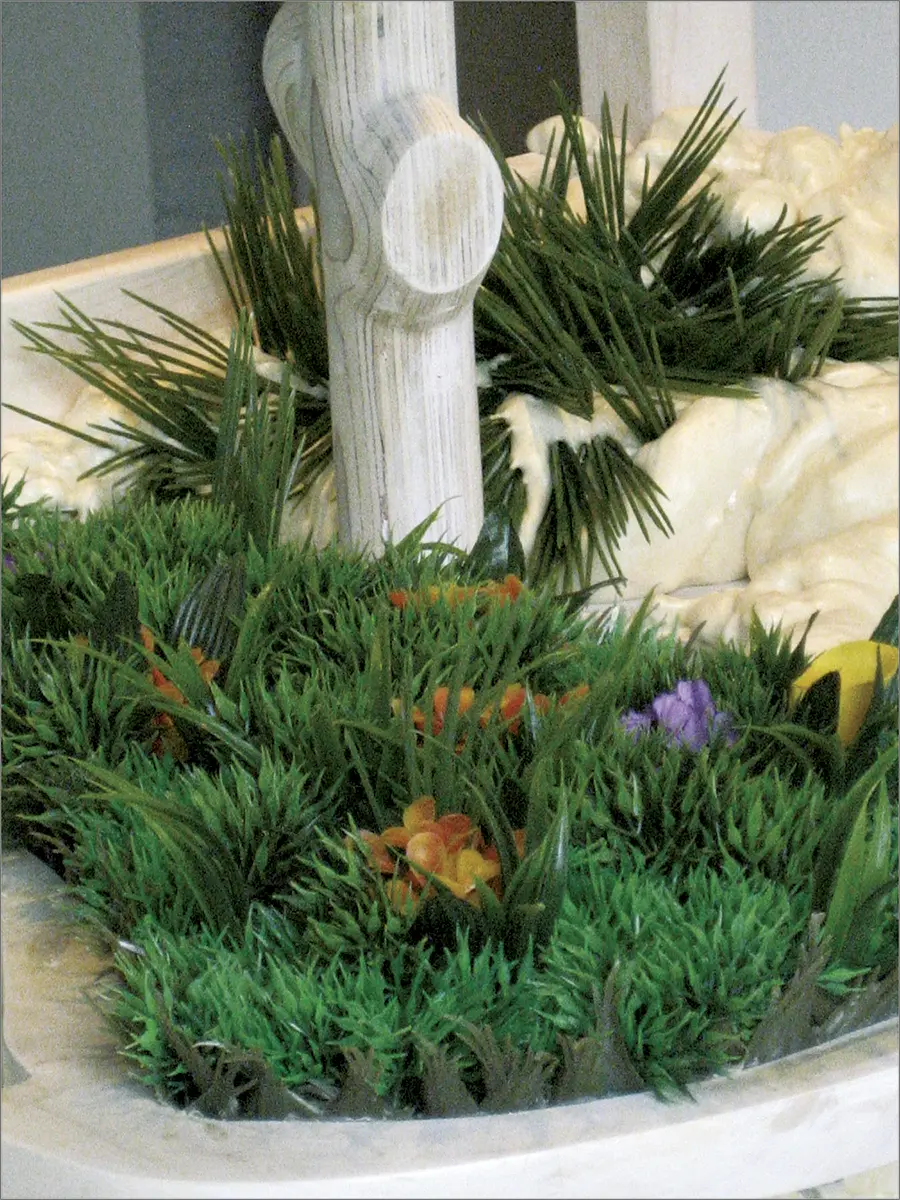
Some elements of creative dislocation were recognizable in the works. Landscape formed a distant horizon that mixed the real and the unreal and became accessible, tactile, evocative, and seemingly tender in its execution when seen up close, even if one was able to intuit the ferocious action of the saw on the wood. In their material structures, these objects were strong but not aggressive; the objects heeded the environmentalist call in a highly personal way, refocusing nostalgia and revitalizing the relationship with the reiterated image of “the island.” Conceptually, these were very intense works. While Gelabert let himself play with his viewers, inviting them in, offering various perspectives and possible readings, one must note that he created an original re-semantization of the autobiographical entry.
In his deconstruction of a relationship with one’s origins, Florencio Gelabert also attended to geographical numbers and proportions. The relative fragility of Cuba, his country of origin, and that of Manhattan, where the show took place (and to where the artist recently moved), established a dialogue of sizes and a comparison with other sections of the world—ever since the 2004 tsunami in Southeast Asia, the relationship of sea and land has shifted. Two different scales were deployed in this exhibition: the small scale of the reliefs and the scale of the surreal table. Beautiful in its monstrosity, the table confronted the visitor with a more realistic experience, one of sitting around a table. For the artist, the table is the symbol of familial integration (as well as the place where the dysfunctionality of certain families becomes evident). At this “table,” each viewer read one situation or another.
Gelabert’s work often personifies the memory of his father, who is also an artist. Gelabert left Cuba in 1990 and, after a brief stay in Mexico, settled in Miami, where he began working with recycled wood. The artist says that this was the material he could find most easily, lending an autobiographical quality to his work. Just as he cut himself off from Cuba, Gelabert does not cut down trees, he only takes that which is already uprooted from the earth. A few years ago, he altered his way of working; he bought raw stumps and later purchased already processed furniture from simple stores, so that “... something new could be born from what is already destroyed.” Gelabert personifies inanimate objects. His tables, of industrialized wood, germinate sculpturally; he “gives them back” the shapes of branches. In his cutting and pasting, separating and restructuring, he has incorporated foam, resin, and other simultaneous chemical processes. If the tree bark gave him a texture, he sections and glues together these white woods to achieve an entirely sanded and protected finish. Gelabert invents the protuberances of what could have been branches. He cuts up a table, relocates a leg, generates irregular shapes and similes of branches, and places them in superpositions and complex baroque constructions, creating allusive textures in foam and including small synthetic plants. Gelabert flirts with kitsch and even with the useless objects that today are produced for temporary decoration.
In all of his works, there is keen handling of volume and three-dimensionality. Located in a separate section of the gallery, there were two other works, connected in their technical and conceptual approaches. One of them, My Father’s Shape, an open ring with a diameter of 91.4 centimeters (36 inches) alluded to a labyrinth; the other one, Personal Mountain, was an allegory of life with yellow synthetic petals. Both revealed an artist in the process of growth.
GRACIELA KARTOFEL