
Starting from painting, generally in large formats, with well-paced and confident steps, Gabriela Morawetz (Poland, 1952) has advanced towards her most recent exhibition at the Museo de Arte Contemporáneo de Caracas (formerly the Museo de Arte Contemporáneo de Caracas Sofía Imber,) exhibiting key works that synthesized a wide-ranging aesthetic the proposal that would be badly served by a single categorization to validate its creative capacity. On the basis of combining elements, techniques, and materials in a severe and at the same tame audacious artistic practice, the artist assumes the serialization of easily recognizable images, repeated in different works. Morawetz systematizes and establishes hierarchies for figurative values within abstract conceptions that are conceptually regulated by a universe of the real/unreal loaded with metaphysical meanings. Reconsiderations of memory as the generator of themes for creation permeate the starting points where the photographic image becomes a rationally regulated modality.
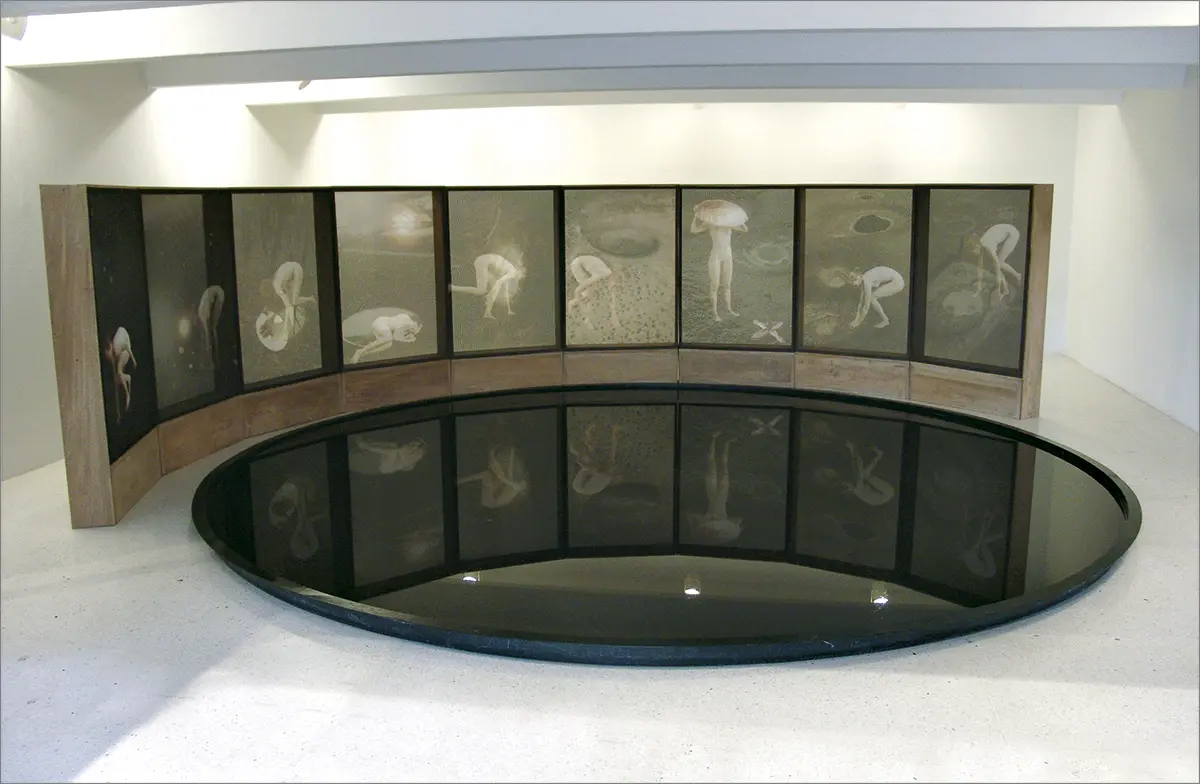
In Juegos de la mirada, as this exhibition is titled, Morawetz carries forward an exploration she has been developing since her earliest exhibitions in 1975. Through large installations, photographs and videos, she attempts the recovery of memory, as we read in the gallery text, “in conjunction with the gestuality of the body, the representation of a condensed and diverse ‘I.’” Concretely, “what predominates here is the specular, the interplay between that which is hidden and that which is evident. The figure —be it male or female— is presented, at the same time, in the fullness of its carnality, and also in the abandonment of an enigmatic and unfinished existence.” A theme can be considered up to this point, but one must go into greater depth in order to conclude that the truly artistic connects at essential points with a philosophical interest regarding time and space, within which the work is developed in connivance with the viewer. The atemporal centers around the figures frozen in time and in a space that is defined by the limits imposed by matter, which creatively challenges the concept. For example, in Casi en la sombra (pigmented inkjet on a veil, water, and fiberglass,) a semi-circular installation of nine panels in cinematic sequence, situations “occur”: a semi-nude female figure “moves” virtually in what could be the action of taking a bath in a forested landscape; a romantic atmosphere that is complemented by the mirror that reflects the “event” that proposes formal transformations and systematization of the order of the ontological universe that preoccupies the artist.
Fragmentation is part of the theme. Situations come one after the other as they do in dreams, break down and reconstitute themselves as a time determined by a given space keeps flowing. In today’s Juegos de la mirada we perceive the precedent of the paintings she exhibited in 1986 at Galería Minotauro in Caracas, for example. Landscapes with a female figure as their protagonist, and today that figure is presented as directing the discourse of an artistic proposal that is inscribed in unconventional values. Morawetz reactivates the fragmentary image repeated in her video Uno or in Pozos, a four-focus vide-projection with an organic, ragged shape in continuous movement. One of the characteristics of the works exhibited here is the participation of the viewer in the sense of searching for each installation’s hidden meaning, as Morawetz moves away from objective reality and enters a semiological system with meanings that are concretely referred to as signs, or signals, that drive our reading of the proposed discourse. While they could be explicit, the images’ references point towards previously known feelings, as in Los ojos del tiempo, an installation of 13 convex-glass medallions on the wall that operates a kind of reconstruction of the image on the basis of its own fragments. Morawetz reaffirms her references and artistic experience by breaking a visual order already academically constituted.
BÉLGICA RODRÍGUEZ