
I should have written this text about Jaime Ávila a long time ago. I remember his participation in a regional salon in the early 1990s. It was there that I saw his work for the first time, and it struck me as unusual: a pair of men’s trousers and a pair of tennis shoes were set up to simulate the form of a photographer crouching and looking through an old, box-like camera. This “character,” unmoving and half-covered by a black cloth, seemed hypnotically trapped. When an observer glanced under the cloth, she found a precarious TV set built of parts of unusable technologies. It was a kind of kaleidoscope of mirrors with small plastic dolls dressed in red; if memory serves, they were Taiwanese dancers. Ever since I have seen Jaime Ávila as an artist who entered the Colombian art scene in order to disorganize consumer society and bend it to his will.
In later works, Ávila appeared as an adolescent artist in the metaphorical sense, with the perspective of maladjustment, where not all the pieces fit, of lack of affection, of discomfort with borders and limits. He is a critical thinker regarding the prior generation, not solely its artists but the whole traditional culture. Ávila was born in 1966 in Saboya, a town in the middle of Colombia’s mountains that is cold and near Muzo, an area known for its emerald mines. From early on, he was interested in comic books, which taught him how to draw, and in film and pornographic magazines, which taught him how to see. His porn comics made him a high school hero, which distracted his friends from the fact that he was an A-level student. I believe he retains this attitude to this day. Ávila has been invited to numerous places, including Caracas, Mexico, Los Angeles, Harvard University, and the Havana and Sao Paulo Biennials, and he remains “fresh,” as we say in Colombia—still interested in the most everyday aspects of life in Bogotá, that weirdest of cities—and his laughter is the same.
After Ávila’s high school days came the city, the game of fashion design—that great simulacrum—and the link to everything marginal and gomelo, a term for the high-class students of the university where Ávila studied first engineering and later art. From the start, he was accustomed to the interplay of quick, intuitive exchanges between art and non-art materials. He has built objects using discarded items, cardboard, clothing items, and technological waste. He has also built objects in porcelain and fiberglass. No observer is indifferent to his objects. I think they have a sense of opportunity. They say what must be said at the precise moment.
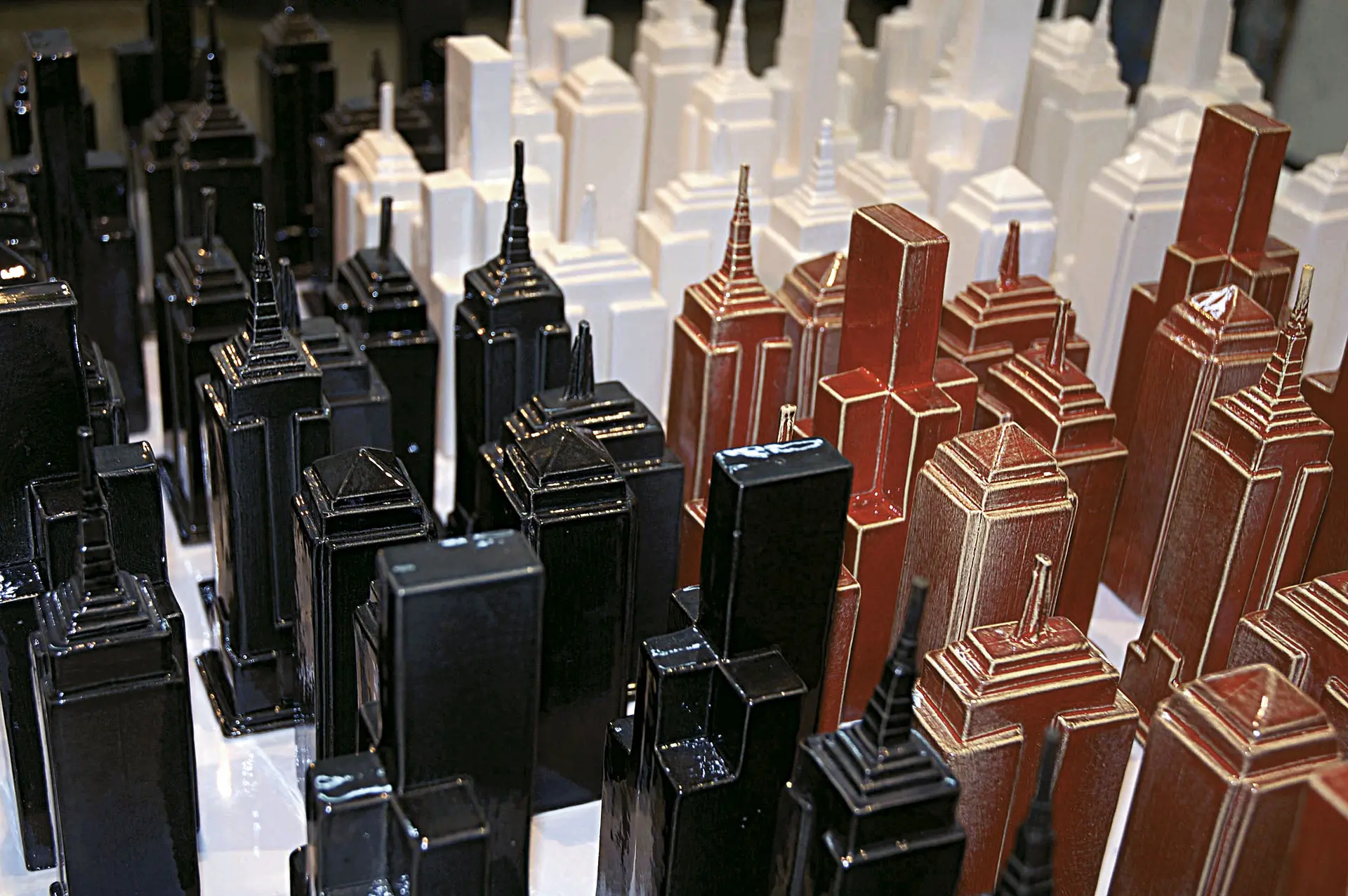
For example, Trofeos is a series of small Manhattan-style buildings in white ceramic. They bring to mind Marshall Berman’s observation, in his book All That Is Solid Melts Into Air, about the oppressive rent as the engine behind development in New York City. In 2006, Ávila created a new version of these trophy buildings in red, white, and black porcelain, the colors of the Iraqi flag, and titled it Ira; in this way, he finds pertinence in his objects. He has also turned photography into an object. An example is the case of his images of Bogotá streets, haunted by poverty and illuminated by small Christmas lights. This relationship between desolation and celebration exemplifies his efficacy of “dense perception.” Ávila has also been a painter, a major photographer, and the author of installations and some short videos. As a teacher in various prisons’ art workshops, he has learned to impart a very personal vision to what Antanas Mockus, one of Bogotá’s recent mayors, calls civic conviviality.
Recently, Ávila has toured Colombia, inviting groups of students to build models of a dream hotel and to tell stories about them. He has attempted to broaden the artistic experience by involving and featuring the creativity of others. In 2005, during an exhibition in the Colombian city of Tunja, Ávila held one workshop where each participant, besides building, naming, and photographing his or her hotel, wrote a story. In the stories, precise affections for and memories of a city became evident. From Hotel Footwear, for instance, one of the supposed tourists writes a postcard that reads:
“Camilo, it was great to once again walk with you in Tunja, among the truck-tire swing sets and our favorite game, the slide. We came home with our pants totally fucked up. The school building reminded me of the many times we had to hide in the cooperative hall in order to avoid being disciplined. It has been more than 50 years; we are old now, and it makes me sad to find you in such bad shape, poor and alone, the only one of my childhood friends who was never good for business and whose life has been filled with sourness. When I saw your eyes sparkle, I saw the same gaze that was yours as a child, the same gaze I used to see when you laughed. My life is filled with luxury, I am filthy rich, and you have no idea how happy it makes me give you this hotel as a present; the helicopter will be flown by your private pilot, in the back you will be able to play in a slide that will end in a thermal-water pool. I hope you have lots of fun, I will stay here in Texas and travel every so often to Las Vegas and getting more and more money, and I will remember the slide behind our school. With love, Plutarco.”
Back in the 1980s, Ávila was one of the first contemporary artists in Colombia to walk the streets of Bogotá and build a persona as an alert pedestrian, establishing a relationship with the place around which he moved. (Francesco Careri, the Italian architect, wrote in 2000 an entire book about walking as a form of critical awareness.) From his walks, Ávila learned that the camera not only captures images but also is an instrument for establishing relationships and for conversation; despite losing some cameras to theft, he continues this project. In sum, he does not take off from a fixed point of origin but moves because he detects intensities or “climate” changes, as in the sports of hang gliding and surfing. Ávila moves because he is interested in human nature.
It is impossible to speak of all dimensions of Jaime Ávila’s work in this review. Some examples will highlight Ávila’s interest in the construction of geography as a new world order, the knowledge of the city, and his ability to connect the heterogeneous, which has resulted in openness of form. His works have made it possible to describe facets of life in the city and in the global village that present shared histories and common emotions rather than differences.
Ávila’s interest in pointing out changes in the world order is a new turn in his recent work. In Bombas, a show presented in May 2006 in Bogotá, Ávila seemed to disorganize geography, or at least to propose different versions of the map that is familiar to many from school. The differently colored political areas of traditional maps begin to shift and are substituted by territories with new boundaries. Toni Negri defines this new configuration of the world as Empire. It is not a metaphor, as Negri explains: the concept of Empire is characterized by its blurring of certain borders and its drawing of others on the basis of money and technology, its imposition of consumerism, and its domination of social life in its totality. A description of this new world moves away from depictions of small and large countries and comes closer to collecting stars and attaching them, irreversibly, “for all eternity,” to a single flag; like stars, countries are collected on a piece of blue cloth. This new description shows the traffic across borders, such as money, and the danger represented by their concentration.
It was not by chance that Ávila’s work was presented under the shadow of a financial institution; money is sovereign and flows beyond any boundary. Ávila arranged situations and experiences of the new global order framed by the idea of a pump— bomba in Spanish, which is also the word for “bomb”—a mechanism used to control the concentrations of fluids before they exert dangerous pressure. In this case, the fluid is money, which had a threatening presence in the exhibition.
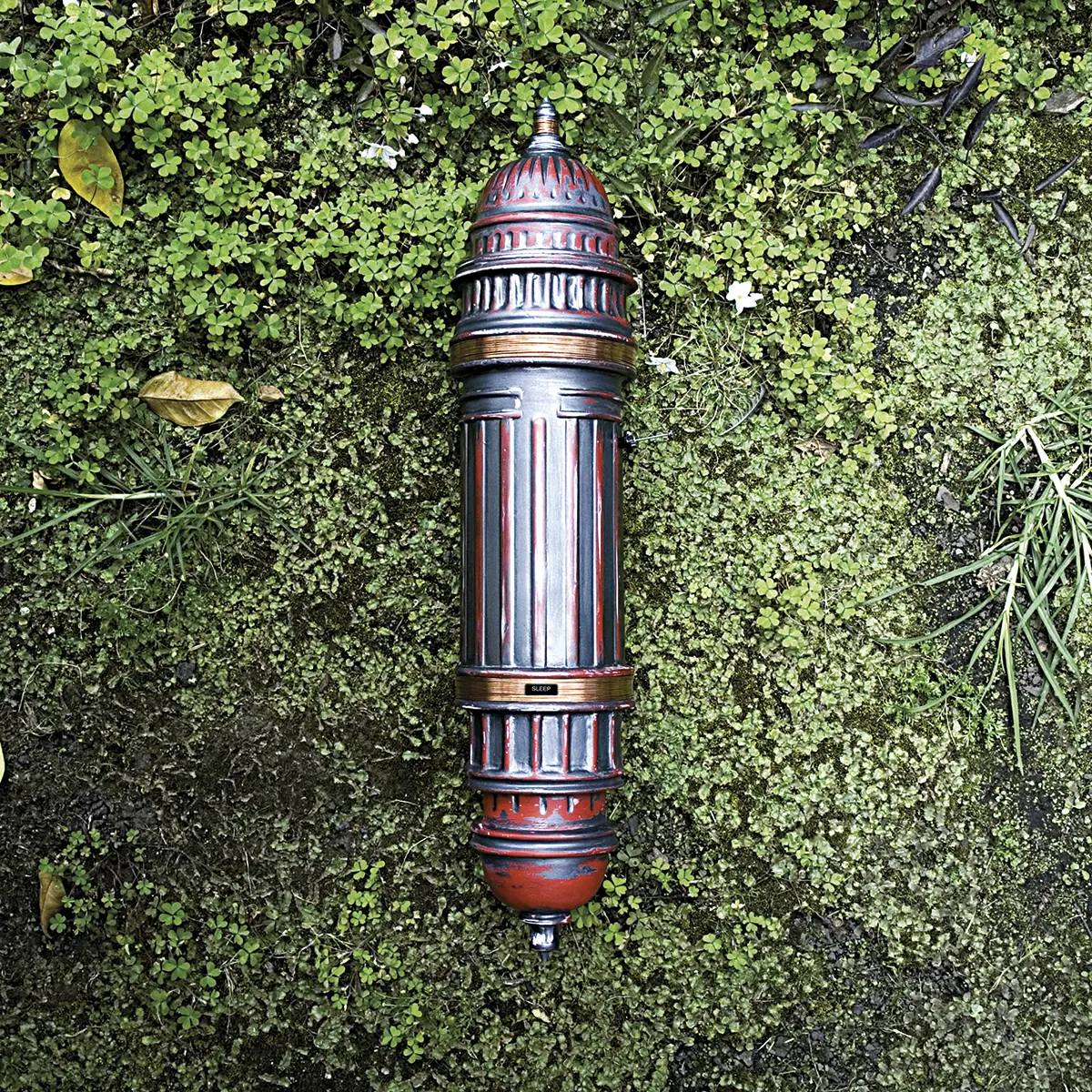
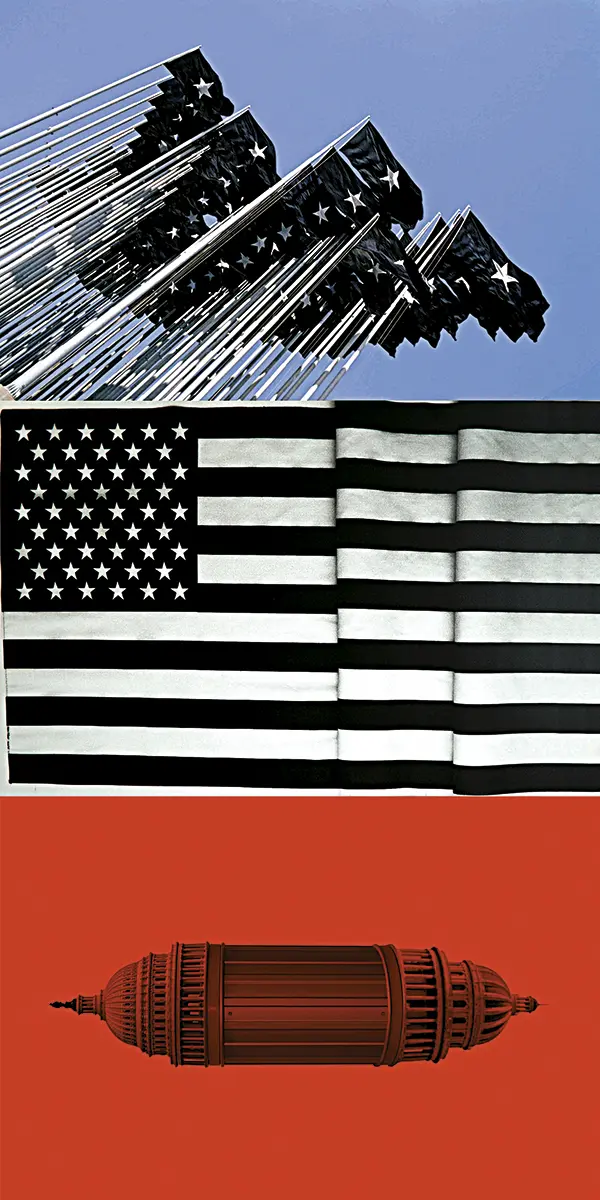
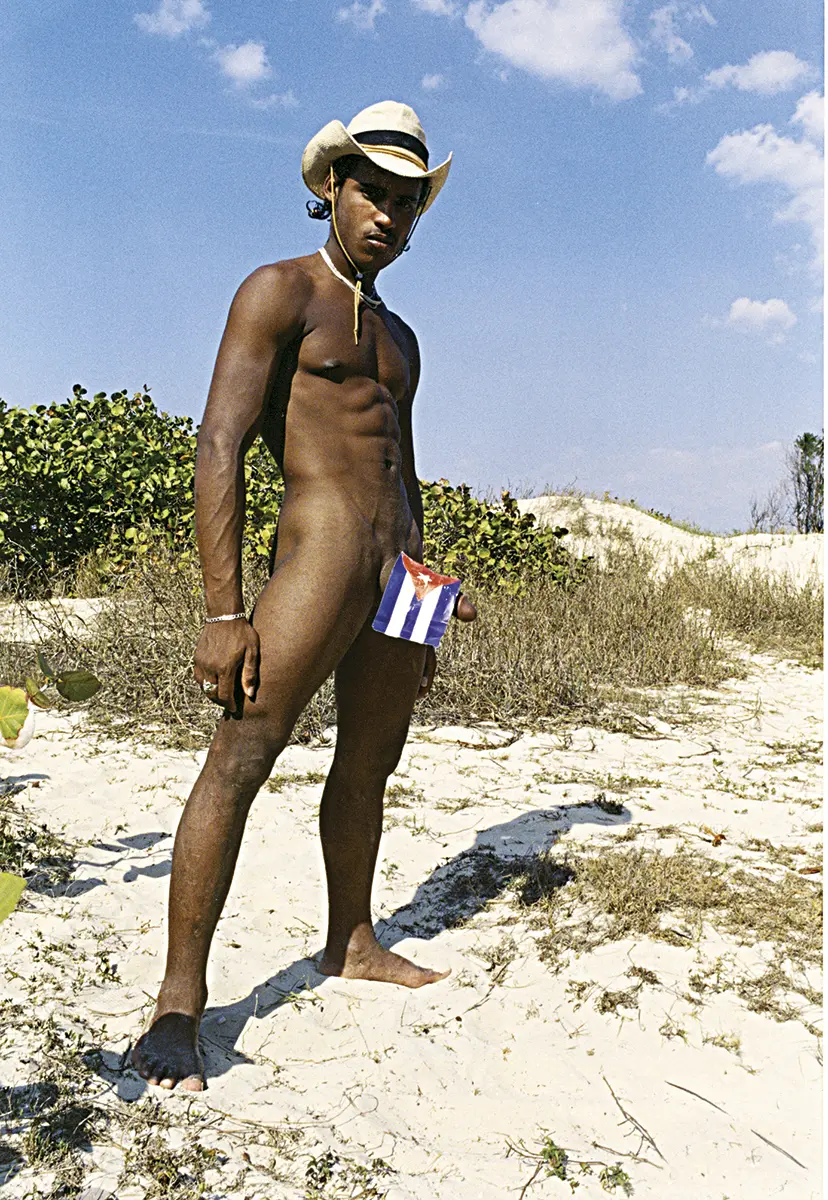
The exhibition was a mise en scène of photographs and objects, and it presented the question of choosing contemporary icons as world powers confront each other again and under new circumstances. One icon was the Cuban flag, painted black, that a group of protesters placed in front of the U.S. delegation in Havana in early 2006. In the composition of Ávila’s photographs, the Cuban flags became the American flag, also in black. The idea of choosing symbolic objects charged with regressive, threatening forces was also visible in Ávila’s pumps. These fiberglass objects resemble homemade explosive devices or some spools of old technology. The pumps have two heads—the U.S. Capitol and the Cuban Capitol—that share the Neo-Classical architecture that characterizes buildings of power. The names of these pumps are significant and somewhat literary: 1,500 miles, 2,000 miles, a hypothetical distance between Washington and Havana, almost the title of a “noir” novel between two opposite poles. Corazón bomba (Heart-Bomb) is an object that foresees pressure and its effects in a material like fiberglass that twists and takes the shape of destruction. My favorite work is one of these “devices” photographed in a garden as if this destructive artifact landed in the backyard or in the garden in Ophelia by the Pre-Raphaelite artist John Everett Millais. This photograph is titled Shakespeare, and the union of heterogeneous elements is essential because progress is only possible by referring to previous paradigms and their own contradictions. Ávila wrote once that his analytical vision was achieved through a romantic construction. Perhaps this is why this is my favorite photograph.
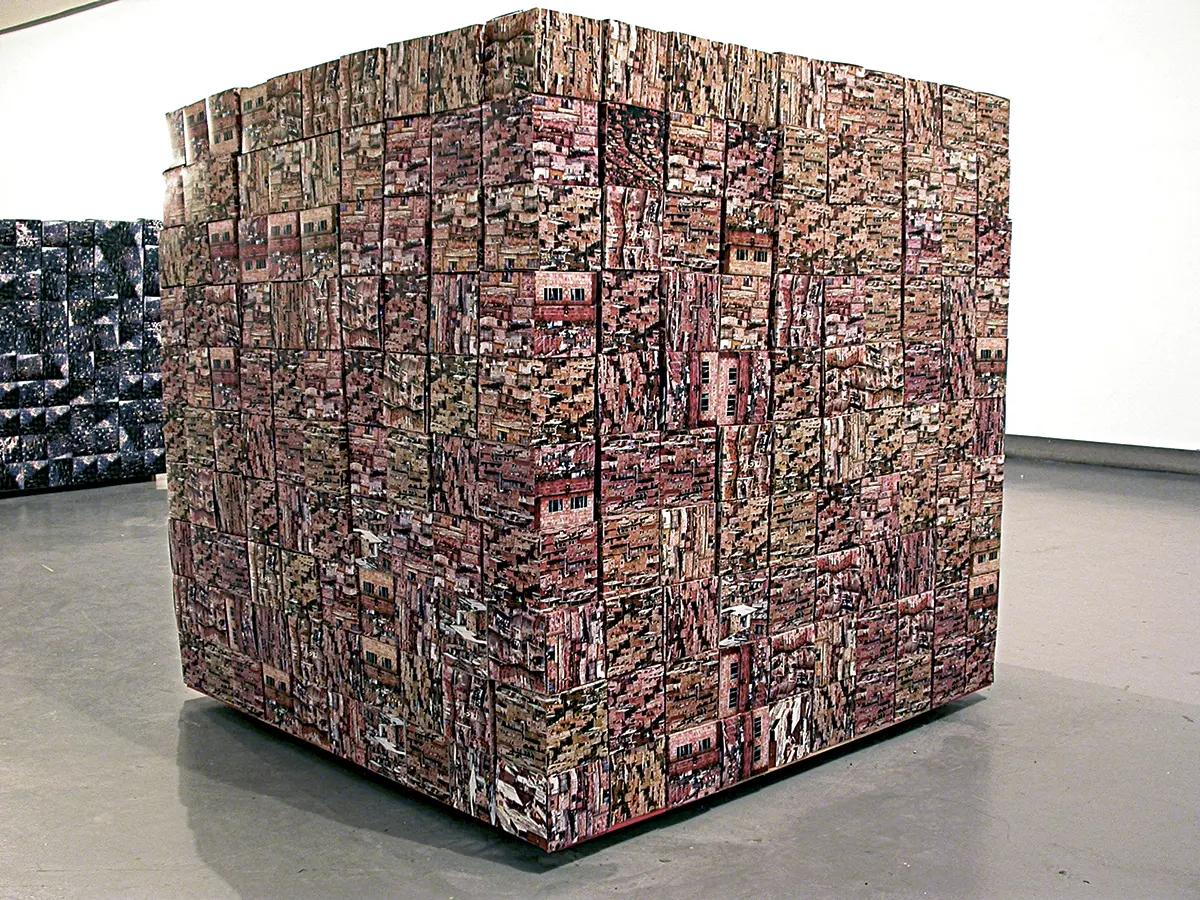
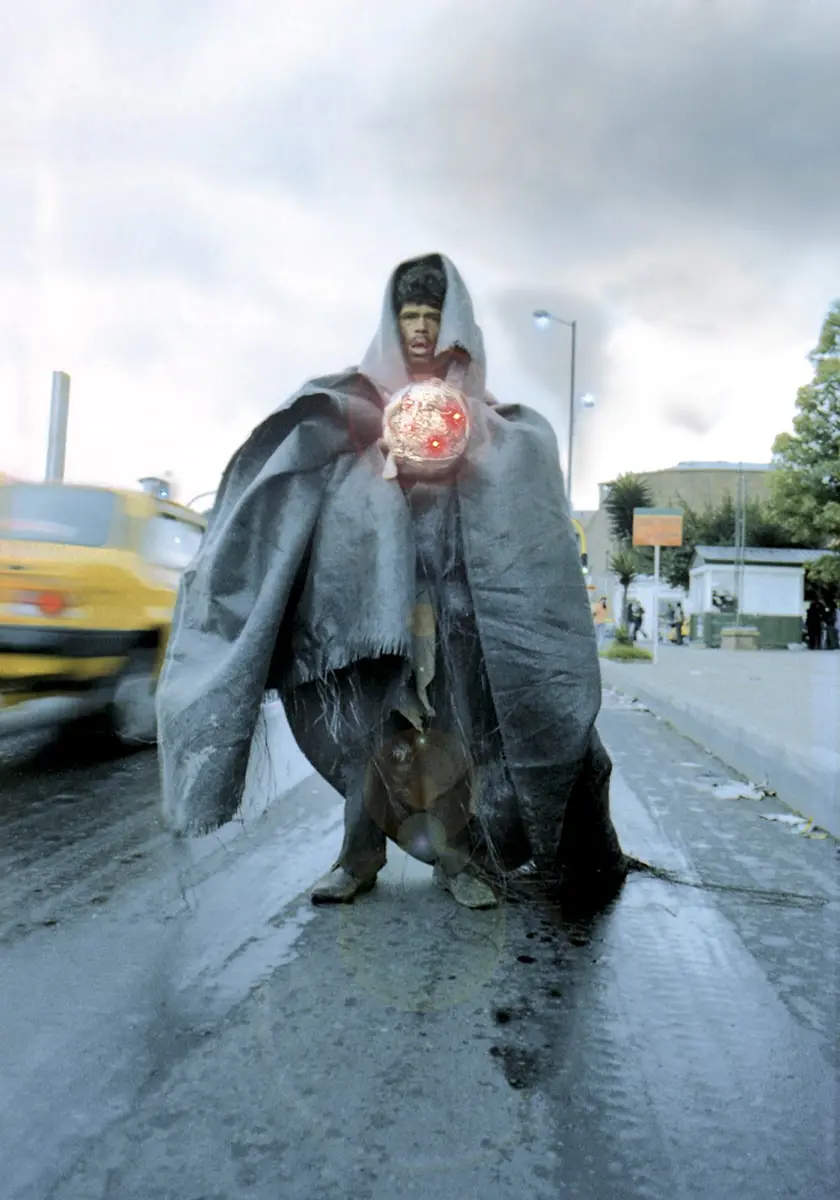
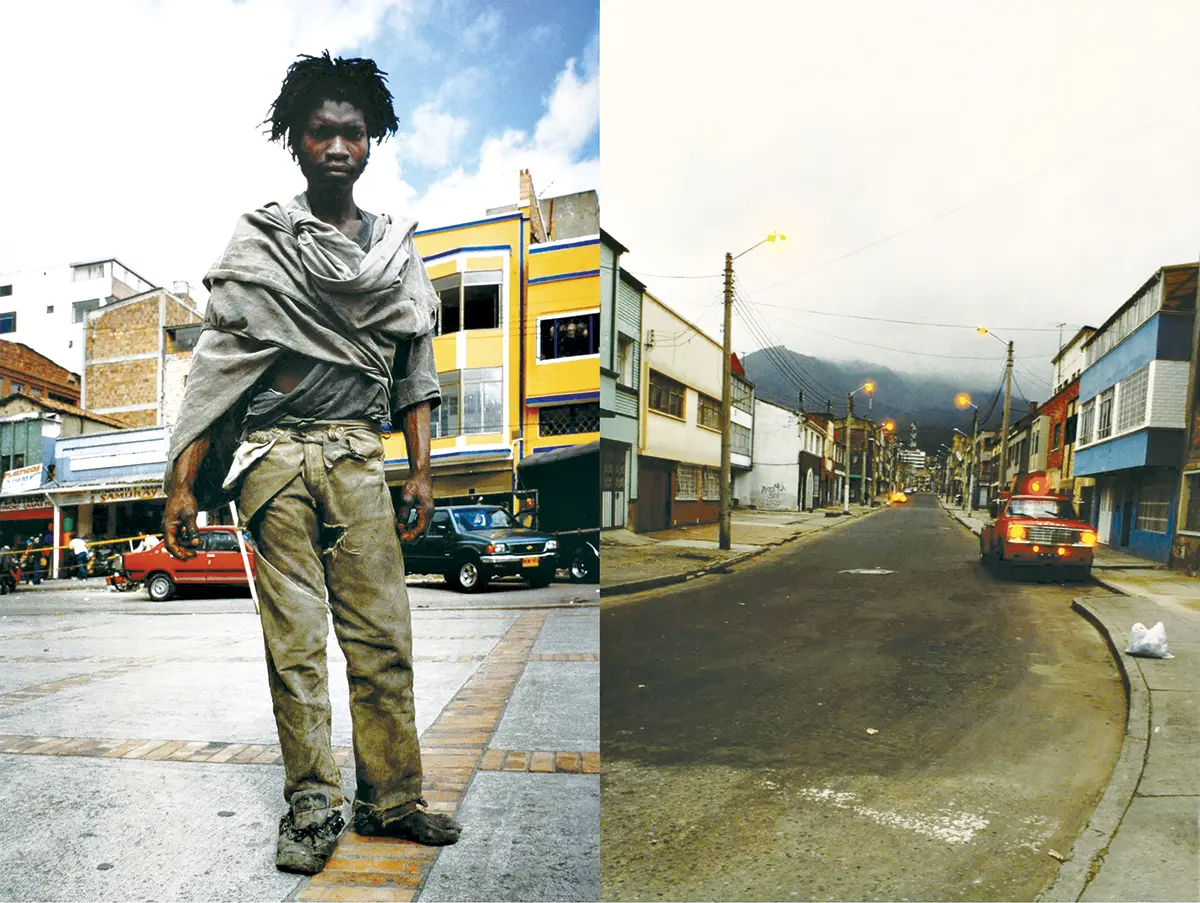
In this exhibition, one also found the underground city, synthesized by red photographs. Arriving at such a synthesized image is possible because Ávila knows the city very well. His previous works portrayed segregation in the street, which is disqualification par excellence, as seen in La vida es una pasarela, a series of polyptychs dated between 2002 and 2005. In them, Ávila explores the paradoxes of public space. Remember that a street is a place defined by the transitory: it has been defined by the analysts of modernity as a place populated by people on the move, hounded by the clock, or by wanderers who have entire afternoons for their aimless strolls. Against these definitions, Ávila shows a street inhabited by subjects who cover themselves in exuberant rags to mark their difference. In La vida es una pasarela (Life is a catwalk), the inhabitants of the street exercise the right to occupy a place in that transient territory, and they attempt to build with their flamboyant outfits a precarious intimacy in a small corner of the city; they attempt to build for themselves a place where it is possible to live amidst ever-growing filth, to eat whatever can be gathered, and to live through the night.
The characters in Ávila’s photographs are nineteen years old, and their attitudes reveal that they haven’t always lived in the street; perhaps they do not fit within a rigid social system and are called failures. Like the character of El Dios de la miseria (God of Misery), they are loners and excited individuals in a moment of performance, which allows them to exist. Ávila wrote:
"In La vida es una pasarela, I reconstruct the worn-out image of drug-addicted youths, like those capitalistic clichés constructed by the fashion magazines; they were born in the 1980s, a booming period of drug-trafficking in Colombia, and in contrast to the 'radioactive youths,' they demonstrated the failure of a system “without future”; the title describes the sarcasm and cruelty, involving the viewer as part of a powerful system that subjugates any fragile person."
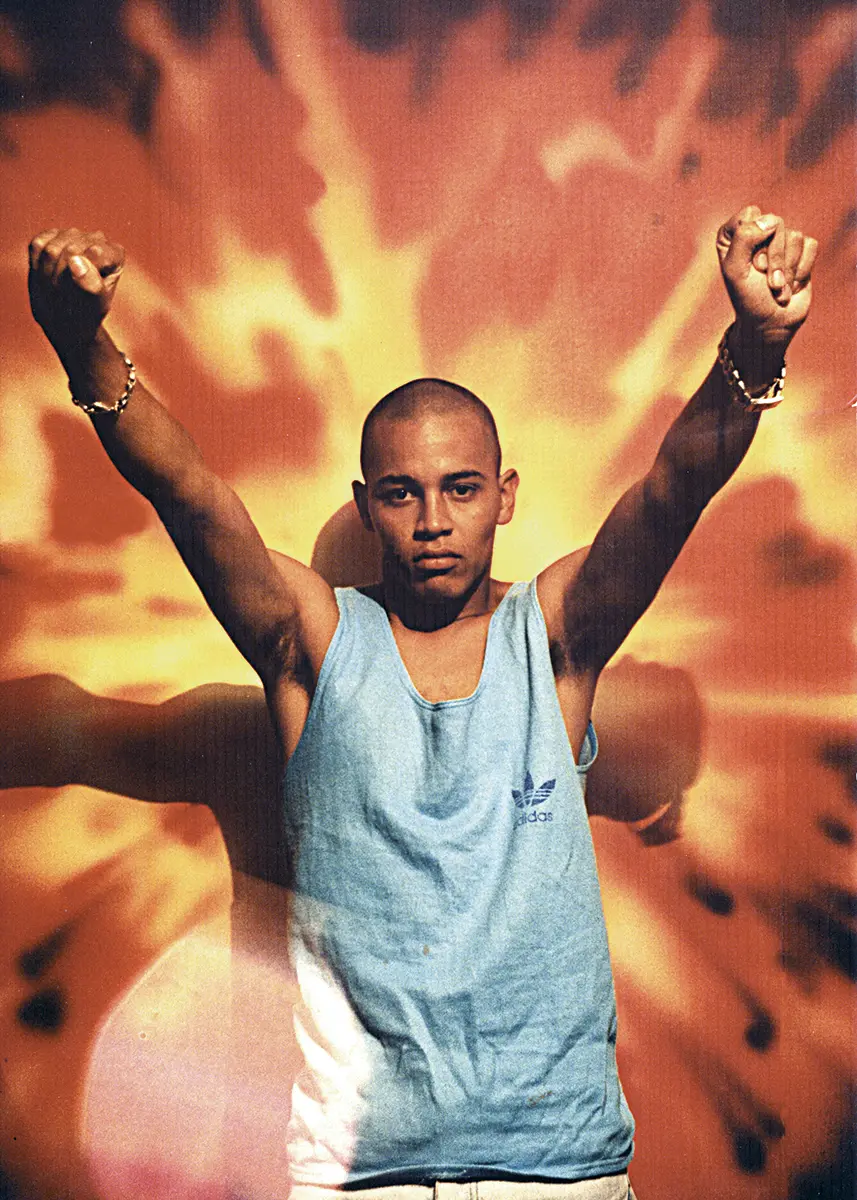
Jaime Ávila’s gaze has always seen power as a fiction, whatever its nature. For example, Bogotá, the city of so many developments, has its reverse side, which is featured in Ávila’s work: Ciudad Bolívar, an informal settlement of the worst social conditions but with a shape and life of its own. Ávila transforms the power of the camera to capture the exotic into a method for communicating the experiences of others. For instance, he describes a group of youngsters he named the “radioactive ones”: “The radioactive ones are pelados, haphazardly lost in the city. I like the term ‘radioactive’ because it implies something nuclear or post-nuclear that survives even if nobody cares.”
Los Radioactivos (The radioactive ones) implies an artistic operation that, in developing an interest in and describing the world of others, reveals similarities in their dreams and desires. The Ciudad Bolívar adolescents want to play in a rock band and they listen to the same radio stations as anybody in Bogotá. This work showed how the city is traversed by shared emotions and desires more than class divisions.
The marginal areas of Bogotá, Sao Paulo, or Mexico City-inspired Ávila’s 2003 work, Diez Metros Cúbicos (Ten Cubic Meters), reflect the unplanned accumulation that is the flipside of development. The ten-meter cubes are made of smaller paper cubes with photographs of places that are run-down but survive with the efforts of human wills. In Ávila’s work, confidence in the power possessed by human beings often appears with its full reflexive power. Eat Me is the photograph of a new protagonist of cultural movements who, following Negri, makes one think that any critique of the empire of capital will solidify it rather than destroy it. What destroys it is the free wandering of desire. It is destroyed by the people’s resistance, by their unwillingness to be defined as simply a labor force; it is destroyed by those who protest in front of diplomatic delegations and who propose the law of those who desire, as a form of protest, even a subconscious one. They passionately and impulsively express what is political. They propose that underneath order there pulsates that which order represses. It is not by chance that under such circumstances, Jaime Ávila facilitates situations and experiences of individuals who question the system of power by exercising their own individuality. Ávila’s work shows mechanisms of a changed time when one's hopes will be disseminated in the desires of the multitude.
NATALIA GUTIÉRREZ
Professor at Universidad Nacional de Colombia.