
The exhibition titled Calar, a series of twenty-eight works, among them a book created in collaboration with Enrique Peña, invites us to explore Caviglia’s discourse, centered in the assemblage of found objects, especially doors, drawers, legs of chairs and tables. Objects ripped from every day or salvaged from oblivion, which once transposed to the artistic realm open the door to perceptions and histories protected by memory.
A coherent line in the development of the artist’s work can be observed as we move through the gallery. Wood, used as raw material, in ovoid, square, or rectangular shapes, is in itself medium and support. Even so, slight differences in the technical and compositional resolution of the assemblage mark smaller groups within the whole. In some cases, the assemblage is resolved by juxtaposing different sections of doors or windows, creating an almost homonymous integration on the surface. In other cases, the elements are superimposed in order to highlight their corporeal characteristics, which, despite the preponderance of volumes, remain within the limits of the bi-dimensional.
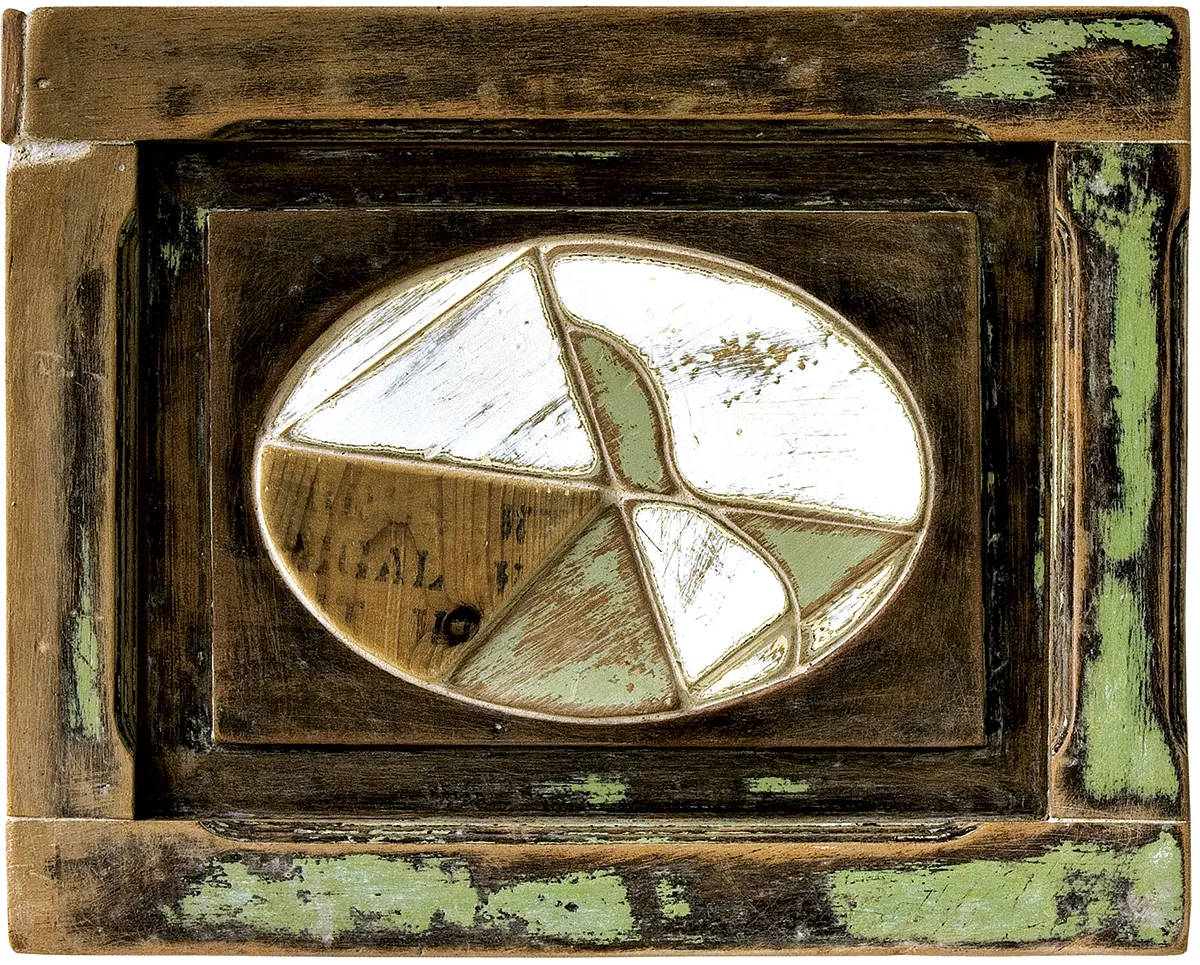
The titles of the works, on their part, have been selected to magnify their content and chromatism. Amarillo de donde vine, Blanco transitado are some examples. In the first work the color yellow dominates, and in the second, white is preponderant, a relationship that beyond the apparent simplicity in the naming of a thing with an objective description on one of its characteristics, is the formal link that allows us to enter new realities and meanings.
Textures guide these new meanings. They are the traces left on the wood, the articulating words in an alphabet that tells silenced stories, amplified by a detail in the original work, for instance, a drawer or a chair leg. These inanimate objects are integrated into the proposition of poetic and profound reality.
The first group of works, Colores transitados, is comprised of a triptych of ovals in similar sizes, with perfectly delineated and cut edges. The designs in relief in the wood pieces from doors, as well as the fading of the colors, denotes textures left behind by use and the passage of time. As a whole, these are three separate ovals, placed in different directions, that converge to the center in an indefinite tension between entering or leaving. Also, in Amarillo de donde vine we perceive the optimism of a yellow that dresses the wood, revitalizing it with light and harmony. Here the support is the oval-shaped door or window with superimposed carved shapes. The highlight in the group is the drawer —present as a recurrence in some works—, deposit and caretaker of memories, open now to reveal for us the secret it preserves.
Next, we find another group of works, the one with “the whites,” which present similar characteristics to the previous ones but with the use of the color white as the regent of their meaning. Thus, Blanco transcurrido, Blanco probado, Blanco sin custodia, Blanco afanado refer us to the essence of the color white, which is to say, to purity and to the traces that are left on it, expressed with textures, that we intuit as resembling the revealing skin of past experiences.
In turn, in Colores embriagados and Colores arados wood is only a formal resource for the creation of a new proposal with entirely visual content. In this case, the sinuosity in the wood is used to recreate unusual shapes of guitars in a cubist line, framed by boxes that are open like niches.
Finally, another group of works alluding to nature presents the variation in the color palette. Brown and sienna shades, characteristic of wood, are the support of a central circle, which in turn is filled with various abstract shapes that click perfectly with each other. Naturaleza prófuga, Naturaleza sin cesar, Naturaleza sin plazo, and Naturaleza viajada are examples of this.
Through these groups of works, Caviglia displays some of the interpretations he makes of the language of wood. Secondary or “carved” meanings he achieves by de-contextualizing these found objects from their original functions, be it when he encourages us to follow the traces of their own histories, be it when he retracts their shapes to create compositions whose interest is purely formal or stylistic, be it when he proposes as meanings of simple natural relationships.
In all of these cases, wood, assemblage, and color are the means to propitiate the encounter with a different vision of our everyday existence and to rescue from oblivion objects that, perhaps, were ours before.
ANNY BELLO