
Recently, the Fototeca de Cuba exhibited Mis 60, a selection of twenty-five photographs by José A. Figueroa, an active member of a generation of artists—some of whom are now dispersed around the world or have passed away—whose early careers began in Cuban magazines and newspapers, in which they passionately and purposefully learned lasting truths and techniques from teachers who were also mostly self-taught, although they did not receive the same recognition as their students. Those masters, which included Korda (who taught Figueroa), Constantino Arias, Osvaldo Salas, Raúl Corrales, Mario García Joya, Liborio Noval, Ernesto Fernández, and in particular the exceptional Luc Chessex and Paolo Gasparini, taught the theory and practice of photography in very difficult circumstances—especially the art of developing negatives and printing in any “darkroom,” places that only resembled a true photo lab in the fact that they were darkened with rags or tape on windows and doors (they were often located in the bathrooms of the artists’ homes).
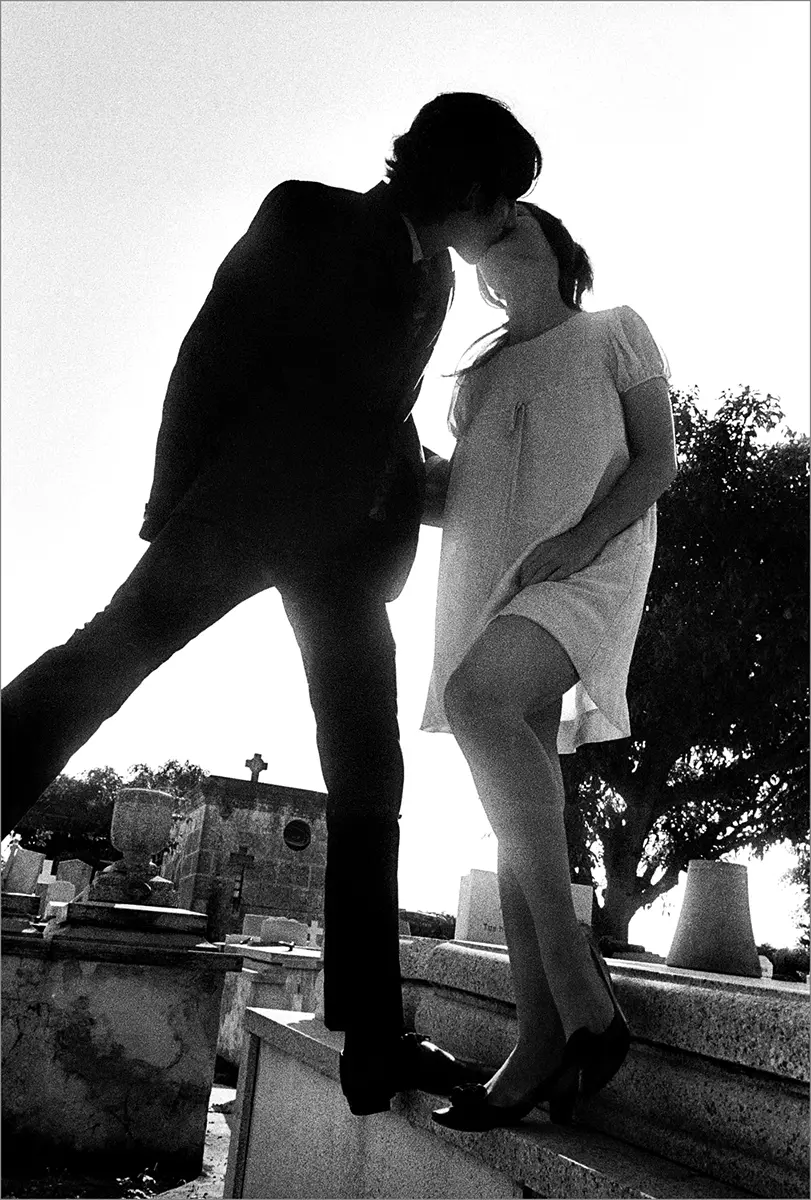
Aesthetics of the document—of photographic witness—permeated the actions of both teachers and pupils in the 1960s and in the following decade, which was when the students became known, as they were anxious to register the cyclone of everyday life in Cuba, in the city or the countryside, in streets or factories, in schools or homes. There was no time for reflection about the history of the genre, its meaning, its reach, its connections, and its limitations—as is done now freely and calmly—because reality shifted week in and week out and situations emerged in the political and social scenes that pushed people to the verge of nuclear confrontation or to the cutting of sugarcane.
But while many of his cohorts devoted themselves to documenting what took place “out there,” in that fascinating, luminous space of the city and the country, Figueroa opted for discovering himself in the intimate, in the private world of his friends, in his own world. Committed to his own experience and that of others, to his country and his time, Figueroa captured gazes, gestures, innocence, and truths.
The photographs exhibited at Fototeca de Cuba were accompanied by a soundtrack of music from the 1960s—most of it banned or demonized at the time—and possessed an impressive tenderness and candor. Looking at the camera or away, each character revealed satisfaction, delicate feelings, self-confidence, value, and integrity through their ways of sitting, leaning against a wall, and kissing each other; they seemed joyful to be living in frank complicity with the photographer. It seemed that Figueroa was part of each of them and experienced the same emotions; subject and object were clearly in synch so that capturing the instant was something entirely natural and never forced, never posed. A secret brotherhood and solidarity pressed the camera shutter, conscious of the value of recording a person’s private spaces, perhaps denuded, without taking into account their circumstances.
Framing acquired great importance in this activity because each photograph described close relationships between physical space, objects, and bodies. Lighting was deployed almost always with the intention of capturing yet another instant and not necessarily the decisive one. Life flowed in front of the photographer; it was the unnamable river in which he and his reality swam, were they regarded each other as they existed in unity, to the point of fusing into one.
It has been many years since I have seen such an organic connection between art and life, in which a photographer has avoided the cold calculus of distance, focus, perspective, light, and shadow that is often employed in order to please someone, something, or to conquer by force a given public as he or she greedily strives to gain a foothold in the cultural scene and a projection as an “artistic product.”
Underlying each one of Figueroa’s photographs is an ethical position equally valuable then as it is now, given the challenge of exhibiting them forty years after their creation and of printing most of them for the first time. Without exaggeration, this is honest and sincere attitude toward the creative act, one devoid of the fashions and spectacles of today: it is certainly a curious fact for a photographer who first became known in the 1970s to show images of the 1960s now, near the turn of this century, isn’t it?
Because most of these photographs were never exhibited before, Figueroa appears as “ahead of the flock.” His themes are rather distinct from the dominant ones at the time, when the trend was to privilege images that bore witness to the mass lunacy of the “happy years,” when one could scarcely distinguish bureaucracy, censorship, defeat, kitsch, doctrine, fanaticism, dogma, or triumph.
The images of Figueroa’s (and my) 1960s enjoy the poetic aura that is immanent to all genuine works of art. They do not employ mystery or magic nor possess a symbolic space contaminated with complex significations, but they are enjoyed through what is simple and direct, like a posted bill or a traffic sign. Seeing them in their totality allows one to distinguish and understand the visual and specifically photographic language that defines them within the culturally and historically epic context in which they were created. Even beyond that, they contribute to feeding the daily gnawing nostalgia for those lost years and to understanding better the years now far away in time. They are, thus, the expression of a very important memory that remains dispersed in negatives, manuscripts, drawings, and recordings by numerous artists who are still with us. To this memory, José A. Figueroa contributes decisively from an intimate universe, projected now into the public space, for which we will be always grateful.
NELSON HERRERA YSLA