
Through his imposing sculptures, Juan Carlos Distéfano (born in 1933, Buenos Aires) expresses his perceptions and ideas about violence in Argentinean society. This impressive show, which fills the Ruth Benzacar Gallery’s two spaces, cannot be easily processed and forgotten; it shakes the viewer, as Distéfano’s work has done so many times before. Distéfano deals with pain and injustice, with the oppressed and the oppressors. Beyond alluded political and social circumstances, these works possess the ability to move the viewer and to awake unexpected feelings regarding situations that are so common in contemporary society that one is unwilling to see them.
At the entrance, one finds figures that resemble both killers and victims. In the sculptures located in the second basement that is devoted to the topic of truncated childhoods, it is difficult to distinguish between these figures. With their child-like, juvenile features, all the characters in this series seem to be victims, even those molded to simulate a terrible act.
Far from being complacent and ornamental, the group of sculptures located in the first space, along with some preparatory drawings, focuses on the abuses of power—by dictators, by the mass media, by religion—that produced mankind’s greatest tragedies, not only Argentina’s misfortunes. The sculpture titled La portadora de la palabra appears as a muted female presence, installed like a preacher in an ecstatic, mystical pose, holding a copy of Thomas Aquinas’s Summa Theologica, which includes his treaty on angels. Attached to her are newspaper clippings with photographs narrating well-publicized twentieth-century atrocities, while her feet threaten to become boots, or vice versa, as in Magritte’s Le Modéle Rouge.
Distéfano, who lived in exile in Spain, says that images come to him and impose themselves: “I don’t choose them, they choose me.” Por gracia recibida is a smaller version of the artist’s proposal for the Parque de la Memoria, a site created by the government of the city of Buenos Aires on the banks of the Río de la Plata as a tribute to the disappeared during the most recent military dictatorship (1976–1983). With this, Distéfano initiates his series devoted to the forced disappearance of people. The five male figures in Los iluminados are identified by the colors they wear as the military and police of the country’s “security” forces, and the sixth figure, painted black, must certainly represent a priest. Kneeling and contrite, these figures are shown with their heads turned back. The feeling that emerges from these sculptures is that those represented have not come to own their atrocities; it updates a popular saying: a dios rogando y con el mazo dando (“praying to god, using a big stick”).
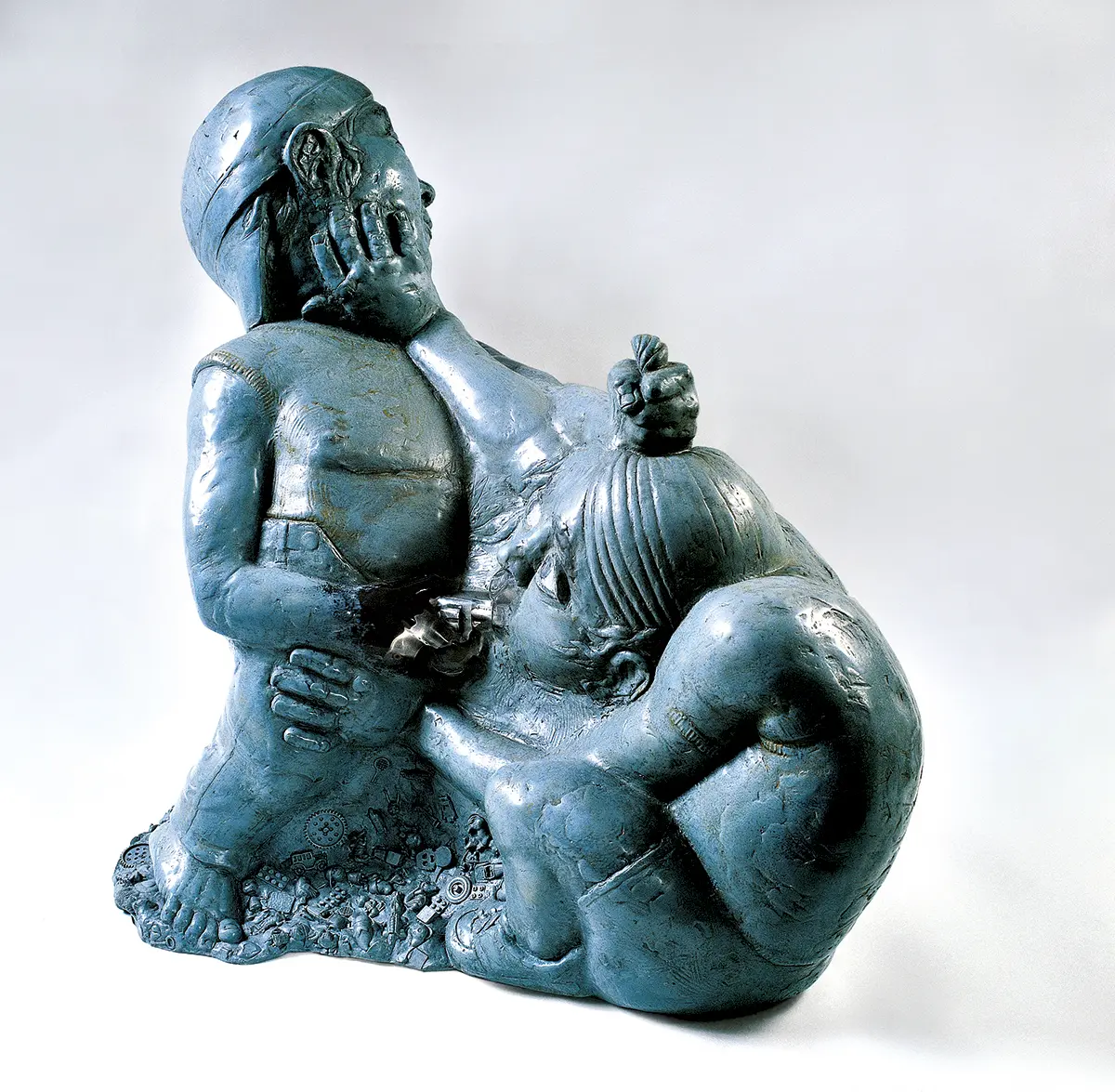
The nine sculptures in Kinderspielen, placed in the second basement area, take one’s breath away. Images of stolen childhood, they quote Pieter Brueghel (ca. 1525–1569), in whose tragic painting Child’s Play Distéfano found inspiration. These works are a tribute to the memory of Eliana Molinelli (1943–2004), an Argentinean sculptor who created her works using weapons exchanged for food.
The sculptures in Kinderspielen attract and overwhelm; they are at once strange and familiar. One doesn’t need to travel far in order to find the scenes of rape, combat, and drug addiction they describe; these are found in the city’s streets, squares, and train stations. But while one hastens one’s steps and looks away in a public space, no escape is possible in the gallery’s white cube. Confronted with the powerful sculptures in Kinderspielen (a group with three themes, each repeated three times in white, black, and gray), the viewer is overtaken by sadness.
Appearing like fallen angels, the chubby youths have firearms (from the disarmament process in the province of Mendoza) stuffed into their figures, with looks of terror in their faces, fierce and lost. They seem to know they have nothing to lose, they hurt each other and stalk the rest of the viewers, or of society.
Sensual to the touch, these works are “an amalgam of painting and sculpture,” and are made of polyester resin reinforced with glass wool. Their impeccable execution makes them shine, while their transparencies reveal vulnerabilities and tools of destruction and the shadows of violence are revealed.
VICTORIA VERLICHAK