
The show El cuaderno del hombre de los pies de barro, inaugurated in late January at the Juan Ruiz Gallery presents a group of 18 site-specific works created for the exhibition. The gallery’s small space is literally filled through the last corner with works that continue to confront the working issues that are characteristic of Kcho: the presence/absence of the sea, precariousness, assemblage, the construction of series, and the relationship between his bi-dimensional pieces and the work of sculpture.
All the paintings on the exhibit were created using natural pigments in earthen hues, and they can be divided, in formal terms, into two groups. First, those that adjust to the rectangular space of the support, where a topic is a man in relation to some navigation object of to other men. Second, those that use several rectangular supports grouped one on top of the other, in order to produce the series Columnas Infinitas. Ideas Fragmentadas.
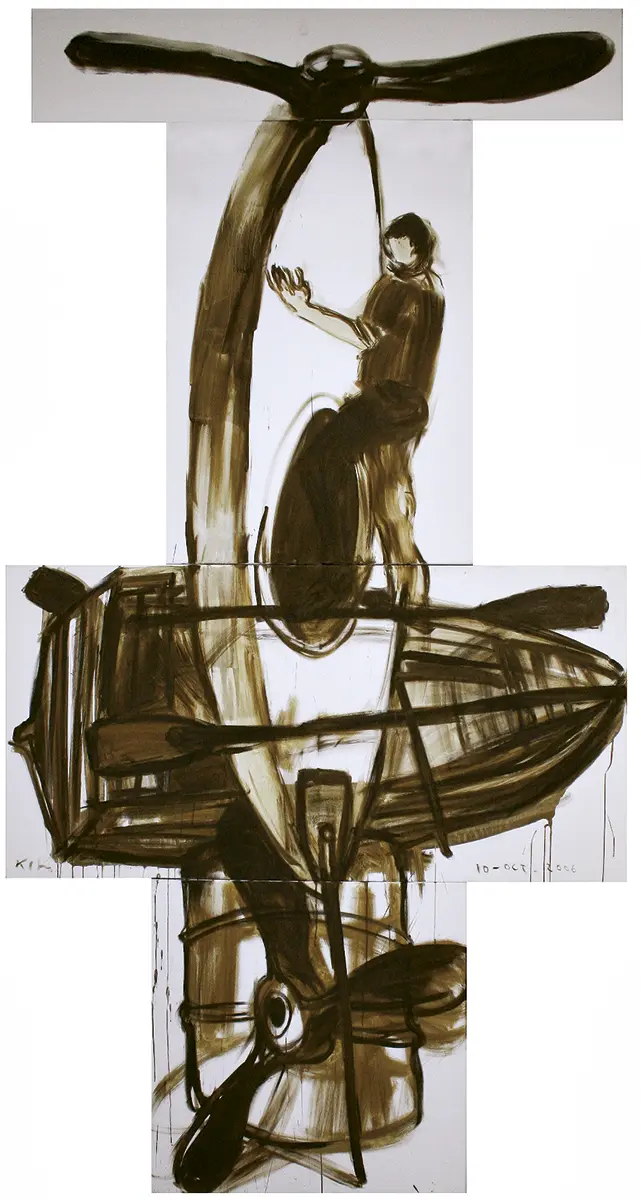
In these works, Kcho explores the fragmentation of the border established by the frame, on the basis of strategies of superposition and accumulation of the kind he usually deploys in his three-dimensional projects. Each represented object adjusts entirely to the space of the canvas, giving corporality to the image. The fragments cannot function as independent elements, but this adjustment to the edge confers on them a certain objectual character, reinforced by the references to the series of assemblages developed by the artist under the same title of Columna Infinita. The classical relationship where drawing is the precursor of sculpture is softened in its intensity here, and it is the sculptures that contribute ideas to paint.
On the other hand, the sculptures included in the show are assemblages based on components manufactured under the artist’s specifications, rather than on discarded objects. The clean wooden boats and the small oars Kcho uses in these works are evocations of the nautical, but they belong entirely to the world of art, not having had a previous life before being incorporated into these works. Paso de los vientos is comprised of two associated structures: a star made of boats, and a star made of oars. Meanwhile, San Sebastián, perhaps a tribute to Maracaibo’s patron saint, is a small tugboat in light-colored wood, speared by many oars, in a contemporary interpretation of the saint’s iconography.
Perhaps we can conclude with the idea that El cuaderno del hombre de los pies de barro gathers, as we said in the beginning, a series of images and references characteristic of Kcho’s work, but seen from the standpoint of a renewed relationship with his visual media and life context.
The artist also had an exhibition at Galería Alonso Garcés, Bogotá in the show The Cuban Arrived, November 2006, his large-format drawings from 2005-2006 were highlighted as well as three sculptures of 2006.
SUSANA QUINTERO BOROWIAK