
Several installations, objects, and one site-specific work by Maria Fernanda Cardoso composed this exhibition, which was characterized by powerful and intricate creative roots. Born in Colombia and based in Australia, Cardoso already worked with insects before leaving her native country. The artist represents one of the most interesting cases of symbiosis between two countries that are separated geographically and culturally. The exhibition was titled Death Becomes Her: A Selection of Works by Maria Fernanda Cardoso. While the title referred to death, the show unfolded toward the perception of facets of aggression, pain, violence, and metamorphosis, strangely joined to a certain enchantment provoked by the natural-world beings and elements with which the artist works. This was the third show presented by the Chelsea Art Museum—home of the Miotte Foundation—under the banner of its Insight series. This series looks closely at contemporary artists who push limits and had a unique case in Maria Fernanda Cardoso. Her aesthetic practices provoke as much controversy as the materials she employs.
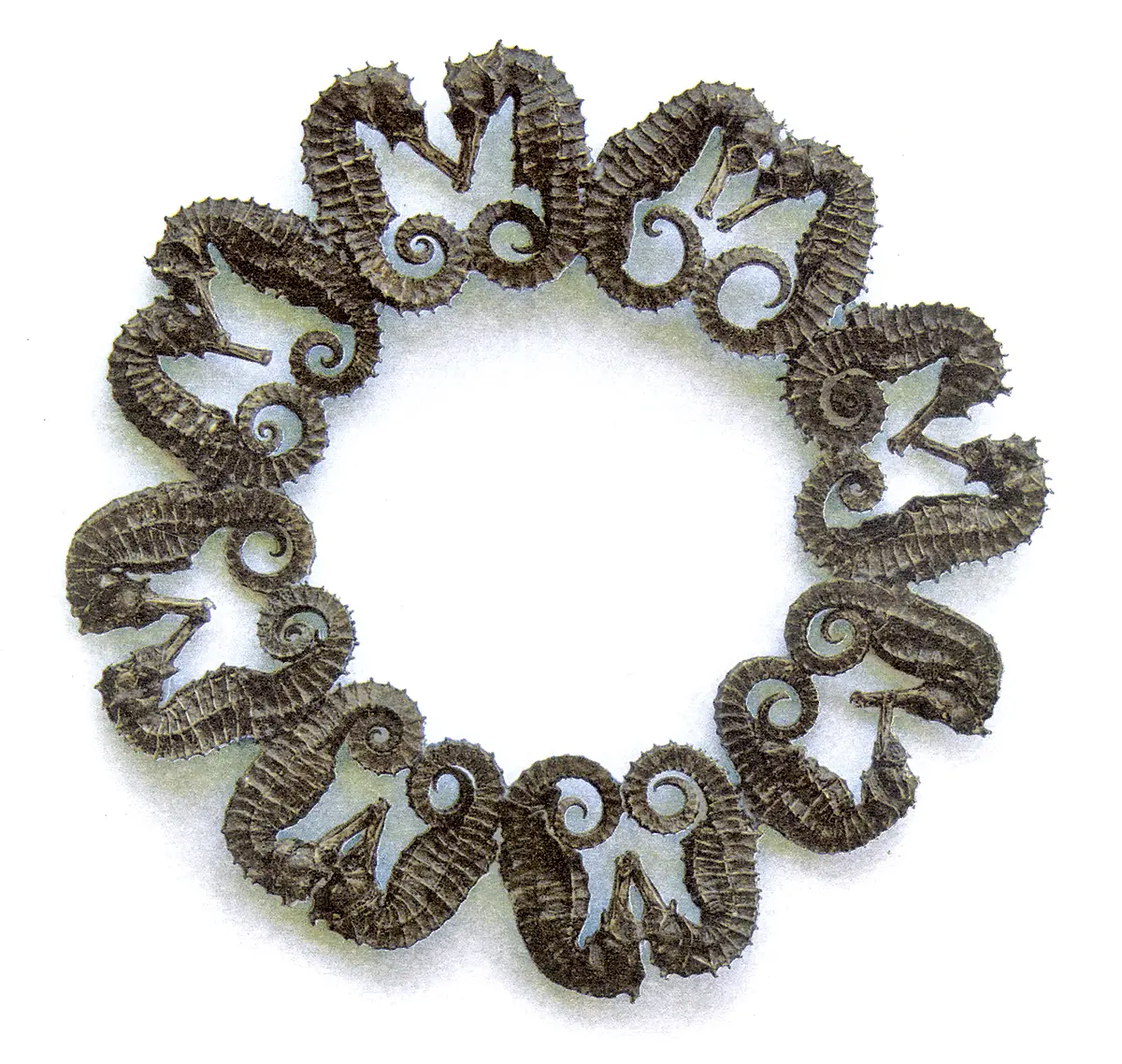
Sea horses, frogs, cattle bones, sheepskins, metal, glue, butterflies, butterfly tongues, piranhas, feathers, preserved insects, nylon thread and strips, glass, and silicon were among the materials featured in the works exhibited, which dated from 1992 to 2006. Some came from private collections, others were courtesy of the artist, and still, others came from the Sicardi Gallery. The show conceptualized nature through some of its entities, manifestations, and stages, such as water, rain, life, and death. In Cardoso’s works, the form did not follow function, and function was greatly modified. Volition, intellect, materials, and space all interacted in a play of abstract, spatial, and allegorical relationships—like Cardoso’s sea horse sphere. A Garden of Insects that Look Like Plants was a 2006 work that ratified the artist’s sleight-of-hand creation of fantasies. Whether one looked at Cardoso’s work from afar or up close affected different readings, and as the distance shortened, the notions of cruelty, pain, and death grew. None of it was inflicted by the artist but by natural processes.
Next to several small pieces and a few medium-sized ones, Cardoso’s monumental on-site installation Pared de lluvia (Rain Wall) was certainly imposing. This 2006 work referred to the experience of lashing rain. Space and material alluded to the aggressive concept, transmitting the notion of how painful it would be to receive lashes with the nylon segments as well as the many who have suffered from storms that destroy and displace large numbers of human beings. With the attitude of a child who gathers, analyzes, and articulates insects, Cardoso has continued on this path of sharp development. She gathered the insects, feathers, bones, and fragments from a wide variety of places, married them with synthetic materials, and created new forms of existence, beings that were a mixture of the simple and the complex. Her work was the opposite of that of a natural science museum. It was as organic as it was inorganic, and it portended change.
Another installation that inverted relationships were Agua tejida, paisaje submarino, a 2003 work in the collection of the Sydney Museum of Contemporary Art. Myriad starfish posited an underwater-like perception that alluded to under-the-sea visions. Compositionally, Cardoso made three-dimensional objects that were predominantly symmetric. These were not sculptures but objects—sculpture responds to traditional means of execution, but objects are created by new processes. The aforementioned wall installation was very well executed. It was a place where an explosion of quantity and dimension, relative to the other works, was produced. Similitude and accumulation were two important agents for someone who presented herself as an artist displeased with the traditional aesthetic world and by extension with society for its aspects of torture and death. Cardoso alluded to the plurality of societies and species, establishing groupings of units of a single species. Visually, her works were powerful without being aggressive; they were strong and effective. But only by coming close to these works did one notice what they were made. With this, the artist implied denial, for many people are not aware of torture or violence. This cause-and-effect connection seemed to allude to the animal but, by extension, attend to the human.
GRACIELA KARTOFEL