
Como quien se asoma a un templo was the title of the Cuban artist Marta María Pérez Bravo’s recent exhibition in Madrid’s Fernando Pradilla Gallery. The narrative of this exhibition was based on fragments of different photographic series by the artist, which encompass the orders of popular religion and the expressive qualities of the female body, transfigured into a discourse with infinite possibilities for hermeneutic interpretation. In the selection of works presented, an earlier series was in convivial dialogue with a newer one that firmly revealed—without abandoning the discursive gears that identify Pérez Bravo’s poetics—a certain turn in the construction of the image and its possible readings. One example was the series exhibited at the entrance to the gallery, Tres coronas y Nunca me abandonará, in which there was a notable change in the composition. The body was still the articulating axis of the work; other objects were diminished through shadows and stains that resembled traces of tobacco smoke, achieving a spectral impression that emphasized a sense of the transcendent.
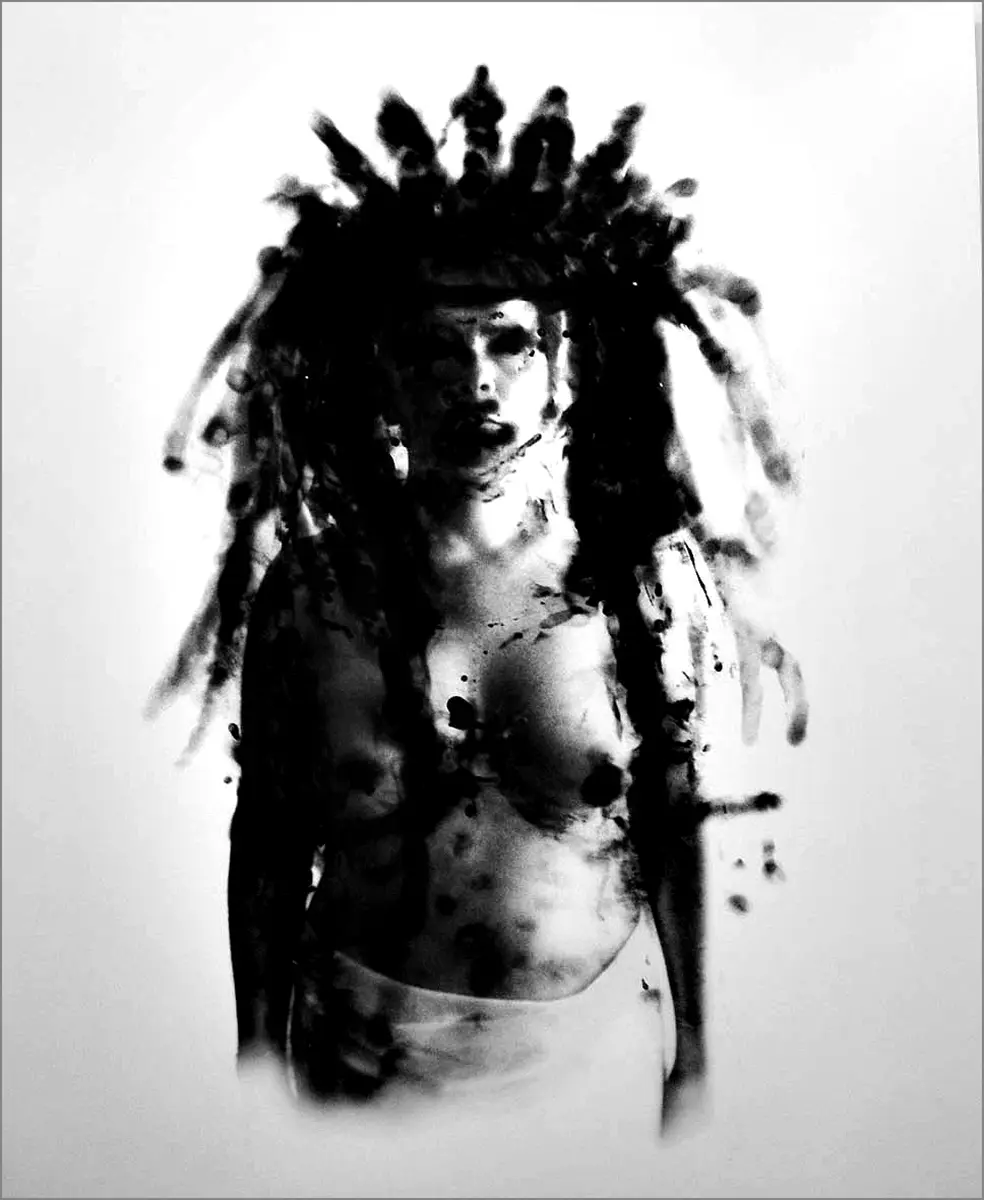
Pérez Bravo is a privileged interpreter of her Cuban roots, despite the distance imposed by her current residence in Mexico City. Her work is a sharp and beautiful tracing of the most relevant signs and symptoms of contemporary Cuban culture, even if some critical readings reduce her poetics to merely anthropological issues. Pérez Bravo’s work is rightfully inscribed among the best of Cuban art of the 1990s thanks to its sobriety and reach, in which the representation and abstraction of myths create images of great aesthetic impact. Her work in the recent exhibition revealed a nation where faith has become the primary sustenance of life. As if Cuba is adrift in the sea, its anguished inhabitants visit the pantheon as their only possibility of redemption and liberty, as an exercise of alienating the mediocrity and the absurdity of circumstance in the belief that things will be better tomorrow. Pérez Bravo’s series like Donde tengo mi confianza I, II, III, IV and V, as well as Echu Castigado, Nadie nos desató, and Con tu ayuda salgo, emphasized this vocation for religious thought and warned of the way that Cubans mediate their everyday existence through superstition and the governing dictates of the pantheon and popular wisdom.
Pérez Bravo’s earliest works aroused spectacular interest in her aesthetic, yet it is only now, in one of life’s paradoxes and far from any suspicious opportunism, that her photographs are revealed as documents of the deterioration of an entire culture. They emphasize the central place reached by belief and the veneration of certain religious entities and texts, at a time when it is no longer possible to kneel in front of the heroes nor to continue paying excessive tribute to a crumbling ideology. Her work has become a catalog of fierce, impeccable postcards in which the artist’s offers her highly personal reading of the Afro-Cuban religious realm via images of the female body, but each image is not a copy or a literal interpretation of the appropriated source. Pérez Bravo’s reading of sources is open, multi-faceted, and filled with interventions and commentary. Her body is a pantheon, a ship, an altar, a fragment of a legend, a cultural text in itself. It is through her body that many lost subjectivities gain a voice. Most of the images, without narrating a séance or describing the external attributes of any given entity or cult, is deeply eloquent, which broadens the universe of their possible readings and understandings, even if her interlocutors do not know in all their purity the religious sources and their interstices. This is one of the most salient virtues of her work, one that it shares with the work of the photographer Mario Cravo Neto, whose work was previously exhibited in the same gallery. Both artists transmute, translate, and represent cultural universes familiar to them from a position of displacement and absurd speculation, which creates a universe of signs in which the reproduction of the cult is meaningless. The resources of the ethnographic essay, anthropological dissection and folkloric adaptation are surpassed by Pérez Bravo’s work. Her oeuvre, based on the exploration of the sources of and contributors to popular religion becomes an eloquent metaphor of life, death, existence itself, and the very nature of the aesthetic event as a space of sociological implications, critical revision, and a scene of redemption and freedom, an anchor for a fleeing subjectivity and also of fleeing itself, a platform for evasion but also for reconciliation.
The fate of the island, it's directionless trajectory, the discredit of the epic, and the time of the struggle are at the base of this photographer’s work. Thus, from the standpoint of an appropriation, re-reading, and aesthetic transmutation of those sources, Pérez Bravo articulates images that purge the pain and dry the tears of a nation that is crying, looking toward the immensity of the sea, and executing maneuvers that retain faith. The work Sueño y vigilia and the beautiful photographic polyptych Si van a un cielo will remain as witnesses of anxiety of the contemporary humans are always ready to think, given the failure of the present, that “everything will be better tomorrow.”
ANDRÉS ISAAC SANTANA