
As the viewer walks among the works of Martha Boto (b. Argentina, 1925-2004) and Gregorio Vardanega (b. Italy, 1923) at Sicardi Gallery, he/she might get the impression of facing very current art with a tinge of nostalgia for the 1960s polished chrome of automobiles and modern buildings. Indeed, the Boto and Vardanega works light up and move with the dynamics of electronic panel controls and mechanical escalators. These works are not sculptures nor assemblages, but true constructions. They aspired to be the art of the glass-and-steel metropolis at a time of a crucial and optimistic expansion of modern technology. Had they been produced less than twenty years ago, they may have been called “installations” —but in the 1960s the term was used primarily among plumbers and electricians. Curiously, Manfreddo Massironi, one of the Gruppo N members, once stated, “We consider ourselves technicians, in the medieval sense, rather than artists.”
Martha Boto and Gregorio Vardanega left Buenos Aires in 1959 and moved to Paris where they soon became part of its artistic milieu. Together they had an exhibition at the Maison des Beaux-Art titled Chromocinétisme (1964). This “isme” underscores their interest in color and movement. Boto had started her explorations in the aesthetics of light and movement around 1957 while she still lived in Buenos Aires. She had produced plexiglass mobiles whose parts emitted and reflected light. Her husband, Vardanega, underwent a similar artistic development focusing additionally on color and the geometric fragmentation of space. In Paris Boto and Vardanega came to be represented by the prestigious Galerie Denise René and continued their explorations in parallel with other artists living in Paris at that time: Victor Vasarely, Yvaral, Julio Le Parc, François Morellet, Yaacov Agam, Carlos Cruz Diez, and Jesus Rafael Soto.
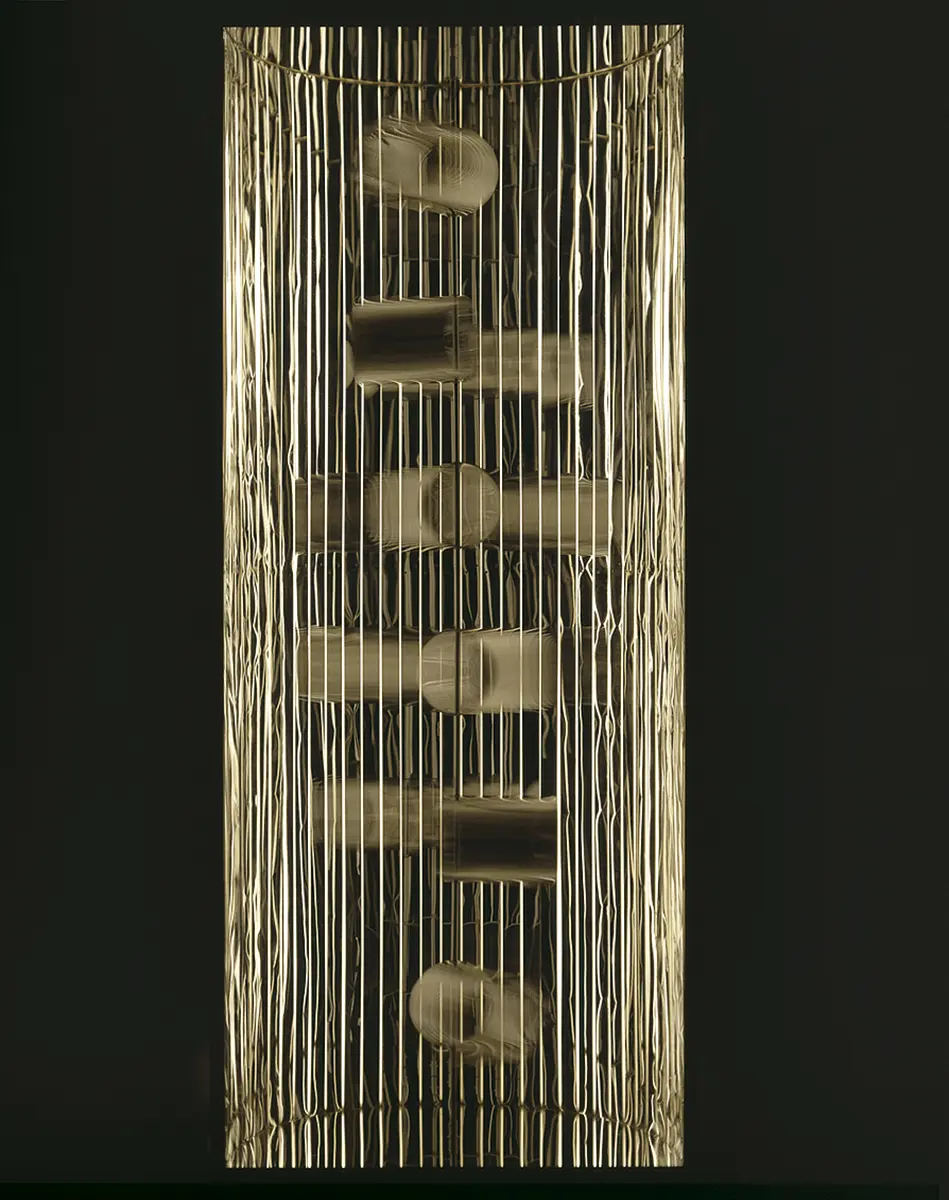
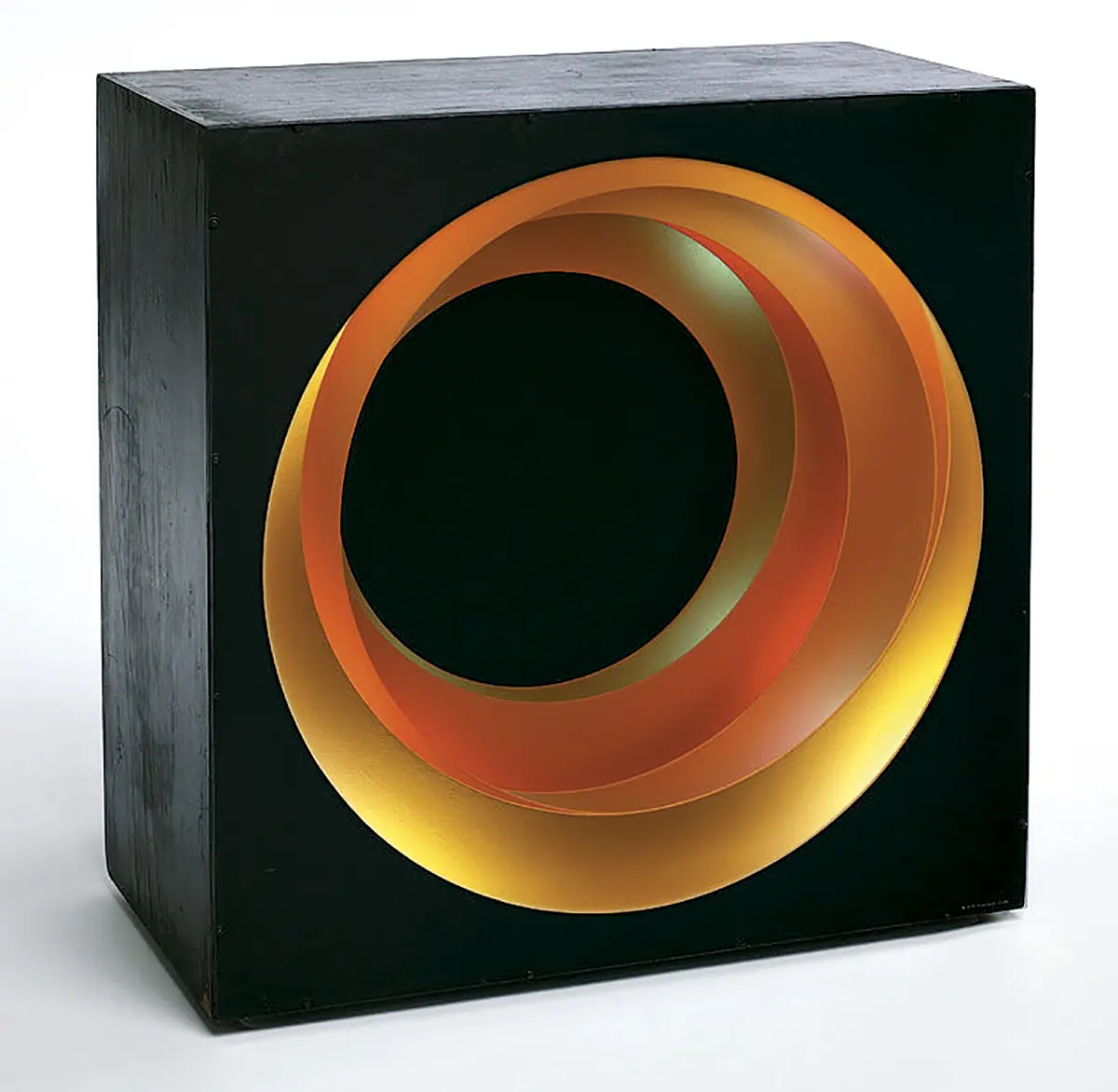
Vardanega’s Tour Orthogonale (1987) resembles a maquette for a modern building with steel beams going up to the last floor and horizontal platforms of lights that turn on sequentially, breaking up its internal space as they do. Although it is of more recent manufacture this work resembles other “towers” Vardanega showed in 1969 at Denise René. Light, space, and verticality are its most notable ingredients. Déplacements de Cylindres (1967) features vertical steel beams as well but also possesses a motor that makes chrome-polished cylinders turn and reflect environmental light. Turbines, pistons, trasmissions? Although the aesthetic vision of these artists did not include referentiality, it is difficult not to associate this work with some motorized machinery. Movement, light, and color are also the ingredients of Métamorphose Chromatique (1968), a helicoid spectrum of pure colors turned hypnotically by a motor as artificial light illuminates different layers of the revolving spiral. In the center of this work, a black hole reminds us of a dilated pupil.
Two of Boto’s motorized works consist of revolving pieces whose shapes are reflected on curving mirrors. Déplacements Optiques (1967) has a lime-green plexiglass structure whose virtual image becomes distorted on the curved mirror until it vanishes only to reappear at the next turn. A larger but later piece bearing the same title is made up of hollow polished steel cylinders that revolve. The perfectly reflecting surface of the cylinders renders them practically invisible while the curving mirror multiplies them. Appearance and disappearance today seem like a metaphor for progress beyond modernity.
What can be more modern than artificial movement and light? Incorporating these elements –products of modern industry– into art would appear prima facie to be more in synch with the supersonic jet airplane and the glass-and-steel metropolis than the semantic vagueness and elusiveness of abstract expressionism. In New York, the first major reaction to the thriving aesthetics of movement, light, and color perception was the 1965 exhibition at the Museum of Modern Art in New York The Responsive Eye. The title suggests that the works included in the exhibit involved the viewer’s perception in important ways. Light/Motion/Space (1967), another seminal exhibit included works by Boto and Vardanega and was shown the Walker Art Center and the Milwaukee Art Center. It brought together some forty artists whose work explored the themes spelled out by its title; most notably, Julio Le Parc, John Goodyear, Nam June Paik, Abraham Palatnik, Günther Uecker, etc. Although it seemed more appropriate for a physics textbook than an art exhibit the title Light/Motion/Space evidenced central concerns in the aesthetic vision of the participants. Most of these artists had previously shown together in the exhibit Lights in Orbit (1967) at Howard Wise Gallery. In fact, this New York gallery was one of the main sponsors of the larger exhibition and represented most of the artists.
Although in general one should not be overly concerned about the issue of under what “ism” one should place artworks, Boto and Vardanega appear to have been comfortable with Chromocinétisme, a term that has not been widely used. In the Light/Motion/Space catalog a heroic attempt is made to propagate the term “Luminism.” Actually, the main terms under which many of these works would later be understood had only recently been put into circulation. Although “kinetic art” existed previously, it only became established in art jargon after Documenta 3 (Kassel, 1964) and the 1964 Venice Biennial. On the other hand, the term Op art first appeared in an article by Jon Borgzinner in Time magazine (October 23rd, 1964). The author of the article used the term Op art to describe works that titillate visual perception by means of carefully devised patterns.
Of all the terms that may be aptly applied to the works, the artists of Light/Motion/Space were creating perhaps Constructivism is the best candidate in spite of its initial links to the Bolshevik Revolution. One of the original ideological selling points of Constructivism was its commitment to using the tools and materials of industry in order to build (as workers do) the art of a brave new society. In spite of this terminological excursion, one must beware that even though “isms” often cast a spell on our understanding of artworks, they usually do not exhaust the interpretation of the works. It is better to understand Boto and Vardanega’s works in the midst of this terminological confusion than to subsume them under any one of them. In these lines, we have rehearsed an interpretation of their works that go beyond the mere fascination with color, light, and movement. We must not forget that they were produced in a decade when many things were done for the first time. The year Boto was creating Déplacements Optiques (1967), Christiaan Barnard performed the first human heart transplant. The year Vardanega made work without title consisting of turning cylinders that resembled missiles, Neil Armstrong became the first human who walked on the lunar surface.
FERNANDO CASTRO