
For contemporary artists in Puerto Rico, this is not the moment for the well-made object. It’s the time of the concept, the collaborative activity, and the performance. Public interventions are in vogue, especially among island graffiti artists whose outlawry tends to be tame and commercial. Prettiness reigns among some of the old-timers—recent works by Luis Hernández Cruz and Antonio Martorell come to mind—but that is not the same thing as craft, as one is reminded by Martorell’s gorgeous, ferociously political prints from the late 1960s, Las Barajas Alacrán (now on view at Museo de Arte de Ponce).
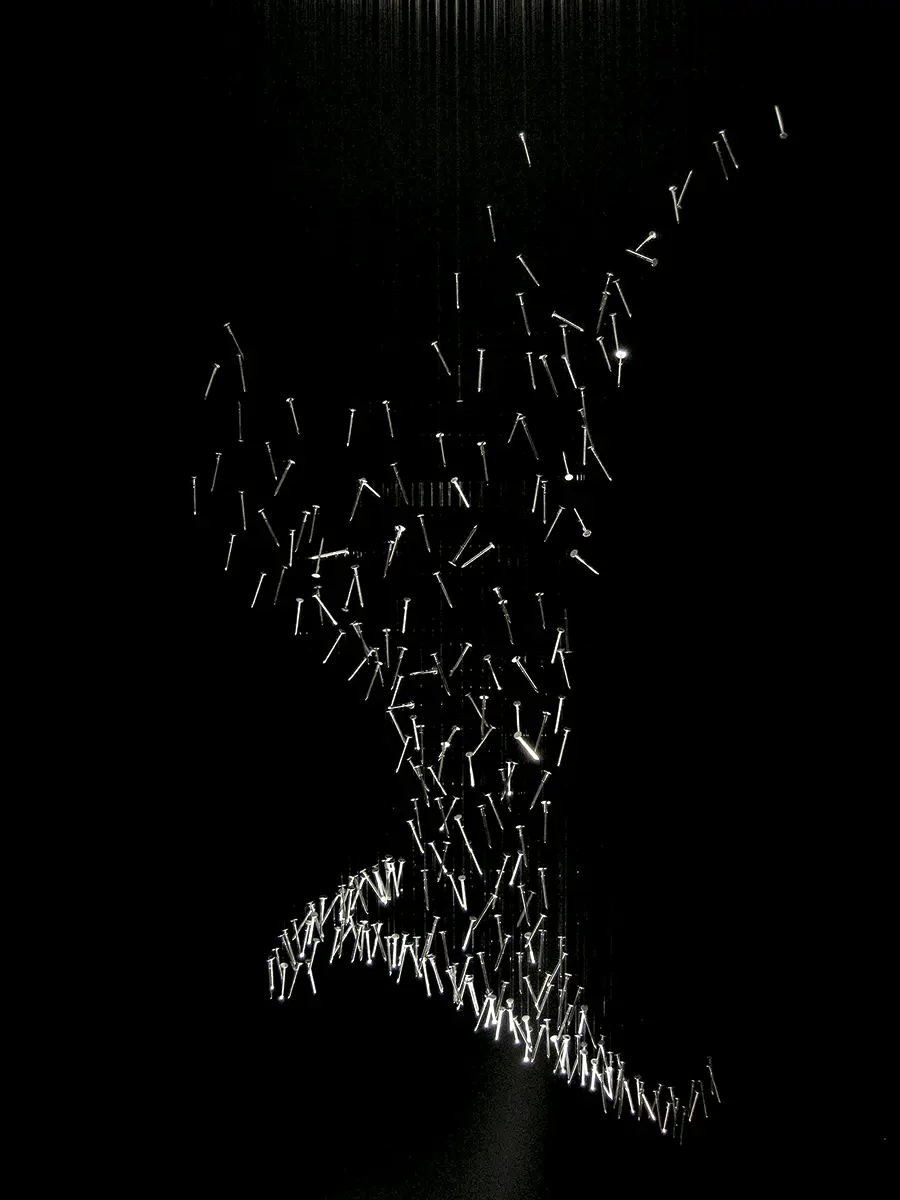
A determined display of formal gumption—works painstakingly made of little more than air, light, and a handful of everyday throwaways suspended by nylon filaments: nails, marbles, sugar packets, nickels, dimes, and quarters—is then a surprising gesture at this time. As her final act at Museo de Arte de Puerto Rico, Marysol Nieves invited the New York artist Milton Rosa-Ortíz to show some of his recent work at the institution. Nieves returned to New York last fall after about a year as MAPR’s contemporary art curator, leaving the museum to drift once again in its accustomed curatorial void, but Rosa-Ortíz came through with eight lighter-than-air, lit-from-below sculptures, plus one sumptuous fifteen-color print.
The sculptures run a gamut from highly figurative to freely abstract, although Rosa-Ortiz confounds such categories by using down-to-earth, immediately recognizable materials in every case: from twinkling shards of broken glass to shiny brass bullet shell-casings and coins. To mix and match opposites seems to be part of the artist’s conceptual and formal approach. The exhibition is based on a series of elided aphorisms, colloquialisms so familiar to Puerto Ricans that only the first few words need to be spoken for the whole expression to be understood. According to the artist, these truncated communications form a kind of coded folk wisdom.
Indeed, Rosa-Ortíz uses the first part of a well-known aphorism to begin the title of each work, and then, after an ellipsis, he supplies his own ending. This is a rather odd strategy since it undermines the significance of the sayings’ abbreviation. It is likewise unhelpful that Rosa-Ortíz’s words are exactly what one would expect. “Quien anda mal... [Termina mal]” is one saying with its Rosa-Ortíz conclusion; “Huye del peligro... [Y no caerás en él]” is another. A good one for the artist might be “Donde esperas ironía y sorpresas... [Siempre hay clichés].”
The determination of the works’ titles foreshadows a similar problem among the works themselves. In some cases, the play of materials, form, and apparent meaning is all too obvious. De agua mansa líbrame Dios... [Que de la brava me libro yo] shows a small raft of driftwood which the artist gathered from the beaches of Rincón where Dominican refugees often wash up on Puerto Rican shores. Más vale naña... [Que fuerza] is an undulating wave of shell casings of various calibers, the de rigueur anti-war statement in any young, early-twenty-first-century artist’s repertoire. A cascade of nails represents—what else?—Al que nace pa’ martillo... [Del cielo caen los clavos].
It’s admirable that these works are calculated to a T and rigorously put together— some hang more naturally than others, although none are shabbily made or mistakable in their meaning—but this is also their shortcoming. Nothing in real life is quite so neat, and a little of the disorder in which one actually finds scatterings of broken glass, nails, or driftwood might add a little of the resonance of lived experience to Rosa-Ortíz’s project.
Works that seem to have leaped from a more poetic, less narrative impulse succeed in spite of the meaning they are freighted with. For instance, Quien anda mal... [Termina mal], with its faux cocaine packets and colonial-era Spanish coins tell nothing especially new about the wages of imperialism, but for all its airy formal simplicity, the work has a palpable fullness and weight, and it makes a perfect trajectory through its mesh of filaments like a red and gold comet falling through an interstellar nebula.
Al que Dios le dio... [San Pedro lo bendiga] portrays a human form in dissolution. Or its flighty arrangement of jade and clear beads may mean something opposite: a state of incorporation, of coming into being. Whatever Rosa-Ortíz’s intention, he has imbued the work with the magic of transformation that no argument or polemic can transmit by itself.
Lyricism far surpasses awkwardness in the exhibition, and the print at the gallery’s entrance, Todo lo que somos es el resultado de lo que hemos pensado, is as stunning an opening statement as anything the artist writes. It, too, has a celestial aspect, featuring a hazy red mass with a tail, surrounded by darting, multi-colored vectors of heat or light. Here, Rosa-Ortíz has managed his fierce concentration and numerous formal elements so that the image’s meaning is thoroughly ambiguous, yet riveting. It could just as well stand for a primordial biological event like a shooting star. The blood-red mass seethes like a beating heart aroused by passion or terror, seeming to fly at light-speed despite being suspended in its darkened cavity.
JOEL WEINSTEIN