
Cornell’s exquisite boxes, Duchamp’s enigmatic constructions, Dalí’s surrealistic small stages, and Damian Hirst’s postmodern displays have inspired many artists in the twentieth century—and now in the twenty-first—to develop greatly varied and interesting three-dimensional artworks in which craft, imagination, and materials make the viewer want to “enter” their “stories.” In Puerto Rico, artists like Néstor Otero, Nick Quijano, Rafal Trilles, Rosa Irigoyen, Annex Burgos, and Rafi Claudio have distinguished themselves by experimenting with this kind of representation. Joining this group is Néstor Millán Álvarez (born 1960, San Germán, Puerto Rico), who began his career as a photographer and quickly established himself as one of the most refined and bold poets in that field, one scarcely appreciated in his country.
As a photographer, Millán (who graduated with honors from the Universidad de Puerto Rico in 1982 and from Pratt Institute in 1987) was able to combine homoerotic and existential elements, producing lyrical and seductive compositions in black and white. His nudes were interesting and bold; a playful relationship with space and their existential charge made the viewer want to decipher the intimacies of their lives. A professor at the Universidad de Puerto Rico, Millán has transferred the themes that defined his photography to painting, achieving interesting effects with the male nude, and in some cases with the female nude as well. Although he has not abandoned photography, his pictorial work has come closer to a highly personal and entertainingly complex form of surrealism; desirous bodies, precious animals, beautiful flowers and plants, and surprising objects that seem to pop up as if driven by magic all coexist and dialogue in his paintings.
Millán is an artist on a constant aesthetic quest. His most recent works are products of that philosophy: to dominate an enchanting three-dimensional space that lends itself to many readings. His latest show, titled Reunión de ecos, beautifully displayed at the Museo de Arte Contemporáneo de Puerto Rico, was probably his best and most mature since devoting himself to painting and mixed media. In Reunión de ecos, Millán invited the viewer to join a grand voyage through his current aesthetic universe—a highly plastic world where the artist effectively interlaces the tale being told, the carefully selected materials, mystery, magic, and Warholian repetition.
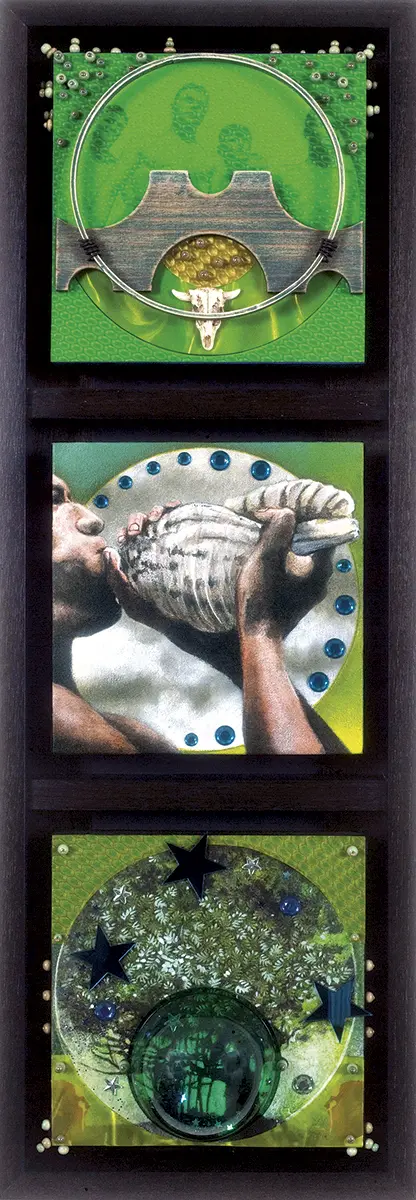
Making use of all the freedoms afforded by postmodernity, each one of the fourteen works in this exhibition was a stop in a fabulous port where the artist achieved the commingling of a well planned existential fiction, his vast knowledge of art history, and autobiographical elements to create microcosms of phenomena. Using his sensibility as an individual and as an artist along with his refined sense of composition, Millán dares to combine different elements in the construction of each of his works. These run the gamut from photography and traditional painting to different industrial materials (especially all kinds of plastics with rich and appealing textures and colors) and truly kitschy objects (beads in all sizes and colors, specifically, rhinestones), from his innate lyricism to surprising ready-mades (small fragments and all manner of small faces and figures, at times, recalling the work of Liliana Porter). The final product is a series of elaborate rectangular or square views containing fragments of the past, the present, and the future, creating an original and powerful aesthetic experience.
In some of his compositions, Millán intelligently incorporated echoes of the riches that decorated the figure of the Virgin Mary and other saints in medieval or Renaissance painting, creating effective shines and textures. In others, he played with the echoes of minimalism, creating spaces for the true protagonist of his work—humanity within the realities of life, carrying forward its narrative. One understood this exhibition as a “gathering of echoes”: from the history of art; from real life; from literature, film, television, and the computer world; from Millán’s models, echoes of his personal experiences during a five-decade artistic journey.
Faces in this series were much more important than bodies. For this critic, the best works in the show were the series of six vertical Baroque-postmodern triptychs (Azul ecoico, Ecotono, Tripulante, Sequía de hombres, Pánico organizado, De gigantes Verdes, and Danza de luciérnagas), Jardín de nanas (combining with elegance painting and photography), Reunión de ecos, Jardín de eco, and Ixis Afixis, which was Millán’s interpretation of the myth of Echo.
Millán’s newest exhibition was not, as Marinetti would say, “a slap on the face of the public’s taste.” As one saw in Reunión de ecos, each work was a potent and independent challenge. In this exhibition, Néstor Millán Álvarez was neither photographer nor a painter. The artist has become a builder within postmodern surrealism, a builder of views from where—in what can be seen as a spatial and, at the same time, a heart-wrenchingly terrestrial journey—he looks out and watches himself, and from where the viewer also looks out and watches oneself, the other.
MANUEL ÁLVAREZ LEZAMA