
In 1999, the Franco-Argentinean painter Octavio Blasi (born 1960) abandoned the kind of satirical and caricature-like figuration at which he excelled with humor and irony in order to devote himself to the geometry of evident American affiliation (from minimalists such as Ellsworth Kelly). While such sudden formal shifts—in both directions—can be found in the oeuvre of many twentieth-century artists, the decision made by each of them is still something unique. In Blasi’s case, an intellectual reflection and desire to erase representation were both aesthetic and existential. Blasi’s awareness of the point of saturation reached by the narrative image and the exhaustion of its discourse drove him to pursue a new version of the minimalist heritage, turning strident color into the form’s determining support.
For many European observers and for some Latin American ones (didn’t the Cuban poet Lezama Lima evoke “the fever of the magician” to refer to Latin America’s art and culture?), Latin America is, without a doubt, the continent of the image. From social or magical realism, to historical illustration and political iconography, to autobiographies impregnated with cultural identities, the continent’s twentieth-century history is marked by both a necessity and a desire to show the world it's vernacular the richness and its difference. Yet, constructive geometry, concretism, and the neo-concretes, as well as kinetic art, have marked the history of the Southern Cone in general and of Brazil in particular, imposing in Europe a new vision of Latin American art, “de-exoticizing” the clichéd image of a continental art conceived as eminently narrative and creating new points of reference and new critical weapons for the understanding of its cultures and artistic forms.
Blasi’s current quest is inscribed in a formal space that the Brazilian critic Roberto Pontual defined with the beautiful name of “sensible geography.” This term created a concept for Latin American geometric art that contrasts with the pure, cool abstraction of the earliest “minimalists,” such as Malevich or, in the 1930s, Mondrian and his Neo-Platonist friends, from whom Joaquín Torres-García was to disassociate himself due to their lack of “humanism,” “spirituality,” and “interiority.”
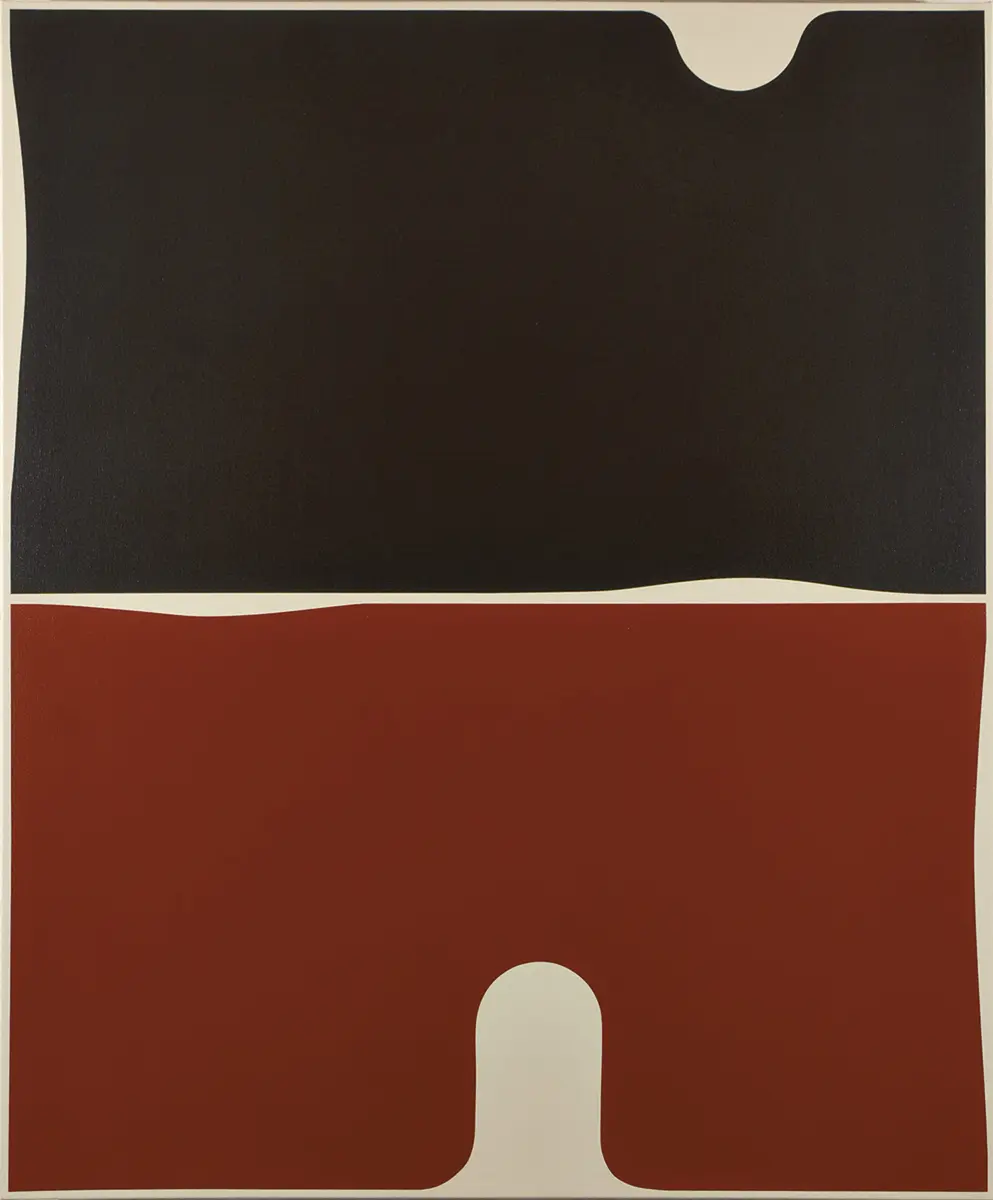
The Julio González Gallery is part of a high-quality cultural circuit south of Paris that for several years has been gaining strength. In Blasi’s recent exhibition, the twenty-one acrylic-on-canvas paintings in medium and large formats (all works 2006) were presented in series of two, three, and four as well as individually and all carried the title of Dentro/Fuera, except for a couple of black paintings titled Uno y otro. In this set of works, Blasi avoided squares and rectangles, breaking straight lines with sinuous ones and contrasting two colors, either warm with warm (orange and pink, for example) or cool with warm (turquoise blue and orange). With purely visual means, the paintings expressed dualities of tension and vibration, equilibrium and instability, and undulations and modulations as well as oppositions of space and the polychrome. What created rupture was not the edge of a painting, which was as curved as in an Arden Quin or an E. Kelly. The paint inserted in the space constructed by the curved line, by also covering the edges of the frame, established the difference and voided the borders. Thus, the frame disappeared in favor of the painting, and this absence allowed an aesthetic breath that opened itself up for contemplation. There was no story to be told, no reference, spiritual or metaphysical truth. The minimalist spirit was respected, except for the way that the works were manufactured. Whereas minimalist works were often made through serial, industrial, or mechanical processes, Octavio Blasi creates his works, one after the other, in solitude.
The visual equilibrium created by the juxtaposition of two colors naturally provokes a reflection about the relationship between form and color, but in Blasi’s work, there was above all the physical sensation of color and its impact on the viewer. In the variations of undulating lines, where the second color found its space even on the edges, a movement was imposed, a kind of musical variation. The colored spaces’ interpenetration produced a rhythm, where the less predominant color “penetrated” the more predominant one and generated a kind of virtual agitation that, in truth, was nothing other than a vibration in the retina. In this way, Blasi’s work situated itself also in a kinetic realm, in the manner of the aleatory movement of a work by Soto, and that kinship asserted itself with the same character as the previous one. The rational dimension of the work was balanced by the sensorial potency suggested by the depth of pure color. By disturbing the order imposed by humans on nature in order to survive, Blasi proposed with this act of re-composition an oscillation between reason and feeling that in the end is nothing more than what characterizes human equilibrium.
CHRISTINE FRÈROT